How to write PSY-FPX7310 Assessment 1

The short answer

This manual is for PSY-FPX7310 Assessment 1, start to submission. The first deliverable in Biological Basis of Behavior establishes the habit the rest of the course grades, and the assessment usually asks you to explain a mechanism at the level the evidence supports and then connect it to a behavior without borrowing certainty you have not earned. Every criterion in your own guide lands at one of four levels, and this is graduate work in a non-licensure degree, so the writing explains rather than advises. Below are the method our tutors use, a structure that follows the criteria, and an annotated excerpt showing a mechanism stated at the right level. Prefer to hand it off? A premium original keyed to your prompt lands inside 24 to 48 hours, revised at no charge until the guide is met. Your courseroom may print this as PSY FPX 7310 Assessment 1 or PSY7310 Assessment 1; it is the same deliverable, and PSY-FPX7310 Assessment 1 is what this manual walks through.

One honesty note before the manual: Capella revises courses and scoring guides over time, so always write to the exact scoring guide attached to your assessment in the courseroom. The course identity above is verified on capella.edu; the method and structure below are our tutors' approach to it, not Capella's official rubric text.
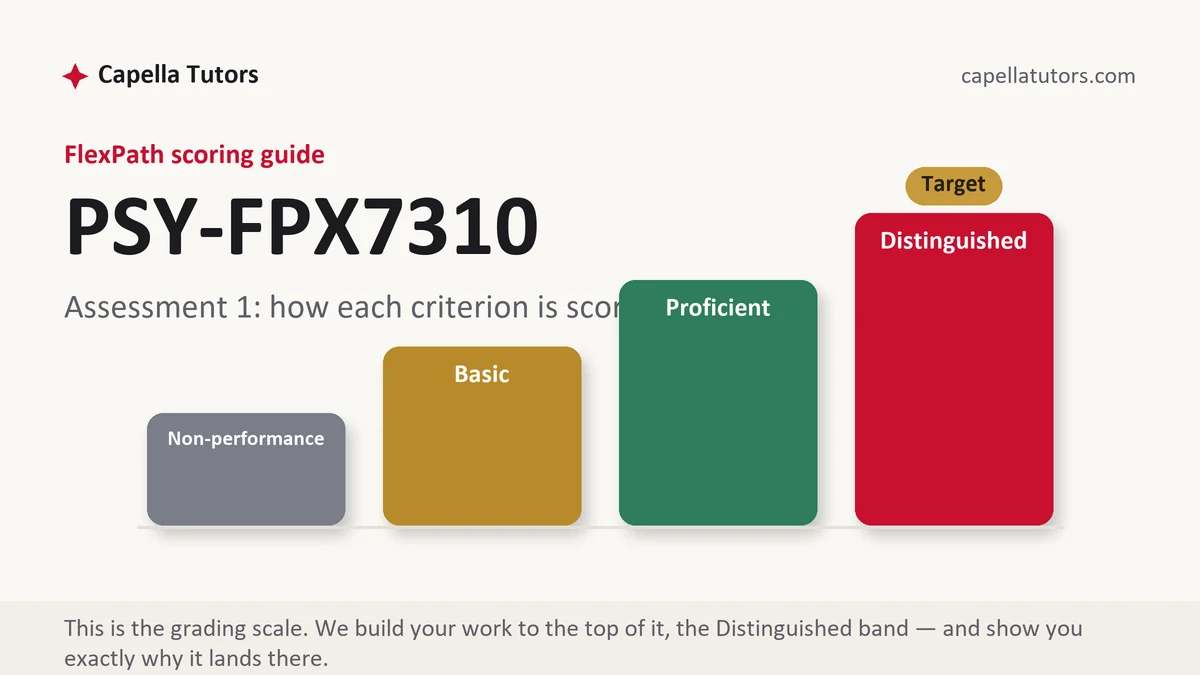
PSY-FPX7310 Assessment 1 grading scale at Capella FlexPath, the criterion levels this assessment is scored on, from Capella Tutors
How Capella FlexPath grades PSY-FPX7310 Assessment 1, visualized by Capella Tutors.

How PSY-FPX7310 Assessment 1 is scored

Four levels sit beside every criterion, and in this course they measure restraint at least as much as knowledge:

LevelWhat it means on a mechanism and behavior paper
DistinguishedThe mechanism is described accurately at one level, the method that produced the evidence is named in the same breath, and the limit of the inference is written inside the section rather than appended to the paper.
ProficientAccurate physiology, correctly cited, connected to the behavior. Everything true, with the strength of each claim left for the reader to judge.
BasicCorrect anatomy carrying overstated verbs, where a region is responsible for something and a chemical causes a mood.
Non-performanceThe mechanism, the evidence or the behavioral link is missing, and a section resting entirely on a textbook definition often reads that way.

One discipline covers most of the risk here. Write the measure, then the level of analysis, then the inference the design permits, and a paragraph cannot drift into a claim the study never made.

The PSY-FPX7310 Assessment 1 method, step by step

  1. Make each criterion a heading before you open an article

    Criteria first, reading second. With the top descriptor under each heading you will notice immediately that one criterion wants a mechanism and another wants an evaluation of evidence, which are different paragraphs and are often written as one by mistake.

  2. Choose a behavior narrow enough for a mechanism to reach

    Motivation is too large for any physiology to explain. Vigilance on a sustained attention task during sleep restriction is small enough that a receptor-level account can plausibly bear on it, and small enough that you can name the measure in the same sentence.

  3. Get the cell-level account right and cite its primary source

    Attribute the mechanism to the work that established it rather than to a summary. Adenosine receptor antagonism as the account of caffeine's effects on alertness traces to Fredholm and colleagues, and citing there lets you describe what was actually shown instead of inheriting a simplification.

  4. Report dose, timing and design as part of the finding

    Pharmacological and physiological effects are quantities. Dose per kilogram of body mass, the interval between administration and testing, and whether the design was double-blind and within-subject are not background detail, they are the reason the finding means anything.

  5. Cross levels deliberately and say when you are doing it

    A receptor account, a systems account and a behavioral measure are three levels, and the step between them is an inference. Write the step out: this is what was measured in cells, this is the systems consequence proposed, this is the behavior recorded, and here is the join that has not been tested directly.

  6. Hunt your own verbs, then self-score

    Search the draft for causes, controls, is responsible for and drives, and check each against the design that supports it. Replace what cannot be defended, then mark every criterion yourself and rewrite anything below the top level before you submit.

A structure that maps to the criteria

Use the word figures as our tutors' planning arithmetic rather than as requirements, and let your scoring guide decide the section list.

SectionWhat it must doGuide word target
The behavior specifiedThe behavior in observable terms, the population, and the measure that would record it.~200 words
The mechanismThe cells, receptors or systems involved, described accurately and attributed to primary work.~350 words
The evidence and its methodThe studies, their designs, doses or manipulations, samples, and what was actually measured.~350 words
Inference limitsWhat the design cannot support, the alternative explanation, and the level-crossing step you had to make.~250 words
ApplicationWhat follows for practice if the account holds, scaled to how well it holds.~150 words
ReferencesCurrent APA, primary research for findings, a current physiological psychology text for standard anatomy only.as needed

Annotated sample excerpt

An original model paragraph from our team, written to show how far a mechanism sentence may travel before it needs a limit attached.

Sample excerpt: mechanism at the right level Original model · Capella Tutors

Caffeine acts as an antagonist at adenosine receptors, and the account that carries a behavioral prediction is the one developed by Fredholm and colleagues: adenosine accumulating across waking hours promotes sleep pressure by acting at those receptors, and a competitive antagonist blocks that action rather than supplying anything of its own.1 The prediction is therefore narrow. Performance degraded by sleep loss should recover part of the way toward rested levels, and performance already at a rested baseline should move less, which is broadly the pattern reported in laboratory vigilance studies using double-blind within-subject designs with doses expressed per kilogram of body mass and a fixed interval before testing.2 Those studies recorded reaction times on computer tasks in laboratories rather than decisions in the closing minutes of a match, so the defensible sentence is that receptor antagonism is the accepted mechanism for the vigilance effect while the transfer to competitive performance under fatigue remains an inference this evidence does not settle.3

  • 1The mechanism is attributed to the work that built it and described at one level. Notice that the antagonist is defined by what it blocks, which forecloses the energy metaphor before it can appear.
  • 2States a prediction that could fail, then gives dose, design and timing as part of the evidence. A finding without those three is a rumor with a citation.
  • 3Marks the level-crossing step openly and holds the verb at remains an inference. The limit is inside the section, which is exactly where the criterion wants it.

The full premium sample for your exact assessment, written fresh to your scoring guide and issue, is free to request. Study it, revise it into your own voice, and submit work you understand.

Get the full sample free

The five mistakes that cost Distinguished

  • A behavior too large for any mechanism. Explaining motivation or resilience from receptor activity guarantees an overstatement somewhere in the paragraph.
  • The energy metaphor. Describing a stimulant as adding energy contradicts the antagonist account you just cited, and the contradiction is visible to anyone who teaches this material.
  • Dose and timing omitted. A physiological effect reported without quantity or interval cannot be evaluated, and evaluation is the criterion.
  • A textbook cited for a contested effect. Reference works are legitimate for standard anatomy and definitions, and they are not evidence about a mechanism still under argument.
  • Limits parked in a final paragraph. A closing list of limitations does not repair a section that already claimed too much, because the criterion is scored where the claim was made.

Pre-submission checklist

  • The behavior is stated in observable terms with its measure named
  • The mechanism is attributed to primary work rather than to a summary
  • Dose, timing, design and sample given wherever a finding appears
  • Every level-crossing step written out rather than assumed
  • Draft searched for causal verbs and each one justified or replaced
  • Limits written inside each section, not collected at the end

Mechanism paper to write?

Send the guide and the behavior your prompt specifies. A team of eight, including a research analyst and two reviewers, returns a premium original in 24 to 48 hours in which every biological claim is written at the strength its source allows, and revises it free until each criterion is met.

Keep going

Online now