This manual is for PSY FPX 6840 Assessment 1, start to submission. The first deliverable in Current Issues in Sport Psychology is where you learn to narrow a controversy, and the assessment usually asks you to take a live dispute, frame it as a claim somebody could deny, and appraise the evidence on both sides before you commit to anything. Each criterion in your guide is scored at one of four levels, and this is master's work in a non-licensure degree, so the paper argues rather than prescribes. Below are the method our tutors use, a structure that follows the criteria, and an annotated excerpt showing how a contested finding gets reported. Prefer to hand it off? A premium original sample for your exact prompt returns in 24 to 48 hours, revised free until the criteria are met. Capella's catalog lists the course as PSY-FPX6840, and some courserooms print PSY6840; both point to this same Assessment 1.
One honesty note before the manual: Capella revises courses and scoring guides over time, so always write to the exact scoring guide attached to your assessment in the courseroom. The course identity above is verified on capella.edu; the method and structure below are our tutors' approach to it, not Capella's official rubric text.
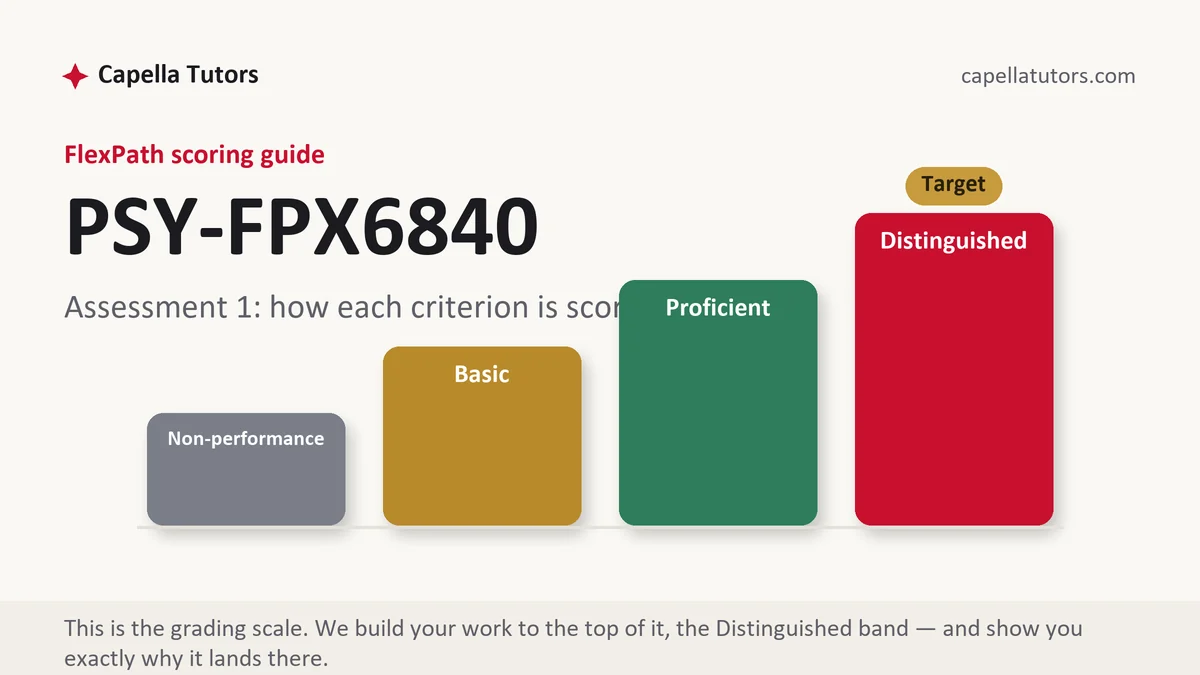
How PSY FPX 6840 Assessment 1 is scored
Every criterion is scored on its own at one of four levels, and on an argued paper the levels describe how you handled evidence rather than which side you took:
| Level | What it means on an issue analysis |
|---|---|
| Distinguished | The issue is a claim rather than a topic, each finding is reported with the design and sample that produced it, and the empirical part of the dispute is separated from the part about values. The reader learns what would change your mind. |
| Proficient | Both positions are represented with sources and the analysis is accurate. Complete, with the evidence stacked rather than weighed. |
| Basic | A description of a controversy with a preference showing through, where the other side appears as a sentence acknowledging that opinions differ. |
| Non-performance | A required element is absent, most often the appraisal of study quality or a position stated at all. Missing beats weak as a way to reach the floor. |
Two habits earn credit throughout this course and cost nothing: design and sample before the finding in every sentence, and a verb that matches the design. A cohort study supports associated with, a randomized trial supports produced, and neither supports proves.
The PSY FPX 6840 Assessment 1 method, step by step
-
Take the guide apart before you pick the issue
Some issues cannot satisfy some criteria, so read the criteria first and choose an issue with a real literature on both sides. Make each criterion a heading, keep its top descriptor visible while you draft, and check that every paragraph you write is answering one of them.
-
Narrow the topic until somebody could deny it
Athlete monitoring is a subject area. A claim looks like this: a collegiate program should be permitted to require wearable load monitoring as a condition of participation. The test is whether a reasonable reader could write the word no in the margin.
-
Trace the strongest supporting evidence to its origin
Find who first proposed the idea and what they measured. Load monitoring arguments run back to Gabbett's work on the ratio between recent and accumulated training load, and citing the origin lets you report the design honestly instead of inheriting somebody else's summary of it.
-
Find the methodological rebuttal, not just the opposing opinion
The interesting objections in this dispute are technical. Impellizzeri and colleagues among others have argued that a ratio of a short window to a longer window generates associations partly through the way it is constructed, since the recent load appears on both sides of it. That is a stronger counter than any statement of principle.
-
Give every rate a denominator and every window its length
Injury figures in this literature are counted per 1000 athlete-exposures or per 1000 hours, and load windows are typically seven days against 28. State those numbers when you use the findings, because a rate without its denominator and a ratio without its windows are not claims that can be checked.
-
Split the empirical question from the values question, then self-score
Whether monitoring reduces injury rates is answerable by data. Whether an institution may require an athlete to wear a device that records sleep and location is a question about consent, ownership of the record and power, and no sample size settles it. Mark yourself against each criterion before submitting.
A structure that maps to the criteria
The figures below are planning numbers our tutors use for an issue paper of this scope, and your own guide decides the required sections and their weight.
| Section | What it must do | Guide word target |
|---|---|---|
| The claim and why now | The dispute stated as a proposition, the population it concerns, and what has made it live in the last few years. | ~200 words |
| The case for | The supporting evidence traced to primary work, each study given with its design, its sample and its measure. | ~350 words |
| The case against | The opposing position as its own authors would state it, including the methodological objections to the supporting evidence. | ~350 words |
| Appraisal | Which findings are strongest and why, what the measurement windows and denominators were, and where the literature is silent. | ~250 words |
| Position and conditions | Your stance, the empirical and ethical grounds kept apart, and the evidence that would overturn it. | ~200 words |
| References | Current APA, primary studies for findings, consensus documents for what bodies recommended. | as needed |
Annotated sample excerpt
A short original model from our writers, showing what a contested finding looks like when it is reported at the strength its design allows.
The monitoring case rests on prospective cohort work in team sports in which injuries were counted per 1000 athlete-exposures and training load was summarized as a seven-day total against a rolling 28-day total, with periods of sharp short-term increase showing higher injury rates than periods of stable load.1 Those are observational data from squads whose coaching staff also decided who trained and who did not, so load and exposure to risk were assigned by the same people whose judgment the finding is used to replace.2 A methodological literature has since argued that a ratio sharing a term between its numerator and its denominator will produce an association even where none exists in the underlying loads, which is why the defensible sentence is that rapid load increases have been associated with raised injury rates in several cohorts, with the size of the association varying by sport and by how load was measured, rather than that a ratio threshold predicts injury in an individual athlete.3
- 1Design, denominator and measurement windows arrive before the result. A reader who reaches the finding already knows how much weight it can carry.
- 2Names the confound in the data-generating process rather than in a limitations list. Saying who assigned the exposure is often the sharpest thing you can say about a cohort study.
- 3Ends on the claim the evidence supports, with the population-level verb kept out of the individual-level sentence. That distinction is worth a criterion by itself.
The full premium sample for your exact assessment, written fresh to your scoring guide and issue, is free to request. Study it, revise it into your own voice, and submit work you understand.
The five mistakes that cost Distinguished
- A topic where a claim was asked for. Wearable monitoring in college sport cannot be argued, defended or refuted, so a paper on it has nowhere to go but description.
- A rate quoted without its denominator. An injury figure means nothing until a reader knows whether it counts events per athlete, per exposure or per hour.
- A ratio used without its windows. Reporting a workload ratio while omitting that it compares seven days to 28 hides the construction that the objections are about.
- Ethics folded into effectiveness. Whether a device reduces injuries and whether a department may compel an athlete to wear it are separate questions, and merging them loses both.
- The rebuttal sourced to a headline. A critique paraphrased from a news article rather than read at source cannot be represented at its strongest, and evaluators can tell.
Pre-submission checklist
- The issue appears as a proposition a reader could deny, in the first paragraph
- Every finding sentence names the design and the sample before the result
- Injury rates carry denominators, load measures carry windows
- The methodological objection is cited from the paper that made it
- Empirical and ethical grounds argued in separate paragraphs
- The position ends with the evidence that would change it
Issue paper to argue?
Send the prompt, the guide and the issue you are drawn to. Eight people build every draft, one of them checking that each figure carries its denominator and its window before it ships, and the premium original arrives in 24 to 48 hours with revisions free until the criteria are satisfied.