How to write PSY-FPX6840 Assessment 3

The short answer

This manual is for PSY-FPX6840 Assessment 3, start to submission. The final deliverable in Current Issues in Sport Psychology is the synthesis one, and the assessment usually asks you to appraise a body of intervention evidence as a whole and say what an organization should do about it, with the quality of that evidence carried into the recommendation rather than declared separately. Your guide sets the criteria and the four levels, and the work is graduate appraisal inside a non-licensure degree. Below are the method our tutors run, a structure keyed to the criteria, and an annotated excerpt showing how a pooled estimate gets reported. Would you rather it was handled? A premium original sample for your exact prompt returns in 24 to 48 hours, revised free until the guide is satisfied. Your courseroom may print this as PSY FPX 6840 Assessment 3 or PSY6840 Assessment 3; it is the same deliverable, and PSY-FPX6840 Assessment 3 is what this manual walks through.

One honesty note before the manual: Capella revises courses and scoring guides over time, so always write to the exact scoring guide attached to your assessment in the courseroom. The course identity above is verified on capella.edu; the method and structure below are our tutors' approach to it, not Capella's official rubric text.
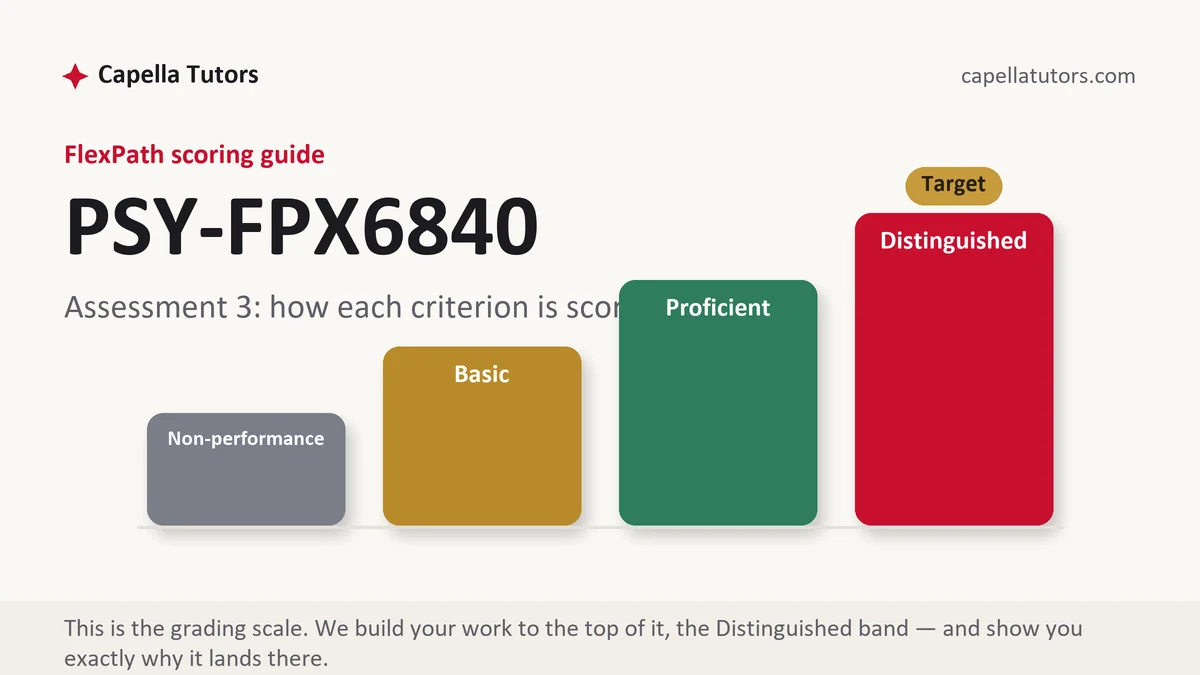
PSY-FPX6840 Assessment 3 grading scale at Capella FlexPath, the criterion levels this assessment is scored on, from Capella Tutors
How Capella FlexPath grades PSY-FPX6840 Assessment 3, visualized by Capella Tutors.

How PSY-FPX6840 Assessment 3 is scored

The guide places each criterion at one of four levels, and in a synthesis the top level is reserved for judgment rather than coverage:

LevelWhat it means on an evidence synthesis with a recommendation
DistinguishedThe body of evidence is characterized by design, sample size and control condition, the pooled picture is reported with its uncertainty, and the recommendation is scaled to that uncertainty rather than to enthusiasm.
ProficientThe literature is reviewed accurately and a recommendation follows from it. Everything correct, with the appraisal reading as description of studies one at a time.
BasicA run of study summaries with a recommendation added at the end, where the strength of the advice bears no visible relation to the strength of the evidence.
Non-performanceThe appraisal of quality is missing, or no recommendation is made, either of which leaves the criterion with nothing gradable.

Recommendations and evidence have separate strengths and this course expects you to say so out loud. You can properly recommend something low in cost and low in risk on modest evidence, provided the sentence that does it admits the evidence is modest.

The PSY-FPX6840 Assessment 3 method, step by step

  1. Set the question and the inclusion rule before you read

    Write the question as who, what intervention, compared with what, measuring which outcome, over what period. Then say which studies you will count and which you will exclude, and hold to it. An appraisal without a rule becomes a collection of the studies you happened to find.

  2. Build a table with the design, the sample and the control

    One row per study, with the number of participants, whether allocation was random, what the comparison group received, who measured the outcome, and how long the follow-up ran. That table is where the appraisal happens; the prose only reports what it shows.

  3. Ask what the control group did, because it decides the question

    A program compared against nothing is being tested against time, attention and expectancy as well as against itself. A program compared against an equally long alternative activity is being tested on its content. Both are legitimate and they answer different questions, so say which one your evidence answers.

  4. Report the pooled estimate with its interval and its spread

    Give the number of studies, the typical sample size, the estimate and the interval around it, and say how consistent the studies were. A small average drawn from a dozen inconsistent trials of 30 participants each earns a hedge that the same average from large consistent trials would not.

  5. Name what the significance test cannot supply

    A p value cannot tell you the probability that a hypothesis is true, cannot substitute for an effect size, and cannot rescue an underpowered literature, because small studies that reach a cut tend to overestimate what they found. Where preregistration or a registered report exists, say so, since it changes how much a result should move you.

  6. Scale the recommendation to the evidence, then self-score

    Match the verb to the strength: offer, pilot with evaluation, or fund as a first-line service are three different recommendations. Say which one the evidence supports, what you would measure if it were adopted, and then grade yourself against each criterion before submission.

A structure that maps to the criteria

These lengths are planning arithmetic from our tutors for a synthesis of this scope; the guide attached to your assessment decides what the paper must contain.

SectionWhat it must doGuide word target
Question and scopeThe population, the intervention, the comparison, the outcome, the period, and the inclusion rule.~200 words
The evidence characterizedHow many studies, of what design, with what samples and which control conditions, described as a body.~350 words
What the estimates showThe pooled or typical effect with its interval, the consistency across studies, and the outcomes that moved and did not.~300 words
Threats to the pictureSmall-study bias, unblinded outcomes, self-report measures, and the difference an active control makes.~250 words
RecommendationThe action, its strength matched to the evidence, what would be measured on adoption, and the condition for withdrawal.~250 words
ReferencesCurrent APA, trials for effects, reviews for orientation, consensus documents for recommended practice.as needed

Annotated sample excerpt

An original model from our writers on reporting a modest literature without either dismissing or inflating it. The numbers are illustrative and belong to the writer's own appraisal table.

Sample excerpt: a pooled estimate reported honestly Original model · Capella Tutors

Eleven trials met the inclusion rule, with a median of 34 participants each, random allocation in eight, and only three using an active comparison rather than a waiting list, so most of this literature compares a program against receiving nothing for the same period.1 Across those trials the average standardized difference on the self-reported anxiety outcome is 0.29, with a 95 percent interval from 0.05 to 0.53 and wide variation between studies, while the two trials that measured competitive performance found no difference on it.2 A literature of this shape supports piloting the program with a proper evaluation and does not support funding it as a first-line service, and the interval is the reason: the smallest value it leaves open is close to no effect at all.3

  • 1The body of evidence is characterized before any result appears, including the control conditions. Eight of eleven randomized and three with an active control tells a reader most of what they need.
  • 2Effect size, interval, heterogeneity and the outcome that did not move, all present. Reporting the null result on performance is what makes the positive one believable.
  • 3The recommendation verb is chosen to match the interval, and the reason is stated in the same sentence. This is the move the synthesis criterion is built around.

The full premium sample for your exact assessment, written fresh to your scoring guide and issue, is free to request. Study it, revise it into your own voice, and submit work you understand.

Get the full sample free

The five mistakes that cost Distinguished

  • An appraisal with no inclusion rule. Without one, a reader cannot tell whether the inconvenient studies were excluded or never found.
  • Waiting-list comparisons treated as controls for content. A program measured against nothing has not been separated from attention and expectancy, and that distinction changes the recommendation.
  • A pooled average with no spread. An estimate reported without heterogeneity hides whether the studies agreed, which is often the more informative fact.
  • A strong recommendation on a modest literature. Advising adoption as standard practice from eleven small trials mismatches the verb to the evidence, and the criterion is written to catch exactly that.
  • Null results left out. Omitting the outcomes that did not move turns a synthesis into advocacy and makes every remaining figure less trustworthy.

Pre-submission checklist

  • Question written as population, intervention, comparison, outcome and period
  • Inclusion rule stated, with the number of studies it produced
  • Design, sample size and control condition given for the body of evidence
  • Pooled estimate reported with its interval and the variation between studies
  • Outcomes that did not move reported alongside those that did
  • Recommendation verb matched to the evidence, with a withdrawal condition

Synthesis and recommendation due?

Send the guide, the intervention and the population. An eight-person pipeline builds the appraisal table first, reports every estimate with its interval and its spread, and returns the premium original in 24 to 48 hours with revisions free until each criterion is satisfied.

Keep going

Online now