This manual is for PSY FPX 6810 Assessment 1, start to submission. Assessment 1 of PSY FPX 6810, Principles of Sport Psychology, asks for theory doing work: a named model with its primary source, a case described concretely enough to test it on, a prediction the model actually makes, and a competing account given the paragraph it earns. The vocabulary built from mental toughness and wanting it more scores nowhere here, because the criteria are written for constructs that have been operationalized. Below is the order our psychology desk drafts in, a structure that answers the criteria, and an annotated excerpt of an applied analysis. Would you rather it were handled? A premium original sample for this exact deliverable arrives inside 24 to 48 hours and is revised free until the descriptors are met. Capella's catalog lists the course as PSY-FPX6810, and some courserooms print PSY6810; both point to this same Assessment 1.
One honesty note before the manual: Capella revises courses and scoring guides over time, so always write to the exact scoring guide attached to your assessment in the courseroom. The course identity above is verified on capella.edu; the method and structure below are our tutors' approach to it, not Capella's official rubric text.
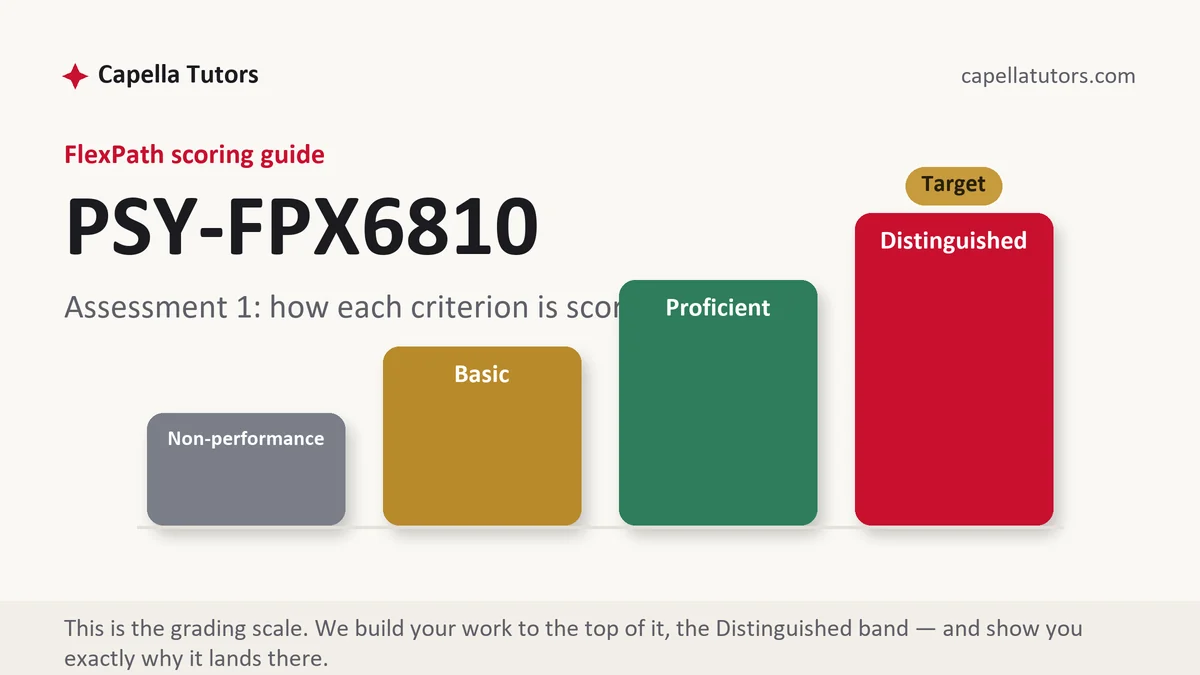
How PSY FPX 6810 Assessment 1 is scored
Nothing on this deliverable becomes a letter. Your guide fixes each criterion at one of four levels, and the top descriptor is the specification you write toward:
| Level | What it means on a theory-to-case deliverable |
|---|---|
| Distinguished | The model is cited to the people who built it, its variables are defined, it makes a prediction about this athlete that could fail, and a rival theory is weighed rather than mentioned in passing. |
| Proficient | The theory is explained correctly and applied to the case without error. Accurate, and missing the prediction that could have been wrong. |
| Basic | A summary of a model followed by a case that illustrates it, with no claim the case could have contradicted. The usual result when the theory is chosen after the story. |
| Non-performance | The guide asks for something the paper does not contain, most often the primary source or any application at all. |
Hold the scope in view while you draft. This degree confers no license, so the work you describe is educational and performance focused, and clinical material belongs in a referral sentence.
The PSY FPX 6810 Assessment 1 method, step by step
-
Build the document from the criteria, verb by verb
Each criterion becomes a heading with its top-level wording parked underneath while you draft. Then read the verb, because explain wants a mechanism, apply wants the mechanism operating on your case, and evaluate wants a judgment measured against a standard you have stated.
-
Name the theory and cite the people who built it
Self-determination theory belongs to Deci and Ryan, achievement goal theory to Nicholls and then to Duda in sport, and attribution work to the tradition Weiner set out. Cite each under its own year, because a source from the 1980s is provenance in this field rather than a lapse.
-
Construct the case with the parameters the analysis needs
Give the sport, the competitive level, the training history, and the behavior you intend to explain, then say in one line that the case was constructed for the assessment. A constructed athlete carries no consent obligation. Your scoring guide decides whether a real case is demanded instead.
-
Make the theory predict something falsifiable
Write the sentence that says what should be observed if the model holds, and the observation that would embarrass it. Self-determination theory predicts one direction when a contract makes an activity instrumental, achievement goal theory another when the climate rewards outcome over mastery. A prediction that cannot fail has not been made.
-
Put the rival account beside yours and choose openly
Take the strongest competing explanation, state what it would predict for the same case, and say which observation would separate the two. Then commit to a position and name the finding that would move you off it, since an argued uncertainty scores above a manufactured consensus.
-
Keep your own competitive history in the framing, then self-score
A season you lived through tells you which problem is worth studying. It cannot serve as evidence, so label it as yours, leave it in the opening paragraph, and let the literature argue. Then grade every criterion D, P, B or N and revise anything short of the top.
A structure that maps to the criteria
Lengths below are planning targets our psychology desk uses for a theory-to-case paper, not Capella rules.
| Section | What it must do | Guide word target |
|---|---|---|
| The case and the question | Sport, level, history and the behavior to be explained, stated so a reader could observe it. | ~200 words |
| The model | The theory, its primary source, its variables, and the mechanism it proposes. | ~300 words |
| The prediction | What the model says should happen in this case, and the observation that would falsify it. | ~250 words |
| The rival account | A competing theory stated fairly, its prediction for the same case, and the discriminating observation. | ~250 words |
| Evidence | Peer-reviewed sport psychology work described by design and sample rather than by conclusion. | ~250 words |
| Scope and references | What lies outside a non-licensure role, the referral pathway, and current APA sourcing throughout. | ~150 words |
Annotated sample excerpt
An original model excerpt from our team, showing how an applied paragraph reads when the theory is doing the work.
The case is constructed for this assessment: a 24-year-old road cyclist, eleven years in the sport, who joined a regional team in February on a results-based agreement and by June was skipping the unstructured evening rides that had previously accounted for most of his training volume.1 Read through self-determination theory, this is a shift in the regulation of behavior rather than a loss of it, since the activity has become instrumental to a contract and the autonomy that supported it has narrowed to a prescribed session file, which predicts that voluntary training outside the plan falls first while prescribed sessions continue to be completed.2 Achievement goal theory predicts something different and testable against the same rider, namely that a climate rewarding placings over mastery pushes an ego-oriented athlete toward avoiding difficult efforts he might lose; if his skipped rides were the hard group rides rather than the easy ones, that account fits better than mine and I would take it.3
- 1Labels the case as constructed in the first clause, then supplies age, history, the date the situation changed and the observable behavior. Every parameter is one the analysis will use.
- 2Applies the model as a mechanism and ends on a prediction specific enough to be checked against a training file.
- 3States the rival prediction, names the observation that would separate the two, and concedes the case in advance. Conceding on a stated condition is the graduate move.
The full premium sample for your exact assessment, written fresh to your scoring guide and issue, is free to request. Study it, revise it into your own voice, and submit work you understand.
The five mistakes that cost Distinguished
- Motivation described without a theory. Writing that an athlete has lost drive gives an evaluator nothing to grade, while naming the regulation, the goal orientation and the climate does.
- A case that can only agree with you. An illustration chosen to fit the model tests nothing, and the analysis criterion is written for a claim that could have failed.
- The rival theory reduced to a sentence. Naming a competitor and ignoring what it predicts is not weighing alternatives.
- Theory cited to a textbook. The people who built the model published it, and quoting a summary of them costs the sourcing criterion outright.
- Personal experience used as evidence. One season, no measurement and years of hindsight is the weakest design available, whatever it taught you.
Pre-submission checklist
- Every criterion answered under its own heading, with the verb obeyed
- Each theory cited to its primary source under that source's own year
- The case described with sport, level, history and an observable behavior, and labeled if constructed
- One prediction stated that this case could have contradicted
- A rival account with its own prediction and the observation that separates them
- Referral boundary written plainly, and every criterion self-scored D before submission
Theory paper due and the model will not stick?
Send the scoring guide, the sport and the level, and say whether your case is real or constructed. A team of eight returns a premium original sample inside 24 to 48 hours that argues from that sport's literature rather than from generic athletics. Revisions run until the criteria clear.