This manual is for PSY FPX 6810 Assessment 3, start to submission. Assessment 3 of PSY FPX 6810, Principles of Sport Psychology, turns a model into a plan: a competitive anxiety problem defined behaviorally, a mental skills program built from components with a dose and a schedule, a referral boundary written before anyone needs it, and measures fixed in advance so improvement could be detected or denied. The plan is graded on the model it came from, which means the anxiety theory has to predict the specific failure you are trying to change. Below is the sequence our psychology desk builds in, a structure that answers the criteria, and an annotated excerpt of an intervention rationale. Rather have it drafted for you? A premium original sample for this exact deliverable returns inside 24 to 48 hours, revised at no cost until the descriptors are met. Capella's catalog lists the course as PSY-FPX6810, and some courserooms print PSY6810; both point to this same Assessment 3.
One honesty note before the manual: Capella revises courses and scoring guides over time, so always write to the exact scoring guide attached to your assessment in the courseroom. The course identity above is verified on capella.edu; the method and structure below are our tutors' approach to it, not Capella's official rubric text.
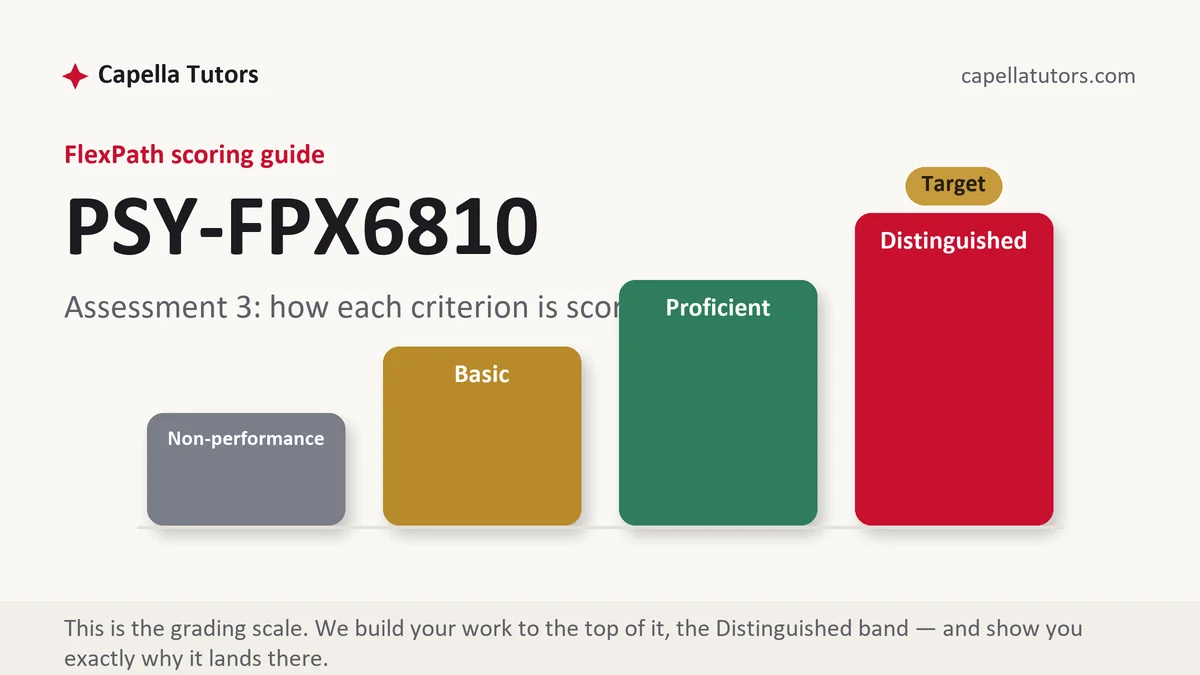
How PSY FPX 6810 Assessment 3 is scored
Levels, not marks, come back from the evaluator. There are four of them and the highest one describes the plan your paper has to produce:
| Level | What it means on an applied intervention deliverable |
|---|---|
| Distinguished | The anxiety model chosen predicts the observed failure rather than anxiety in general, every component carries a dose and a schedule, the referral pathway is written in plain sentences, and the evaluation could have shown the plan did nothing. |
| Proficient | A defensible program drawn from a named model, delivered with a timetable, and evaluated in general terms. |
| Basic | A list of mental skills recommended for a team described as nervous, with no model doing work and success assumed. Where a plan lands when the theory arrived last. |
| Non-performance | Something the guide requires is missing outright, most often the scope statement or the evaluation plan. |
The scope criterion is not decoration. A plan that quietly absorbs restricted eating, depressed mood or suicidal thinking reads as a boundary violation, and the sentence routing those to a licensed provider costs eleven words.
The PSY FPX 6810 Assessment 3 method, step by step
-
Describe the failure before you name a model
Write what happens, when it happens, and how anyone would know it had changed. Goals conceded in the last twenty minutes, penalties missed under a specific score line, first serves lost in a deciding set: a behavioral description lets a later measure detect improvement rather than assert it.
-
Choose the model that predicts that failure
Multidimensional anxiety theory, from the work Martens and colleagues published, splits competitive anxiety into cognitive and somatic components with a different relationship to performance for each. Hanin's individual zones of optimal functioning asks instead where this athlete has performed well before. The catastrophe model earns its place only where the history shows sudden collapse rather than gradual decline. Pick on the pattern, not on preference.
-
Build components with a dose and an owner
Breathing and somatic regulation, a pre-performance routine, cognitive restructuring of the worry content, and simulation of the exact competitive condition each need a length, a frequency, a place in the training week, and an owner. A skill list without a schedule is a suggestion, and the criteria grade it as one.
-
Write the referral boundary before the plan needs it
Say which presentations leave your scope, who they go to, how the athlete is told, and what you do in the meantime. The Ethical Principles of Psychologists and Code of Conduct is the document to cite, and writing the pathway early stops it being improvised in front of a distressed player.
-
Fix the measures, the window and the failure condition in advance
Name the instrument, the behavioral marker, the interval, and the result that would tell you the program did not work. A plan that can only succeed has not been designed for evaluation, and adding the disconfirming measure is one sentence.
-
Strip out the coaching vocabulary, then self-score
Mental toughness and killer instinct are not constructs and cannot be measured, so replace each with the operationalized variable you mean. Then mark every criterion D, P, B or N and rewrite anything below the top level.
A structure that maps to the criteria
Lengths below are planning targets our psychology desk uses for an applied plan, not Capella requirements.
| Section | What it must do | Guide word target |
|---|---|---|
| The team and the problem | Roster, level, season context, and the failure stated as behavior anyone could observe. | ~250 words |
| The model and its prediction | The anxiety model chosen, its components, and what it predicts about this specific pattern. | ~300 words |
| Evidence for the components | Peer-reviewed support for each technique, described by design and sample, laboratory work kept separate from field work. | ~250 words |
| The program | Each component with its dose, its schedule, its owner, and where it sits in the training week. | ~250 words |
| Scope and referral | What leaves your role, who receives it, how the athlete is informed, and the conduct standard cited. | ~200 words |
| Evaluation and references | Instruments, behavioral markers, intervals, the disconfirming result, and current APA sourcing. | ~250 words |
Annotated sample excerpt
An original model excerpt from our team, showing how an intervention rationale reads when the model is carrying it.
Across a seventeen-match season this college men's soccer squad of 26 conceded 21 goals, thirteen of them inside the final twenty minutes, and converted four of nine penalties over two seasons, which is a pattern of late and high-consequence breakdown rather than a general performance problem.1 Administered 45 minutes before three fixtures, the Competitive State Anxiety Inventory 2 returned squad means of 24 on the nine-item cognitive subscale and 14 on the somatic subscale, both scored from 9 to 36, which is high worry alongside modest physiological activation, and multidimensional anxiety theory predicts attentional narrowing and hurried decisions from that combination rather than a loss of gross motor control.2 The program therefore targets the worry content and the attentional task directly, with a fixed pre-kick routine rehearsed under a simulated score line twice a week, and it will be judged failed if the proportion of goals conceded in the final twenty minutes has not moved from 62 percent by the end of the next seventeen matches, a threshold recorded here before the season starts.3
- 1Defines the problem with counts, denominators and a season window, so the pattern is a fact rather than an impression.
- 2Reports the instrument with its subscale ranges and administration timing, then lets the model make a prediction about this profile rather than about anxiety in general.
- 3Attaches a dose and a schedule to the intervention, then writes the failure condition down in advance. Naming a threshold before the data exists is the move that earns the evaluation criterion.
The full premium sample for your exact assessment, written fresh to your scoring guide and issue, is free to request. Study it, revise it into your own voice, and submit work you understand.
The five mistakes that cost Distinguished
- A team described as nervous. Without a behavioral definition there is nothing for a measure to detect.
- The inverted U reproduced and left there. Drawing the curve is not testing a prediction, and later models in this field were built precisely to contradict it.
- Skills listed without a dose. Imagery and self-talk with no length, frequency or owner are intentions rather than a program.
- Clinical presentations absorbed into a performance plan. Restricted eating, depressed mood and suicidal thinking need a named referral pathway, not a coping module.
- Evaluation that can only agree. A plan with no stated failure condition has declined to be judged, and evaluators read the omission accurately.
Pre-submission checklist
- The failure described as observable behavior, with counts and a window
- An anxiety model chosen because it predicts this pattern, cited to its primary source
- Instruments reported with subscale ranges and administration timing
- Every component carrying a dose, a schedule and an owner
- A referral pathway in plain sentences, with the conduct standard cited
- Measures, intervals and a disconfirming result fixed in advance, every criterion self-scored D
Mental skills plan due for a whole squad?
Send the scoring guide, the sport, the level, and the pattern you have been asked to change. A team of eight returns a premium original sample inside 24 to 48 hours with its model named, its components dosed and its boundary written. Revisions continue until the criteria clear.