This manual is for PSY FPX 6810 Assessment 2, start to submission. Assessment 2 of PSY FPX 6810, Principles of Sport Psychology, is the measurement deliverable: an instrument chosen because the question is about a state or about a trait, reported with its format and its published weaknesses, interpreted against a named normative sample, and never asked to carry a claim its design cannot hold. This is the most mechanical place in the course to lose credit, which makes it the easiest place to gain it. Below is the working order our psychology desk uses, a structure that answers the criteria, and an annotated excerpt of properly reported measurement. Want this one taken care of? A premium original sample for this exact deliverable comes back inside 24 to 48 hours, reworked at no charge until the descriptors are met. Capella's catalog lists the course as PSY-FPX6810, and some courserooms print PSY6810; both point to this same Assessment 2.
One honesty note before the manual: Capella revises courses and scoring guides over time, so always write to the exact scoring guide attached to your assessment in the courseroom. The course identity above is verified on capella.edu; the method and structure below are our tutors' approach to it, not Capella's official rubric text.
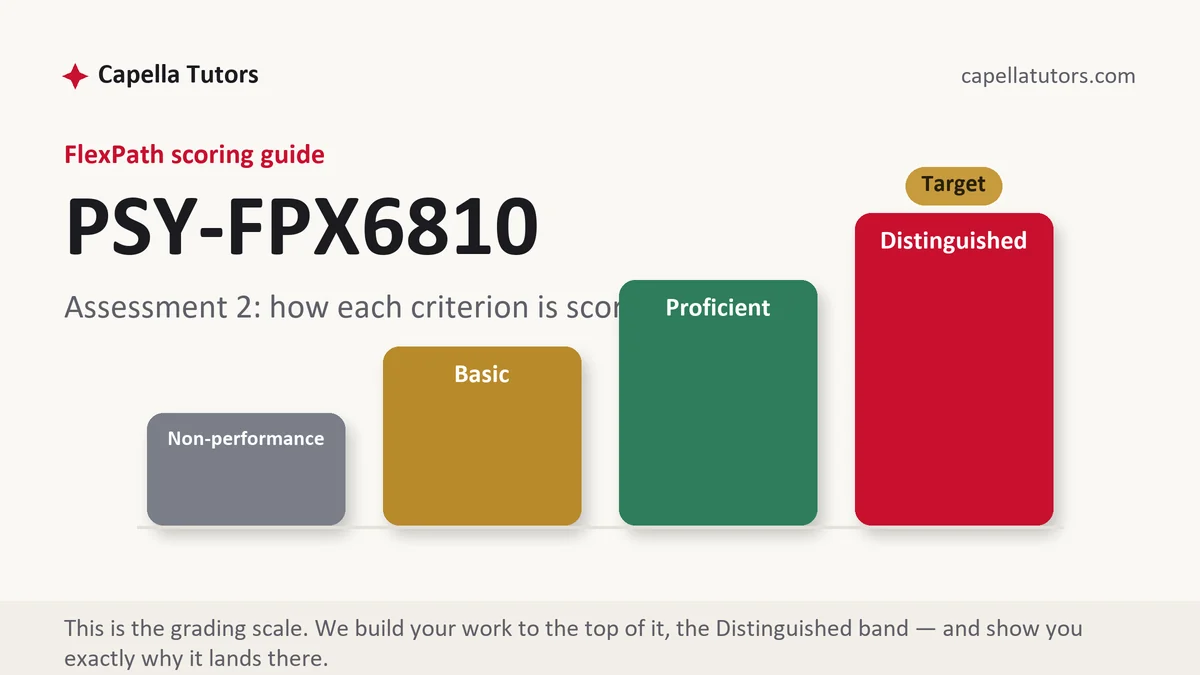
How PSY FPX 6810 Assessment 2 is scored
Four levels, no grade point. The wording of the level your criterion lands on is a reporting standard rather than a comment:
| Level | What it means on a measurement and appraisal deliverable |
|---|---|
| Distinguished | The instrument is matched to a state or trait question on purpose, its items, scale and subscales are reported, reliability is given for the sample in hand, the normative comparison is named, and every relational claim carries its size, its interval and its denominator. |
| Proficient | The right instrument, correctly described and correctly interpreted, with reliability quoted from the manual and the comparison group left implicit. |
| Basic | A questionnaire named, a score reported and a conclusion drawn about the athlete, with no format, no reliability and no comparison group. The default outcome when the instrument is treated as a label. |
| Non-performance | An element the guide requires is absent, usually the appraisal of the instrument's weaknesses. |
A single administration is a snapshot of a state, not a diagnosis and not a trait, and a self-report score is a report about a self. Writing both limits into the paper before an evaluator writes them in the margin is most of this criterion.
The PSY FPX 6810 Assessment 2 method, step by step
-
Settle state or trait before you open a catalogue
The question decides which instruments are even eligible. A tool built for a stable disposition cannot explain one bad afternoon, and a tool built for right now cannot describe a season. Write the question in one sentence, then say which family of instrument it licenses.
-
Report the instrument as an instrument
Give the number of items, the response scale, the subscales and their score ranges, and cite the paper that developed it, because the development article is the only place its intended use and its known weaknesses are set out together. The Group Environment Questionnaire, from the work Carron and colleagues published, carries four subscales that behave differently and cannot be averaged into a single cohesion figure.
-
Give reliability for the sample you have
Quote the published internal consistency, then report what you obtained, because reliability is a property of a sample rather than of a questionnaire. Where your sample is too small to estimate it, say so in those words instead of borrowing the manual's figure and letting it stand as yours.
-
Name the normative sample before comparing anyone to it
Norms developed on collegiate men in team sports do not transfer to a masters competitor in an individual event, so say which sample the comparison rests on and what differs between it and your athletes. A percentile with no stated reference group is a number without a meaning.
-
Report relationships with size, interval and denominator
Give the estimate, the interval around it, the number of people it came from, and the window it was measured in. Then resist the temptation to describe a wide interval as a promising trend.
-
Say which direction the data cannot settle, then self-score
Cohesion and performance are associated, the association is stronger for task cohesion than social cohesion and stronger in interactive sports than coacting ones, and most of the underlying work measured both at the same moment, which leaves the arrow unresolved. Name that, then grade each criterion D, P, B or N and revise.
A structure that maps to the criteria
Targets below are planning figures from our psychology desk for a measurement deliverable, not Capella requirements; adjust to the guide you were given.
| Section | What it must do | Guide word target |
|---|---|---|
| The question | What is being measured, in whom, and whether the question concerns a state or a trait. | ~200 words |
| The instrument | Items, response scale, subscales, score ranges, and the development paper it comes from. | ~300 words |
| Reliability and validity | Published evidence, the figure obtained in this sample, and what the instrument does not claim. | ~250 words |
| Administration and comparison | When and how it was given, and the normative sample any interpretation is measured against. | ~250 words |
| Findings | Scores by subscale, any relationship with its size, interval and denominator, and the window. | ~250 words |
| Appraisal and references | The instrument's weaknesses, what the design cannot settle, and current APA sourcing. | ~200 words |
Annotated sample excerpt
An original model excerpt from our team, showing the reporting register these criteria pay for.
Cohesion in a semi-professional women's rowing eight was measured with the Group Environment Questionnaire, eighteen items answered on a nine-point scale across four subscales, which are reported separately here because task and social cohesion behave differently and averaging them would hide the finding.1 Group integration for task rose from a crew mean of 5.8 to 6.9 across the nine weeks between the first and last administration, and race margins narrowed over the same period, but the crew is nine people, internal consistency could not be meaningfully estimated at that size, and I report the published alphas as the developers' figures rather than as mine.2 The two changes are associated within a single crew across one window, with no comparison crew and no randomization, so nothing here distinguishes cohesion improving performance from a crew that got faster and consequently enjoyed each other more, and the design that would separate them is a repeated-measures comparison across several crews with the measurements offset in time.3
- 1Reports items, scale and subscale structure, then refuses the composite score and says why. The refusal is the graded part.
- 2Gives both figures with the window, then admits the sample is too small for a reliability estimate instead of borrowing one. Attribution of the published alpha is explicit.
- 3Names both directions the data cannot separate and specifies the design that would. This sentence is worth more than the finding it qualifies.
The full premium sample for your exact assessment, written fresh to your scoring guide and issue, is free to request. Study it, revise it into your own voice, and submit work you understand.
The five mistakes that cost Distinguished
- A trait instrument explaining one performance. Stable dispositions cannot account for a single afternoon, and the mismatch shows the tool was never checked against the question.
- Cohesion reported as one number. Collapsing task and social subscales into a single score destroys the only distinction the literature is confident about.
- The manual's reliability presented as yours. Internal consistency belongs to a sample, and the difference between the two claims is a graduate distinction.
- A percentile with no reference group. Comparing an athlete to unnamed norms produces a number that means whatever the reader assumes.
- A causal reading of simultaneous measures. Two variables recorded at the same moment cannot tell you which of them moved first.
Pre-submission checklist
- The question written down, and state or trait settled before the instrument was chosen
- Items, response scale, subscales and score ranges all reported, with the development paper cited
- Reliability given for this sample, or its absence stated plainly
- The normative sample named, with the differences from your athletes acknowledged
- Every relationship carrying an estimate, an interval, a denominator and a window
- The unresolved direction stated, and every criterion self-scored D before submission
Instrument section due and the scores will not behave?
Send the scoring guide, the instrument you were told to use, and whatever scores you are working from. A team of eight returns a premium original sample inside 24 to 48 hours, and one pass exists purely to confirm every empirical claim still matches the design behind it.