How to write PSY-FPX6110 Assessment 3

The short answer

This manual is for PSY-FPX6110 Assessment 3, start to submission. The closing deliverable in this course is a synthesis: a training or instructional programme designed on the retention literature and then evaluated, so that the same document says what will be taught, how, and how anybody would know it worked. Your scoring guide decides the exact deliverable, and the assessment usually asks for the evaluation to be built in rather than promised. Below is the method our tutors use, a criterion-mapped structure, and an annotated excerpt from a model paper. Prefer support on this one? A premium original sample lands inside 24 to 48 hours, rewritten free until the guide is satisfied. Your courseroom may print this as PSY FPX 6110 Assessment 3 or PSY6110 Assessment 3; it is the same deliverable, and PSY-FPX6110 Assessment 3 is what this manual walks through.

One honesty note before the manual: Capella revises courses and scoring guides over time, so always write to the exact scoring guide attached to your assessment in the courseroom. The course identity above is verified on capella.edu; the method and structure below are our tutors' approach to it, not Capella's official rubric text.
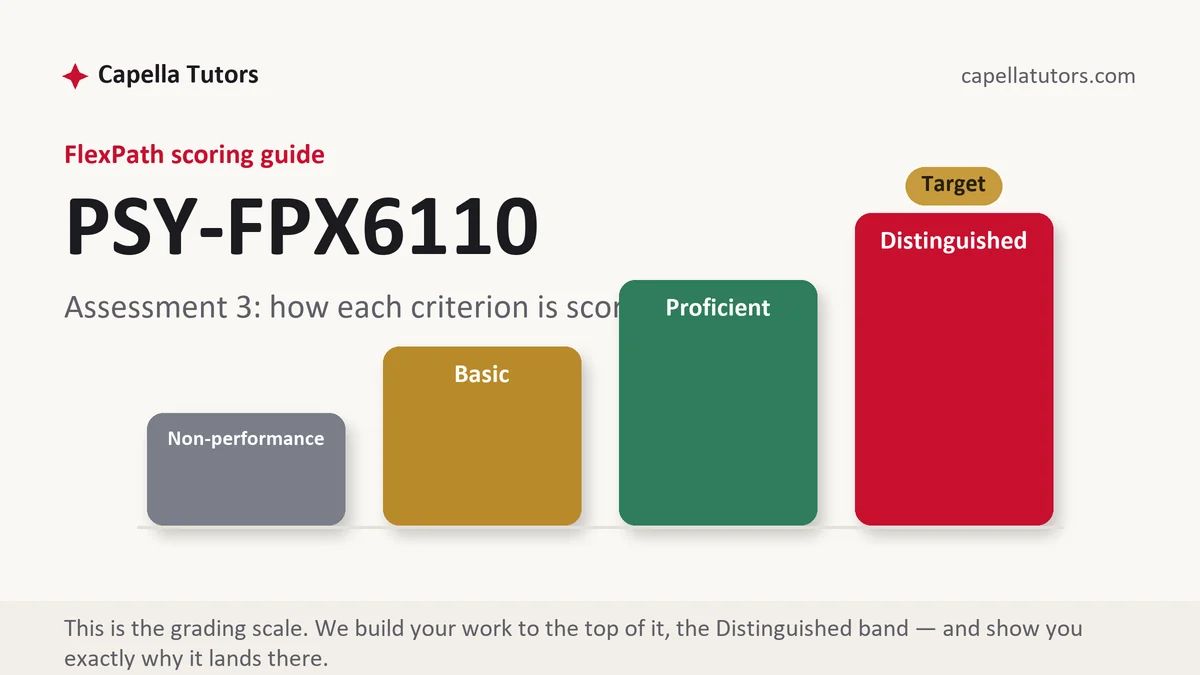
PSY-FPX6110 Assessment 3 grading scale at Capella FlexPath, the criterion levels this assessment is scored on, from Capella Tutors
How Capella FlexPath grades PSY-FPX6110 Assessment 3, visualized by Capella Tutors.

How PSY-FPX6110 Assessment 3 is scored

Four descriptors, one per criterion, and on a training-evaluation deliverable they translate as follows:

LevelWhat it means on a training design and evaluation
DistinguishedThe instructional choices are traced to retention evidence at the size that evidence reports, the evaluation measures at a delay and in the work setting, and the paper states which conclusions its design cannot support. That third element is where most of the available credit sits.
ProficientA defensible programme with an evaluation attached and sources behind each choice. Complete, and silent about its own limits.
BasicA curriculum outline with a satisfaction survey called an evaluation. Common, and it forfeits both the evidence row and the measurement row.
Non-performanceThe criterion asked for something the document does not contain, usually the delayed or transfer measure. A plan to evaluate later is not an evaluation design.

The reason a delayed measure is not optional is that the methods which produce the best performance during a session are frequently the weaker ones a month later. Massed rereading feels fluent while it is happening, and distributed retrieval practice feels laborious, which is exactly why an end-of-session test flatters the wrong programme. Bjork's (1994) account of desirable difficulties is the primary framing, and this is the finding a graduate paper is expected to build a measurement plan around rather than mention.

The PSY-FPX6110 Assessment 3 method, step by step

  1. Convert the criteria into headings, then note the verbs

    Design, justify and evaluate are three different obligations, and a paper that designs beautifully while never justifying will lose a row it never noticed. Put the top descriptor under each heading and check off its elements one by one as the draft fills in.

  2. Define the outcome before the content

    Say what the trainee should be able to do, where, and to what standard, and write it as something observable in the workplace rather than as knowledge of a topic. That single sentence determines your measure, and a programme whose outcome is stated as awareness has already given up the evaluation criterion.

  3. Choose the instructional design from the retention literature

    Distribute the sessions rather than massing them, put retrieval attempts ahead of rereading, and mix problem types once the basics are secure. Ebbinghaus (1885) is the origin of the spacing observation, Cepeda and colleagues (2006) is the meta-analysis to cite for its size and moderators, and Roediger and Karpicke (2006) is the primary source for testing as a learning event rather than an audit.

  4. Report each effect the way its source reports it

    Give the design and the sample before the finding, then the effect size with an interval, then the retention interval it applies to. An advantage observed on 120 undergraduates recalling word pairs after two days is evidence about word pairs after two days, and a graduate paper says so before extending it to a workplace procedure.

  5. Design the evaluation on more than reaction

    Reaction, learning, behavior and results are separable, a distinction Kirkpatrick (1959) introduced and which the transfer literature after Baldwin and Ford (1988) treats as the real problem. Specify a delayed knowledge or skill measure, then one on-the-job measure with its denominator and window, then the comparison group or staggered start that lets you attribute a change to the programme.

  6. Write the limits paragraph, then self-score and submit

    Name what your evaluation cannot establish: who chose to attend, what else changed in the same quarter, and the fact that a statistical test which fails to reach significance has not shown the programme does not work. Then mark every criterion yourself, repair anything short of the top descriptor, and submit early in the week rather than on Friday.

A structure that maps to the criteria

Lengths below are our tutors' planning targets for a deliverable of this scope rather than Capella rules; expand any section your guide weights more heavily.

SectionWhat it must doGuide word target
The performance problemThe gap in observable terms, its current size with a denominator, and who is affected by it.~200 words
Learning outcomesWhat trainees will do, where, to what standard, written so a measure follows directly.~150 words
Design and its evidenceSession spacing, retrieval schedule, practice mix and feedback timing, each with the study or review behind it.~400 words
Evaluation planDelayed measure, transfer measure with its window, comparison condition, and who collects what.~300 words
Threats and limitsSelection, concurrent change, measurement quality, and what a non-significant result would and would not mean.~250 words
Maintenance and referencesRefresher schedule, supervisor support for transfer, and current APA both ways.~200 words

Annotated sample excerpt

An original model excerpt from our team showing the register that earns the evidence and measurement rows. Learn the moves from it and write your own programme.

Sample excerpt: the evaluation design Original model · Capella Tutors

The programme trains 58 member-service representatives at a credit union to identify and escalate suspected payment fraud, and the outcome measure is the proportion of eligible cases escalated within one business day, currently 61 of 143 eligible cases across the previous quarter, or 42.7 percent.1 Because distributed practice with retrieval produces its advantage on delayed rather than immediate tests, with pooled estimates in the region of a moderate effect and wide variation by retention interval, the four sessions are spread across three weeks and the knowledge check is scheduled at eight weeks rather than at the end of the last session (Cepeda and colleagues, 2006; Roediger and Karpicke, 2006).2 Two of the four branches begin in March and two in May, so a rise in the escalation proportion confined to the trained branches would be associated with the programme rather than with the fraud-alert bulletin issued to all staff in April; with 58 participants this design cannot establish that the training caused the change, and a test that returns no significant difference would leave the question open rather than answer it in the negative.3

  • 1The outcome is a proportion with its numerator, denominator and window stated, which means the post-programme figure will be comparable to it.
  • 2The design choice is justified by the retention evidence, the effect is described at the magnitude the review reports rather than inflated, and the measurement point follows from the evidence.
  • 3A staggered start, the named rival explanation, association language instead of causal language, and an accurate statement of what a null result cannot say.

The full premium sample for your exact assessment, written fresh to your scoring guide and issue, is free to request. Study it, revise it into your own voice, and submit work you understand.

Get the full sample free

The five mistakes that cost Distinguished

  • Satisfaction sheets called an evaluation. How much trainees enjoyed a session tells you about the session, and nothing about what they will still do in October.
  • The test scheduled at the end of the training. An immediate measure systematically favors the method that produces the least durable learning.
  • Instruction matched to a preferred learning style. The matching prediction has been tested and not supported, and asserting it costs the evidence row outright.
  • Causal verbs over a one-group design. Improved and increased claim an attribution that a single trained cohort with no comparison cannot deliver.
  • A null result read as proof of no effect. A test that misses significance with 58 people is uninformative about small effects, and saying otherwise is a measurement error rather than modesty.

Pre-submission checklist

  • Learning outcomes are written as observable workplace performance with a standard
  • Every instructional choice cites the retention evidence behind it, with its interval
  • Effects appear at the magnitude the source reports, with an interval where one exists
  • A delayed measure and a transfer measure are both scheduled, with denominators
  • A comparison condition or staggered start is built into the design
  • Association language is used wherever the design cannot support a causal claim

Training design and evaluation, done properly?

Send the guide, the performance gap, and whatever numbers your organization already tracks. Our eight-person pipeline returns a premium original sample inside 24 to 48 hours, with one pass devoted to checking that every reported effect matches its source and that no sentence claims cause the design cannot support. Revisions are free and uncapped.

Keep going

Online now