This manual is for PSY-FPX6110 Assessment 1, start to submission. The first graded deliverable in this course takes one learning process and explains it at the level of mechanism, normally with a case attached, and the assessment usually asks for the contingencies written out rather than summarized. Graduate criteria here are not checking whether you can name a theorist; they are checking whether every label in your paper was earned from what happened to the behavior. Below is the method our tutors use, a structure keyed to the criteria, and an annotated excerpt from a model paper. Would you rather hand it over? A premium original sample for your exact deliverable comes back in 24 to 48 hours, revised free until your guide is satisfied. Your courseroom may print this as PSY FPX 6110 Assessment 1 or PSY6110 Assessment 1; it is the same deliverable, and PSY-FPX6110 Assessment 1 is what this manual walks through.
One honesty note before the manual: Capella revises courses and scoring guides over time, so always write to the exact scoring guide attached to your assessment in the courseroom. The course identity above is verified on capella.edu; the method and structure below are our tutors' approach to it, not Capella's official rubric text.
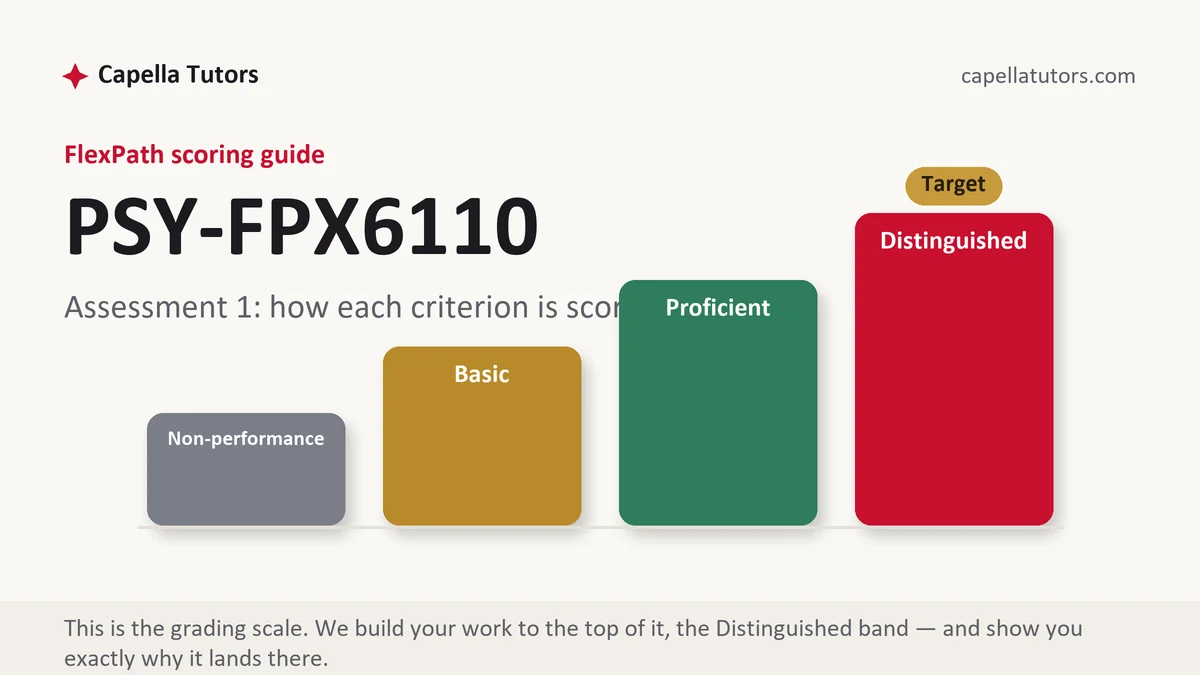
How PSY-FPX6110 Assessment 1 is scored
FlexPath issues no letter grades. Every criterion on your guide lands on one of four levels, and the level wording is the brief you should be writing to:
| Level | What it means on a learning analysis |
|---|---|
| Distinguished | The contingency is derived from the observed direction of change, the mechanism is attributed to the research that established it, and the paper says what this case cannot settle. The extra move sits inside the criterion wording; locate it and make it. |
| Proficient | The process is explained accurately and the case is analyzed completely. Correct, and one move short of the top column. |
| Basic | The theory described, with the case used as illustration rather than analyzed. This is where papers land when the labels arrive before the observations. |
| Non-performance | A required element is absent, most often the account of what maintains the behavior now. A criterion goes to the floor for absence, not for weakness. |
Two features of this course make its criteria unusually literal. The technical vocabulary is defined by effect rather than by feel, so reinforcement means the behavior became more likely and negative means something was removed, and a paper that assigns those words by pleasantness has surrendered the mechanism in its first paragraph. The second feature is that the criteria expect prediction. A theory that has been applied properly says what the case will do next, and a paper that only describes what already happened has explained nothing an evaluator can score as application.
The PSY-FPX6110 Assessment 1 method, step by step
-
Turn the guide into your outline before you choose a theory
Copy each criterion into the document as a heading and paste its top-level wording underneath. That skeleton is the deliverable, and prose that serves no criterion is unpaid work. Mark the verb in each row too, since describe, analyze and apply are graded at different levels of precision in this course.
-
Write the behavior in countable terms first
Before any theory enters the draft, state what a second observer would record: what the behavior looks like, where it happens, how often, and over what window. A weekly count across four sessions is analyzable; a sentence about a learner being unmotivated is not, and the analysis rows have nothing to grade in it.
-
Record antecedent, behavior and consequence in that order
Lay the sequence out as a table before you interpret it. What was happening immediately before, what the person did, what followed within seconds. Keep the sequence descriptive at this stage, because the moment you name a consequence a punishment you have committed to a claim about frequency you have not yet checked.
-
Read the direction of change, then apply the label
Compare the counts across your window. If the behavior rose, the consequence functioned as reinforcement whatever anyone intended, and if something was removed it was the negative variety. Skinner's (1953) framing is the primary source for that logic, and the functional analysis tradition running through Iwata and colleagues (1982) is the source for asking what the behavior achieves rather than what it looks like.
-
Analyze the adult's contingency on the same terms
Almost no student paper does this, and it is often the single move that lifts the analysis row. The instructor, supervisor or parent in your case is also behaving, and their behavior has consequences too. When a practice persists despite failing, the usual explanation is that it works for the adult on a shorter timescale than it fails for the learner.
-
Self-score every criterion, then submit early in the week
Read the draft one criterion at a time against the guide and mark yourself honestly at one of the four levels. Anything under the top level gets another pass, and the usual gap is a missing sentence about what the evidence cannot establish. Faculty take up to two business days per attempt, so a Thursday submission can idle until Monday.
A structure that maps to the criteria
The word targets are planning figures our tutors use for an analysis of this size, not Capella requirements; your scoring guide decides the sections and the length.
| Section | What it must do | Guide word target |
|---|---|---|
| The case and the behavior | Setting, people involved, and the target behavior defined so two observers would agree on a count. | ~200 words |
| The observed sequence | Antecedent, behavior and consequence across a stated window, with the frequencies as recorded. | ~250 words |
| The learning process explained | The mechanism named and attributed to its primary literature, with the term used in its technical sense. | ~350 words |
| The contingency labeled | Direction of change first, label second, plus the maintaining variable and the adult's contingency. | ~300 words |
| Prediction and limits | What the analysis predicts next, and what this observation cannot establish about cause. | ~200 words |
| References | Current APA, primary sources under their own dates, every citation matched both ways. | as needed |
Annotated sample excerpt
An original model excerpt from our team, written at the register the top column pays for. Treat it as study material: borrow the sequence of moves, then write the case in front of you.
Across four consecutive Saturday lessons at a municipal pool, the instructor recorded 11 refusals to put the face in the water in week one and 19 in week four, so whatever the shallow-end move was meant to be, it functioned as reinforcement.1 The sequence held on 26 of 30 recorded occasions: the instructor called the submersion drill, the child gripped the wall and protested, and the instructor moved him to the shallow end to practice kicking, which removed the drill. A consequence that subtracts a demand and raises the behavior preceding it is negative reinforcement, and escape from the drill is the maintaining variable rather than fear of water in general (Skinner, 1953; Iwata and colleagues, 1982).2 The instructor's behavior sits on the same contingency, since the protest stops within seconds of the reassignment, which is why a practice that has failed for a month survives without anyone deciding to keep it.3
- 1Frequencies and the window arrive before any label, so the reader watches the direction of change decide the analysis rather than the writer's vocabulary.
- 2The label is derived in one sentence, the maintaining variable is named, and the mechanism goes to the primary literature instead of to a textbook chapter.
- 3The adult's contingency, analyzed on the same terms. This is the sentence that most often separates the top column from a competent report.
The full premium sample for your exact assessment, written fresh to your scoring guide and issue, is free to request. Study it, revise it into your own voice, and submit work you understand.
The five mistakes that cost Distinguished
- Reinforcement used as a synonym for reward. The term is defined by an increase in the behavior, so a consequence nobody enjoyed can still be a reinforcer, and pleasantness decides nothing.
- Negative read as bad. Positive and negative record whether something was added or taken away, and reversing that misclassifies most escape-maintained cases in the wrong direction.
- A theory summarized instead of applied. Three paragraphs of accurate description with the case bolted on at the end leaves the application criterion untouched.
- The adult left out of the analysis. If nobody's behavior but the learner's is examined, the paper cannot explain why the ineffective response keeps happening.
- Secondary sources standing in for the experiments. Citing a textbook for a conditioning mechanism reads as undergraduate sourcing, and the primary paper is a database search away.
Pre-submission checklist
- Every criterion on the guide has its own labeled section in the document
- The target behavior is stated so that two observers would produce the same count
- Frequencies and the measurement window appear before any contingency label
- Each mechanism is attributed to the primary research that established it
- The adult's contingency is analyzed, and the maintaining variable is named
- One sentence states what this observation cannot establish about cause
Want this one built with backup?
Send the scoring guide and the case you have in mind, even in rough notes. Eight people, analyst through double review, return a premium original sample aimed at the top column in 24 to 48 hours, with one pass reserved for checking that every behavioral term in the document is used in its technical sense. Revisions are free until the criteria clear.