How to write PSY-FPX6110 Assessment 2

The short answer

This manual is for PSY-FPX6110 Assessment 2, start to submission. The second deliverable moves from explaining a process to using one: a plan that changes a behavior, built on learning research and written so that somebody else could run it and check whether it worked. Your scoring guide decides the form, but the graded skill stays constant, which is specifying a target, a schedule, a measure and a maintenance strategy instead of describing an activity and hoping. Below sits our tutors' method for it, a structure keyed to the criteria, and an annotated excerpt. Rather have it done alongside you? A premium original sample arrives in 24 to 48 hours with free revision until every criterion clears. Your courseroom may print this as PSY FPX 6110 Assessment 2 or PSY6110 Assessment 2; it is the same deliverable, and PSY-FPX6110 Assessment 2 is what this manual walks through.

One honesty note before the manual: Capella revises courses and scoring guides over time, so always write to the exact scoring guide attached to your assessment in the courseroom. The course identity above is verified on capella.edu; the method and structure below are our tutors' approach to it, not Capella's official rubric text.
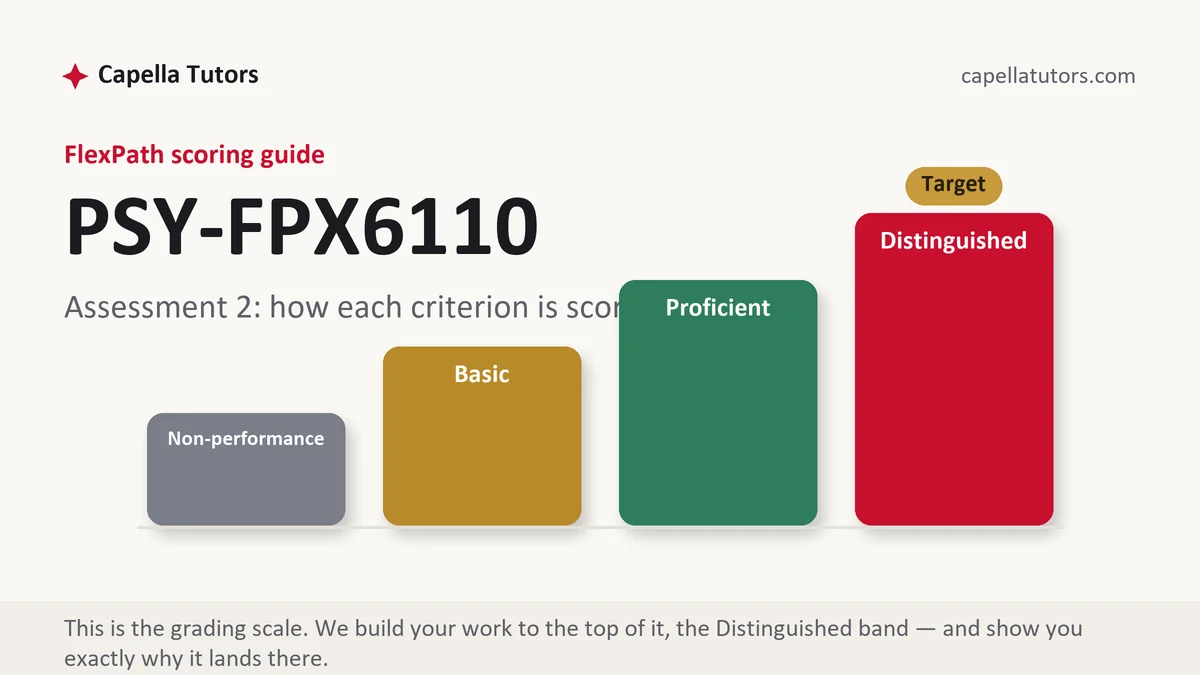
PSY-FPX6110 Assessment 2 grading scale at Capella FlexPath, the criterion levels this assessment is scored on, from Capella Tutors
How Capella FlexPath grades PSY-FPX6110 Assessment 2, visualized by Capella Tutors.

How PSY-FPX6110 Assessment 2 is scored

Each criterion is judged against four descriptors rather than against a percentage, and on a design deliverable those descriptors read like this:

LevelWhat it means on a behavior-change plan
DistinguishedThe procedure follows from a stated function, the design allows the change to be attributed to the intervention, and generalization and maintenance are programmed rather than assumed. The top column almost always asks for one of those three explicitly.
ProficientA complete, evidence-based procedure with a measure attached. Everything a reviewer needs to run it, and nothing that anticipates its failure.
BasicA sensible-sounding programme of activities, with the function unexamined and the measure vague. Plans written from good intentions land here reliably.
Non-performanceAn element the criterion names is not in the document at all, most often baseline data or the maintenance plan. Reviewers do not award partial credit for an implied section.

The reason function comes first is that two identical-looking behaviors can be maintained by different consequences, and a procedure aimed at the wrong one fails predictably. This is the logic Iwata and colleagues (1982) formalized, and it is why a plan that opens with a reward schedule rather than with an account of what the behavior currently achieves has skipped the step the criteria are built around.

The PSY-FPX6110 Assessment 2 method, step by step

  1. Build the document from the criteria outward

    Each criterion becomes a heading with its top descriptor pasted beneath, and every paragraph you write afterwards has to earn a place under one of them. Doing this first also tells you which sections the guide weights, because a criterion that names four elements is asking for four paragraphs rather than one.

  2. State the function before you choose the procedure

    Say what the behavior currently achieves for the person doing it: access to something, escape from something, attention, or a sensory consequence. Then note how you know. An informant interview, a scatterplot of when the behavior occurs, or a structured observation each carry different confidence, and naming which one you used is a criterion-level move.

  3. Take a baseline you would be willing to publish

    Count the behavior under ordinary conditions for long enough that a reviewer can see whether it is stable, rising or falling. Report the denominator every time, because eleven errors means nothing until the reader knows it came from 240 opportunities, and a plan that reports raw counts against an unstated volume cannot show improvement afterwards.

  4. Write the procedure with the schedule specified

    Name the replacement behavior, the antecedent change, and the consequence you will arrange. Then commit to numbers: how often reinforcement is delivered at the start, when it thins, who delivers it, and what happens on an occasion when the behavior does not occur. Ferster and Skinner's (1957) schedule work is the primary source for why the thinning pattern matters more than the initial richness.

  5. Choose a design that lets you attribute the change

    One group measured before and after cannot separate your intervention from time, training effects or the season. Staggering the start across three settings, or alternating conditions within one, gives you a comparison you can defend, and it costs nothing but sequencing. Then say plainly what your design still cannot rule out.

  6. Program generalization and maintenance, then self-score

    Behavior reinforced richly and then abandoned reverts, so write down how the schedule thins, who owns it after you leave, and where the behavior has to occur that you did not train. Then grade yourself criterion by criterion and fix anything below the top level before you submit, early in the week rather than late.

A structure that maps to the criteria

These are the planning lengths our tutors work to on a plan of this scope, offered as a shape rather than as a rule; your scoring guide governs.

SectionWhat it must doGuide word target
Setting and targetWhere this happens, who is involved, and the behavior stated as something countable.~200 words
Function and evidence for itWhat the behavior achieves now, how that was established, and how confident that method allows you to be.~250 words
BaselineCounts with denominators across a stated window, and a sentence on stability or trend.~200 words
ProcedureAntecedent change, replacement behavior, reinforcement schedule, thinning plan, and who runs each part.~350 words
Measurement and designThe measure, the observation schedule, agreement between observers, and the comparison that allows attribution.~250 words
Maintenance, limits, referencesGeneralization and upkeep, what the design cannot establish, and current APA in text and list.~250 words

Annotated sample excerpt

A model excerpt written by our team to show what the design criteria reward. Use it to see the moves, then build your own plan around your own setting.

Sample excerpt: baseline and design Original model · Capella Tutors

Across ten shifts at a regional food bank, volunteers at the three sorting stations misrouted 84 of 2,140 donated items, a 3.9 percent error rate, with station two accounting for 51 of those errors on 690 items.1 Interview and observation both indicate an antecedent problem rather than a consequence one, since the bin labels at station two are behind the conveyor and the fastest route to a decision is a guess; no volunteer receives any consequence for a misroute, so nothing currently maintains accuracy either way.2 The intervention therefore starts at the antecedent, with relabeled bins and a two-minute sorted-versus-unsorted retrieval drill at shift start, and it begins at station two in week three, station one in week five and station three in week seven, so that a drop confined to the stations already trained separates the procedure from the seasonal rise in donation volume.3

  • 1Numerator, denominator and window in one sentence, with the problem localized. A percentage without its base cannot support anything the plan claims later.
  • 2The function is examined and, honestly, comes back as an antecedent and skill issue rather than a reinforcement one, which is what then determines the procedure.
  • 3A staggered start across three stations, with the specific rival explanation named. This is the sentence that earns the design row.

The full premium sample for your exact assessment, written fresh to your scoring guide and issue, is free to request. Study it, revise it into your own voice, and submit work you understand.

Get the full sample free

The five mistakes that cost Distinguished

  • A procedure chosen before the function is known. Adding an incentive to escape-maintained behavior makes the record look busy and changes nothing.
  • Percentages with no denominator. An error rate that hides its base cannot be compared with anything, including the post-intervention figure from the same plan.
  • A pre-and-post design presented as evidence. Without a comparison, any improvement is equally consistent with practice, weather or who happened to be on shift.
  • Reinforcement so rich it cannot be sustained. A schedule nobody can keep running after week four is a plan for a relapse with paperwork attached.
  • Acquisition treated as the finish line. Generalization and maintenance are separate problems, and the criteria expect both to be written into the plan rather than hoped for.

Pre-submission checklist

  • The function is stated, with the method that established it named
  • Baseline counts carry denominators and a stated measurement window
  • The reinforcement schedule includes its thinning plan and an owner
  • Observer agreement is described, not just the measure itself
  • The design supports attribution, and one rival explanation is named
  • Generalization and maintenance each have their own written provision

Need the plan built and the numbers checked?

Send the guide, the setting and whatever counts you already have. An eight-person pipeline returns a premium original sample inside 24 to 48 hours, with one reader doing nothing but recomputing rates against their denominators and confirming that the design can carry the claim. Free revisions until the criteria are met.

Keep going

Online now