This manual is for PSY FPX 6030 Assessment 2, start to submission. The middle deliverable in Adolescent Psychology is the applied one: a programme or intervention plan for a defined group of young people, with the target written as a measurable behaviour, the content chosen from evaluation evidence, the group composition decided on purpose, and the risk of making things worse written into the plan rather than left out of it. That last element is what separates graduate work here, because this is a field where documented interventions have produced harm. It is master's work in a non-licensure MS in Psychology, and each criterion on the guide is decided entirely on its own. Below you will find the method, a structure that follows the criteria, and an annotated sample excerpt. Prefer this handled for you? A premium original sample for this assessment is back in 24 to 48 hours, with revisions free until the guide is met. Capella's catalog lists the course as PSY-FPX6030, and some courserooms print PSY6030; both point to this same Assessment 2.
One honesty note before the manual: Capella revises courses and scoring guides over time, so always write to the exact scoring guide attached to your assessment in the courseroom. The course identity above is verified on capella.edu; the method and structure below are our tutors' approach to it, not Capella's official rubric text.
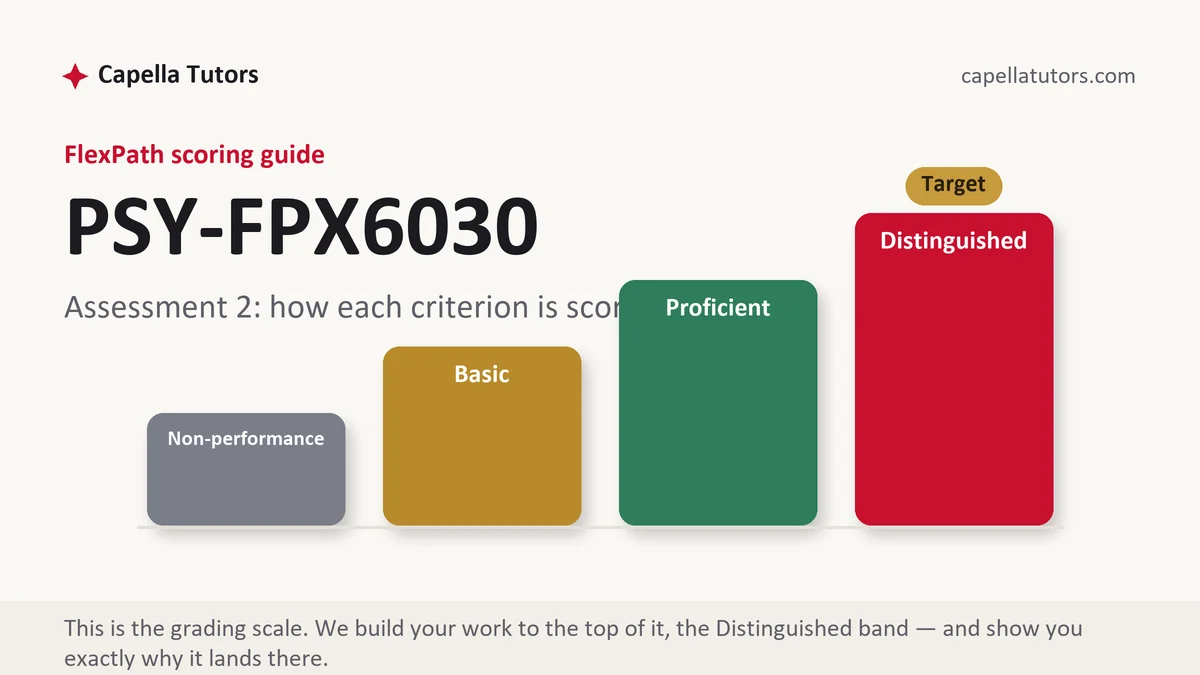
How PSY FPX 6030 Assessment 2 is scored
The guide prints criteria and four possible readings of each. Your job is to make one of those readings obviously the right one:
| Level | What it means on an intervention plan |
|---|---|
| Distinguished | The target is a countable behaviour with a measurement window, the content is chosen from trials rather than from plausibility, group composition is justified, and the plan carries a monitoring schedule, a stopping rule and the writer's own account of how it could do harm. |
| Proficient | A well organised plan with evidence behind its content. Complete, and lacking the harm case and the stopping rule that the top column wants in writing. |
| Basic | A programme built on plausibility. Workshops, awareness sessions and information delivery, aimed at an attitude, measured by satisfaction. |
| Non-performance | The measurement plan or the ethical protocol is missing outright, which puts that criterion on the floor regardless of how good the rest reads. |
Expect the guide to grade feasibility as well as design. A plan that needs a clinician you do not have, or data nobody collects, has answered the content criteria and failed the one that asks whether this could happen.
The PSY FPX 6030 Assessment 2 method, step by step
-
Write the target as something a school could count
Improve engagement is not a target. Unexcused period absences per enrolled student per month, among the 62 students in years nine and ten with four or more referrals last term, is a target. Give the behaviour, the population, the unit and the window, and every later section has something to point at.
-
Choose content from the trial literature, not from what sounds reasonable
The assumption that adolescents act dangerously because they lack information has been tested repeatedly and does not carry the weight put on it. What tends to work is structured practice of a specific skill with feedback, delivered often enough to be learned, usually alongside a change in the adult environment. Cite the evaluations, including the ones that found nothing.
-
Decide group composition deliberately, and say why
Gathering high-risk adolescents into a group to work on their behaviour has produced worse outcomes than no programme in several evaluations, and the mechanism is ordinary: in a peer group, risky behaviour earns attention and status, and the group supplies both an audience and practice. Prefer individual, family or mixed-composition formats, and write the reasoning out where the criterion can see it.
-
Build the measurement plan with denominators and windows
Name the indicator, the source that already records it, the baseline period, the review points and the denominator each figure will be reported against. Add one measure the young people themselves supply, because internal states are the thing adults reliably under-detect, and one the setting supplies, because behaviour shows up where somebody is watching.
-
Write the harm case and a stopping rule
State the two or three ways this plan could make things worse: the group effect, a label attached to the selected students, or attention shifted away from a wider problem. Then give the indicator that would reveal it, the review date, and the threshold at which the programme pauses. A plan that cannot detect its own failure is not finished.
-
Set the ethics and the escalation route, then self-score
Guardian permission and the young person's assent both come before anything begins, confidentiality is offered with its limits named at the outset, and the plan says who a disclosure goes to. A non-licensure graduate student is not the person who manages acute risk, so the protocol names the qualified adult. Then mark each criterion against the guide and submit with the two-day evaluation window in mind.
A structure that maps to the criteria
Targets below suit a plan for a single setting with a measurement section attached; shift them wherever your own guide asks for a fuller literature review.
| Section | What it must do | Guide word target |
|---|---|---|
| Population and target | Age band, setting, selection rule for who is included, and the behaviour stated as a count. | ~200 words |
| Mechanism and rationale | The developmental process you are acting on and why it predicts change in this behaviour. | ~250 words |
| Content and evidence | What happens in each session, drawn from evaluations named with designs and results. | ~350 words |
| Composition and delivery | Group format justified, dose, duration, who delivers it, and the training they need. | ~250 words |
| Measurement and harm case | Indicators, sources, baselines, review dates, denominators, iatrogenic risk, stopping rule. | ~300 words |
| Ethics and references | Permission, assent, disclosure limits, escalation route, and current APA both ways. | ~200 words |
Annotated sample excerpt
An original passage from our own writers, pitched at the level the highest descriptor describes. Take the moves and rebuild them for your setting and your age band.
The plan targets unexcused period absences among the 62 students in years nine and ten who received four or more behaviour referrals in the autumn term, reported per enrolled student per month against the attendance record the school already keeps.1 Sessions pair each student with one trained mentor rather than convening the 62 as a group, because evaluations of interventions that aggregate high-risk adolescents have in several cases reported worse outcomes than no intervention, and a group of peers is a setting where the target behaviour earns status.2 Review points fall at six and twelve weeks; if unexcused absences among participants rise relative to their own baseline while the year-group rate holds steady, the programme pauses and the design goes back to the pastoral team.3
- 1Behaviour, population, selection rule, unit and existing data source in one sentence. Nothing here needs new data collection, which is what makes the plan feasible.
- 2Composition justified from the harm literature rather than from convenience, with the mechanism stated in a clause. This is the paragraph most drafts leave out entirely.
- 3A dated review, a comparison group already available in the record, and a threshold that triggers a stop. The plan can now detect its own failure.
The full premium sample for your exact assessment, written fresh to your scoring guide and issue, is free to request. Study it, revise it into your own voice, and submit work you understand.
The five mistakes that cost Distinguished
- An attitude as the target. Attitudes cannot be counted next term, and a criterion asking for measurable outcomes has nothing to grade.
- Information delivery as the content. Telling adolescents about a risk has been evaluated many times, and the results do not support building a programme on it.
- High-risk students grouped without comment. Convening the exact population most likely to reinforce each other, with no justification, ignores the clearest harm finding in this field.
- Satisfaction reported as outcome. Participants enjoyed the sessions is process data, and no criterion asking whether the behaviour changed can accept it.
- Confidentiality promised without limits. The disclosure rule and the escalation route belong in the protocol before the first session, not in a paragraph after a difficult conversation.
Pre-submission checklist
- The target is a counted behaviour with a population, a unit and a window
- Content is traced to named evaluations, including null results
- Group composition is justified against the iatrogenic evidence
- Indicators come from records that already exist, with denominators stated
- A harm case, a review date and a stopping threshold all appear in writing
- Permission, assent, disclosure limits and the escalation route are specified
Intervention plan to build?
Send the guide, the age band and the setting. We build the target as a measurable behaviour, justify the composition, attach the monitoring plan and the stopping rule, and return a premium original sample in 24 to 48 hours with free revision until the criteria are clear.