This manual is for PSY FPX 6030 Assessment 3, start to submission. The closing deliverable in Adolescent Psychology is usually the synthesis: a case where the adults and the young person report different things, and the paper has to decide what the pattern means, where the case sits against the developmental literature on temporary and persisting difficulty, and what response is proportionate to that reading. Disagreement between informants is the finding here rather than the noise. It is master's work in a non-licensure MS in Psychology, scored one criterion at a time against your own guide. The method comes next, then the structure, then an annotated sample excerpt. Rather hand the drafting off? A premium original sample written to your prompt and guide comes back in 24 to 48 hours, revised free until nothing is outstanding. Capella's catalog lists the course as PSY-FPX6030, and some courserooms print PSY6030; both point to this same Assessment 3.
One honesty note before the manual: Capella revises courses and scoring guides over time, so always write to the exact scoring guide attached to your assessment in the courseroom. The course identity above is verified on capella.edu; the method and structure below are our tutors' approach to it, not Capella's official rubric text.
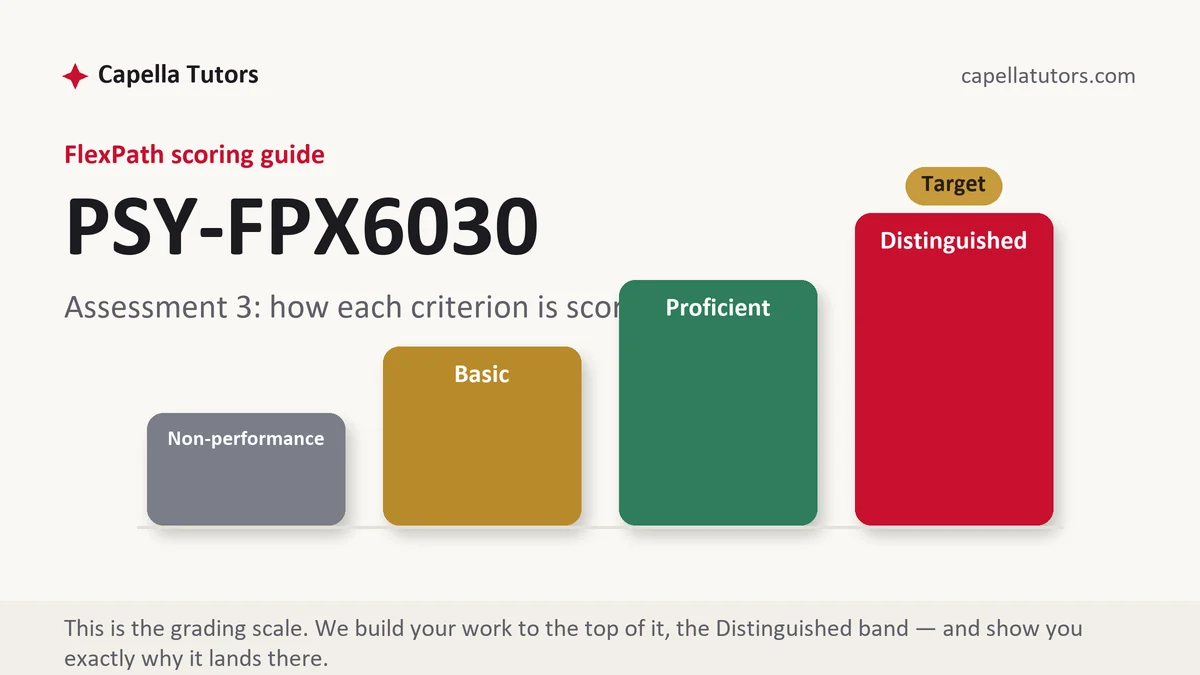
How PSY FPX 6030 Assessment 3 is scored
An evaluator works down the guide and assigns each criterion a level. Written descriptions, not points, are what you are drafting toward:
| Level | What it means on a case synthesis |
|---|---|
| Distinguished | Each informant is used for what that informant can observe, the discrepancy is explained by context rather than resolved by preference, the developmental framework is attributed to its authors with its modelling assumptions stated, and the plan is sized to the pattern the evidence actually supports. |
| Proficient | A coherent synthesis with a reasonable plan. Everything covered, with the discrepancy smoothed rather than interpreted. |
| Basic | One report chosen as the true one, usually the adult's, and the others mentioned in passing. Alternatively three reports averaged into a summary judgment nobody made. |
| Non-performance | The synthesis or the ethical protocol is missing. A criterion with no corresponding section scores at the bottom whatever else the paper does well. |
The synthesis row rewards a position with its assumptions on display. Take a stand about what this case is, say what modelling or measurement choice that reading depends on, and name the observation that would change it.
The PSY FPX 6030 Assessment 3 method, step by step
-
Outline from the criteria, then fix the band and the setting
Criteria become headings, top-level wording sits underneath, and the first line of the document names the age and the context: a seventeen-year-old in a workforce readiness programme, for instance. Studies of fourteen-year-olds in school are a different population, and the paper has to say so when it borrows from them.
-
Tabulate who reported what, by which instrument
Build a short table before you write a paragraph: informant, instrument or method, what was reported, and where that person can actually observe the young man. A guardian rating scale, a supervisor's incident notes and a self-report questionnaire are three measurements of three overlapping things, and the table stops you treating them as one.
-
Read the disagreement as information about context
Correlations between different kinds of informant in this literature sit at the low end, often around .3, and that is a property of the phenomenon rather than a defect to average away. Behaviour reported at work and not at home points at something about the work setting. An internal state reported only by the young person is exactly the class of information adults are known to miss.
-
Place the case against the developmental taxonomy honestly
The argument that most antisocial behaviour in adolescence begins and ends there, while a smaller group shows difficulty from early childhood that persists, belongs to Moffitt and should be cited to her. Then state the assumption: trajectory groups come out of models that have to be told how many groups to look for, and the same data often support a continuum. Write tendencies, not types.
-
Size the plan to the reading, not to the worry
If the history points to a difficulty that began in adolescence, an intensive programme designed for the persisting pattern is expensive, unnecessary and, given what grouping can do, capable of harm. If early history is present, the plan is longer and involves the family. Write which pattern you are treating and what evidence put the case there.
-
State the disclosure protocol and what would move you, then self-score
Confidentiality limits and the escalation route belong in the plan before any conversation happens, and the named qualified adult belongs in it too. Close by naming the observation that would revise your formulation. Then mark each criterion against the guide, revise anything under the top level, and leave the two business days faculty need to evaluate an attempt.
A structure that maps to the criteria
The lengths below fit a case synthesis with a plan attached, the common shape in this course; reweight where your guide divides the work differently.
| Section | What it must do | Guide word target |
|---|---|---|
| The case and the question | Age, setting, history in dates, and the decision this synthesis exists to inform. | ~200 words |
| Data sources compared | Informant, method, what each reported, and where each can observe. A table earns its space here. | ~250 words |
| The discrepancy interpreted | What the pattern implies about settings, and the additional information that would resolve it. | ~300 words |
| Developmental formulation | The framework, its authors, the mechanism, and the assumptions the reading depends on. | ~350 words |
| Plan proportionate to the reading | What happens, who does it, at what intensity, with the harm case for over-treating named. | ~250 words |
| Ethics, revision, references | Disclosure limits, escalation, what would change the formulation, current APA both ways. | ~200 words |
Annotated sample excerpt
Here is one of our model paragraphs, written at the register the top descriptor sets out. Study how the three reports are handled and then write your own case with your own sources.
The guardian's rating placed conduct concerns in the average range, the job coach recorded six walk-offs in eleven shifts, and the young man's own questionnaire returned elevated worry that neither adult mentioned.1 All three are most likely accurate about what each can see, since agreement between different classes of informant in this literature is modest by rule rather than by accident, and behaviour appearing on shift but not at home points toward the demands of the workplace rather than toward a disposition he carries everywhere.2 The worry reported only by him is the class of information adults consistently under-detect, so the formulation treats it as the most probable driver of the walk-offs and names the observation that would test it, which is a supervisor log of what immediately preceded each departure.3
- 1Three sources, three methods, three findings, with counts and denominators where they exist. No source is ranked before the interpretation begins.
- 2Explains the disagreement from what the literature says about informants, then reads the setting difference as evidence. Nothing is averaged and nothing is discarded.
- 3Commits to a formulation, then supplies the observation that could refute it. Naming the test is what turns a plausible story into a graduate synthesis.
The full premium sample for your exact assessment, written fresh to your scoring guide and issue, is free to request. Study it, revise it into your own voice, and submit work you understand.
The five mistakes that cost Distinguished
- One informant crowned as the truth. Choosing the adult who sounds most reliable throws away the part of the data that carries the most information.
- Reports averaged into a composite. A mean of three disagreeing sources describes a young person nobody has met.
- A taxonomy cited as a diagnosis. Trajectory groups are model output with an assumed number of classes, and writing them as types overstates what the statistics deliver.
- Intensity chosen by anxiety. Applying a programme designed for a persisting pattern to a temporary one wastes resources and can worsen outcomes.
- A framework attributed to a textbook. Developmental theory belongs to the researchers who proposed it, and the source criterion checks that specifically.
Pre-submission checklist
- A table names each informant, each method, and where that informant can observe
- The discrepancy is explained by context rather than resolved by preference
- Theory is attributed to its originators, with modelling assumptions stated
- The plan's intensity is justified by the pattern the evidence supports
- Disclosure limits, the escalation route and the qualified adult are named
- The paper states the observation that would revise the formulation
Case synthesis waiting on you?
Send the guide and whatever case material you hold. We build the informant table, interpret the discrepancy, attribute the framework properly, and return a premium original sample inside 24 to 48 hours, revised free until every criterion is met.