This manual is for PSY FPX 6030 Assessment 1, start to submission. The opening deliverable in Adolescent Psychology is normally the analytic one: take an association reported about young people and work out how much of it could be an effect, which means naming the design, the sample and the confounds before the finding gets repeated. Nearly all of this literature is observational, so the verbs you choose are graded as closely as the sources you pick. This is master's work in a non-licensure MS in Psychology, and the four levels on your guide are assigned row by row. Below are the method, a structure that maps to the criteria, and an annotated sample excerpt. Want someone else to draft it? A premium original sample keyed to your own guide arrives in 24 to 48 hours, and we revise it free until every row is answered. Capella's catalog lists the course as PSY-FPX6030, and some courserooms print PSY6030; both point to this same Assessment 1.
One honesty note before the manual: Capella revises courses and scoring guides over time, so always write to the exact scoring guide attached to your assessment in the courseroom. The course identity above is verified on capella.edu; the method and structure below are our tutors' approach to it, not Capella's official rubric text.
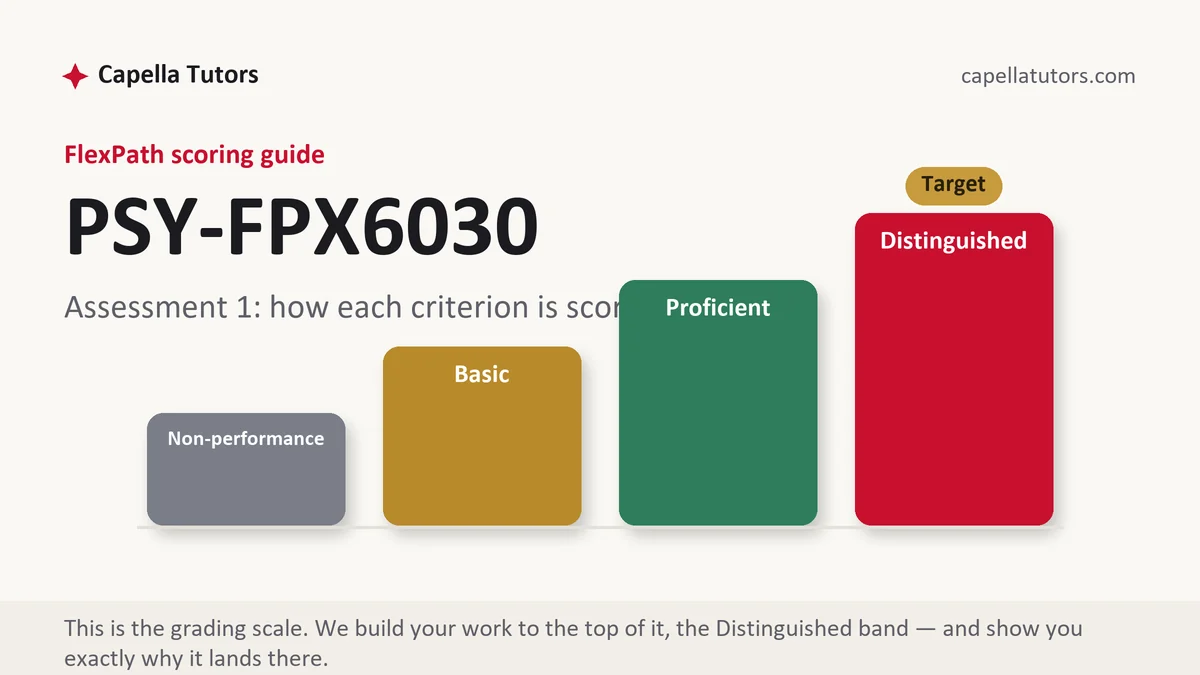
How PSY FPX 6030 Assessment 1 is scored
Each criterion is placed at one of four levels by a reader working through your sections in order. The descriptions are the assignment:
| Level | What it means on an analysis of evidence |
|---|---|
| Distinguished | Design and sample precede every result, the association is decomposed into influence, selection and shared cause, effects appear as magnitudes with intervals, verbs match designs, and the writer names the study that would settle the question. |
| Proficient | An accurate reading of the literature with appropriate caution. Sound, and short of the column that pays for taking the association apart. |
| Basic | The association restated as a cause with citations attached. This is the most common landing spot in this course, and it is a language failure as much as a reasoning one. |
| Non-performance | The appraisal of design or the treatment of confounding is absent, and an absent element cannot score above the floor. |
Everyone arrives at this course with a theory of teenagers, formed partly by having been one. The fastest way to lose these rows is to defend that theory with references, and the fastest way to win them is to write one paragraph that takes a familiar finding apart.
The PSY FPX 6030 Assessment 1 method, step by step
-
Fix the age band and the setting, then outline from the criteria
Turn every criterion into a heading with its top-level wording underneath, then write the band and the setting on the first line: sixteen-year-olds enrolled in secondary school, for instance. Any study of college students you later cite belongs to a different population, and the criterion that grades population drift is watching for that substitution.
-
State design, sample and measurement before the finding
Say your case is the association between hours of paid term-time work and falling grades. Before any number, give the design, the number of adolescents, the age range, the waves of measurement and how work hours were reported. A reader who knows the hours were self-reported at a single point weighs the result correctly without being told to.
-
Decompose the association into three candidate accounts
Some of the pattern could be an effect of the hours themselves, since time is finite and late shifts shorten sleep. Some could be selection, since adolescents already disengaged from school take more hours. Some could be a shared cause, since family income shapes both the need to work and the resources behind schoolwork. Give each a paragraph and say which the data can address.
-
Report magnitudes with intervals and in real units
A standardised coefficient means little to a reader who has to act. Convert it: how much of a grade point, across how many additional hours a week, with the interval attached. When the interval spans values that would and would not matter to a school, say so, because that is the honest description of what the study established.
-
Name the design that would settle it
Here it is within-person change across waves, with the adolescent's own earlier grades held constant, or a natural experiment created by a change in hours rules. Studies of that kind generally yield smaller estimates than cross-sectional comparisons. Saying which design you would want, and what it typically finds, is the sentence the analysis criterion is built for.
-
Match any recommendation to the mechanism, then self-score
If selection carries most of the association, a policy capping hours addresses the wrong thing and a re-engagement effort addresses the right one. Write the implication as conditional on the decomposition. Then mark each criterion yourself, revise anything under the top level, and allow the two business days faculty have to evaluate a submitted attempt.
A structure that maps to the criteria
These are our tutors' planning numbers for an analytic paper of this type rather than Capella instructions; adjust them to the weight your own criteria carry.
| Section | What it must do | Guide word target |
|---|---|---|
| The claim and the band | The association as it is usually stated, the age band, the setting, and the question this paper answers. | ~180 words |
| Evidence base described | Each study with its design, waves, sample, and how the exposure and outcome were measured. | ~300 words |
| Influence, selection, shared cause | Three accounts of the same pattern, each with the evidence that speaks for and against it. | ~350 words |
| Magnitude and precision | Effects in units a school would recognise, with intervals, and what the interval does not exclude. | ~250 words |
| The design that would settle it | The study you would run or cite, and what work of that kind reports. | ~200 words |
| Implication and references | The recommendation made conditional on the mechanism, and current APA in text and list. | ~180 words |
Annotated sample excerpt
Below is an original model paragraph from our writers, aimed at the top of the guide. Read it for the order the information arrives in, then rebuild it around whatever association your assessment gave you.
In a cross-sectional survey of 2,140 sixteen and seventeen-year-olds, self-reported paid work of twenty or more hours a week was associated with a grade point average roughly a quarter of a point lower, with a confidence interval running from about a tenth of a point to just under half.1 That single comparison cannot distinguish three accounts: that long shifts displace study time and sleep, that adolescents already disengaged from school seek more hours, and that household income drives both the need to work and the support available for schoolwork.2 Panel studies that hold each adolescent's earlier grades constant and model change across waves report smaller estimates than this, which is the pattern to expect when selection is doing part of the work, and it is the design this analysis would want before recommending an hours cap.3
- 1Design, sample, age band and measurement method arrive before the number, and the effect is given in grade points with its interval rather than as a coefficient.
- 2Three accounts named in one sentence, with the causal, the selection and the shared-cause reading kept separate. The verb stayed at associated with because the design allows nothing stronger.
- 3States what a better design typically finds and ties it to the recommendation. Naming the study you would want is the move that lifts this from a summary to an analysis.
The full premium sample for your exact assessment, written fresh to your scoring guide and issue, is free to request. Study it, revise it into your own voice, and submit work you understand.
The five mistakes that cost Distinguished
- A cross-sectional finding written with a causal verb. Caused, led to and resulted in require a design this literature rarely has, and the criteria are graded on the verb.
- Selection left out of the account. Adolescents sort themselves into activities and friendships, and an analysis that ignores that is measuring a mixture without saying so.
- Coefficients quoted with no real-world units. A standardised beta tells a reader nothing they can act on until it is expressed in grades, hours or days.
- The band drifting mid-paper. Opening on sixteen-year-olds and citing undergraduates has changed populations silently, which is the easiest catch an evaluator has.
- Popular commentary cited as evidence. A magazine feature about this generation is material to analyse, and it is not support for a claim about behaviour.
Pre-submission checklist
- The age band and setting are stated once and held throughout
- Every study appears with its design, its waves and its sample
- Influence, selection and shared cause each get their own treatment
- Effects are given in interpretable units with intervals attached
- Causal verbs appear only where the design supports them
- The paper names the design or dataset that would resolve the question
An association paper to appraise?
Send the guide, the association you were assigned and your age band. A research analyst pulls the longitudinal work, two QA reviewers check every causal verb against its design, and a premium original sample arrives in 24 to 48 hours with unlimited free revision.