How to write PSY-FPX6025 Assessment 2

The short answer

This manual is for PSY-FPX6025 Assessment 2, start to submission. The middle deliverable in Child Psychology is the applied one: a structured observation of a real child, analysed with developmental research, and closed with a recommendation an adult in that setting could actually carry out. The graded difference between a narrative and an observation is defining the behaviour before you count it, then reporting the count against the time you watched. The register is master's, the programme is a non-licensure MS in Psychology, and each criterion is judged separately. The method, the structure and an annotated sample excerpt follow. Short on time this week? A premium original sample matched to your prompt returns in 24 to 48 hours, with unlimited free revision against the guide. Your courseroom may print this as PSY FPX 6025 Assessment 2 or PSY6025 Assessment 2; it is the same deliverable, and PSY-FPX6025 Assessment 2 is what this manual walks through.

One honesty note before the manual: Capella revises courses and scoring guides over time, so always write to the exact scoring guide attached to your assessment in the courseroom. The course identity above is verified on capella.edu; the method and structure below are our tutors' approach to it, not Capella's official rubric text.
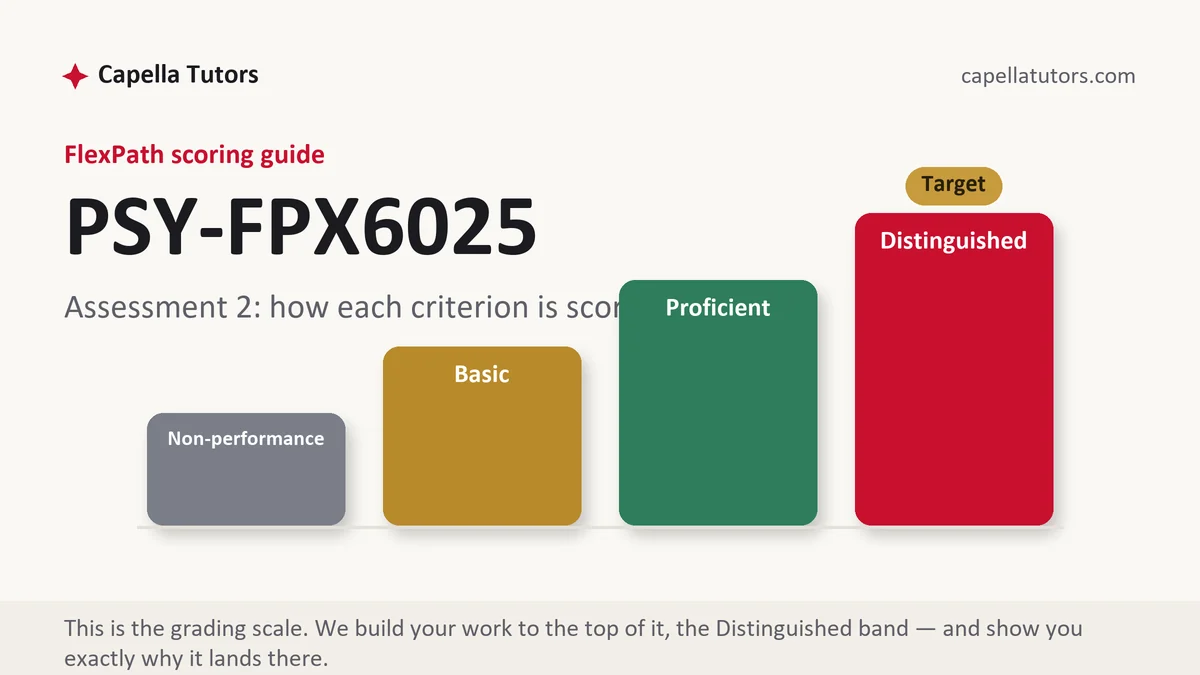
PSY-FPX6025 Assessment 2 grading scale at Capella FlexPath, the criterion levels this assessment is scored on, from Capella Tutors
How Capella FlexPath grades PSY-FPX6025 Assessment 2, visualized by Capella Tutors.

How PSY-FPX6025 Assessment 2 is scored

The guide holds a row for each criterion and four descriptions inside each row. An evaluator reads your section and points at one description:

LevelWhat it means on an observation and analysis
DistinguishedBehaviours carry definitions a second person could apply unaided, a recording method is named, counts are reported against the intervals observed, theory is attributed to its originator and used on the observed detail, and the limits of one session with one observer are stated by the writer.
ProficientA careful observation interpreted with sound research. Everything present, with the counting looser and the limits thinner than the top column wants.
BasicA story about a child. Interesting, sympathetic, unrepeatable, and full of motives inferred rather than behaviours recorded.
Non-performanceThe consent arrangements, the recording method or the analysis is missing rather than imperfect, and a missing element cannot be scored upward.

One warning about this deliverable specifically. Reliability requires two coders, so if you observed alone, write that agreement could not be established and stop there. An invented coefficient is a fabrication, and it is the one error on this assessment that does more than cost a level.

The PSY-FPX6025 Assessment 2 method, step by step

  1. Build the outline from the criteria, then fix the child's age

    Each criterion becomes a heading with its top-level wording underneath. Then write the age at the top: months for a child under three, years above it. A 34-month-old and a 44-month-old are different assignments, and every age claim you later cite has to belong to the band you wrote down.

  2. Collect three agreements before you collect any data

    The setting agrees, because a family childcare home or a classroom is somebody's responsibility. The guardian agrees, having been told what you will record and where it goes. The child agrees in words they can follow, and can refuse. Confidentiality is offered with its limit named, since a disclosure suggesting harm carries obligations a course assignment does not suspend.

  3. Define the behaviour with an inclusion and an exclusion

    Choose one or two behaviours and write them so a stranger could apply them. For a toddler at snack: a child initiation counts when the child directs speech, a point or an object toward the caregiver; it does not count when the child vocalises while facing away, and a second bid within three seconds counts as part of the same initiation. Definitions like that are what make a count mean anything.

  4. Choose a recording method that produces a denominator

    Continuous description gives you prose. Structured recording gives you data. Fifteen-second partial intervals across two twelve-minute routines yield 96 intervals, so a result reads as child initiations occurred in 31 of 96 intervals across snack and clean-up. Event counts and durations in seconds work equally well; what fails is a figure with no time attached.

  5. Interpret with primary sources and name the instrument behind each age claim

    Bring the literature to the specific thing you saw. If you use a sociocultural account of adult support, attribute it to Vygotsky rather than to a course reader, and say what the child managed with the caregiver's help that they did not manage alone. Where you cite an age at which a capacity appears, name the task that detected it, since ages in this literature are properties of the capacity and the procedure together.

  6. Write the recommendation as adult behaviour, then self-score

    Be more responsive cannot be performed. Name the object the child is looking at during the first five minutes of snack, once per turn, can be. Give the setting, the frequency and the person. Then read each criterion, mark yourself, revise anything below the top level, and submit with the two business days faculty have for evaluation in mind.

A structure that maps to the criteria

The targets below fit a single-session observation with an analysis attached, which is the usual shape; follow your own guide where it asks for more sessions or more sections.

SectionWhat it must doGuide word target
Child, setting, questionAge, setting, relevant context, and the developmental question this observation can answer.~180 words
Consent and confidentialitySite agreement, guardian permission, child assent in the child's words, and the stated limit.~180 words
Definitions and methodOperational definitions with exclusions, recording method, interval length, total duration.~250 words
What was recordedCounts against denominators, sequence where it matters, behaviour described without motive.~300 words
AnalysisThe literature applied to these observations, with instruments named and mechanisms doing work.~350 words
Limits, recommendation, referencesWhat one observer cannot establish, one performable action, and current APA both ways.~250 words

Annotated sample excerpt

An original model passage from our team, written where the guide's highest description points. Copy the discipline rather than the content, and build the version your own setting allows.

Sample excerpt: definitions and what was recorded Original model · Capella Tutors

The child, a boy of 34 months in a licensed family childcare home, was observed across two twelve-minute routines, snack and clean-up, using 15-second partial interval recording for a total of 96 intervals.1 An initiation was scored when he directed speech, a point or an object toward the caregiver, and was not scored when he vocalised while turned away or when a second bid followed within three seconds.2 Initiations occurred in 31 of 96 intervals, 27 of them during snack and 4 during clean-up, and the caregiver expanded his utterance into a longer form in 9 of those 31 intervals.3

  • 1Age in months, setting, routines, method, interval length and total intervals in one sentence. The denominator is established before any figure appears.
  • 2An inclusion rule and two exclusions, written so a second coder could apply them without a conversation. The three-second rule prevents the count inflating on a single episode.
  • 3Counts against the denominator, split by routine, with the adult's response counted separately. The routine split is what turns a number into a finding worth a recommendation.

The full premium sample for your exact assessment, written fresh to your scoring guide and issue, is free to request. Study it, revise it into your own voice, and submit work you understand.

Get the full sample free

The five mistakes that cost Distinguished

  • Motive recorded as observation. He wanted attention is an interpretation; he pointed at the cup and looked at the caregiver is a record, and only one of them can be checked.
  • Counts with no time behind them. Four initiations is not a result until a reader knows across how long and out of how many opportunities.
  • An age claim with no task attached. Capacities are dated differently under different procedures, so an unqualified age of onset is a slogan rather than a finding.
  • A recommendation nobody could perform. Encourage more language is advice; naming objects during the first five minutes of snack is an instruction with a setting and a frequency.
  • Ordinary variation written as delay. Early vocabulary ranges enormously inside the normal band, and calling the low end a delay is a clinical claim with no instrument behind it.

Pre-submission checklist

  • Site agreement, guardian permission and child assent are all documented
  • Each behaviour has an inclusion rule and at least one exclusion
  • The recording method, interval length and total duration are stated
  • Every count is reported against the intervals or opportunities observed
  • Frameworks are attributed to their originators, and every age claim names its task
  • Limits of a single observer are stated, with no agreement figure invented

Observation write-up due?

Send the guide, the child's age and the setting you can access. We build the definitions, the recording sheet and the analysis around what you can actually collect, and return a premium original sample in 24 to 48 hours with unlimited free revision.

Keep going

Online now