How to write PSY-FPX6025 Assessment 1

The short answer

This manual is for PSY-FPX6025 Assessment 1, start to submission. The opening deliverable in Child Psychology is usually an appraisal: you take a published claim about children and establish what the study behind it can and cannot support, which in this course means naming the design and the sample before you repeat a single finding. It is master's work in a non-licensure MS in Psychology, and it is scored the FlexPath way, one criterion at a time against the guide attached to your own assessment. What follows is the method our tutors use, a structure built from the criteria, and an annotated sample excerpt. Prefer to pass it to us? A premium original sample for the assessment in front of you comes back within 24 to 48 hours, revised free for as long as it takes. Your courseroom may print this as PSY FPX 6025 Assessment 1 or PSY6025 Assessment 1; it is the same deliverable, and PSY-FPX6025 Assessment 1 is what this manual walks through.

One honesty note before the manual: Capella revises courses and scoring guides over time, so always write to the exact scoring guide attached to your assessment in the courseroom. The course identity above is verified on capella.edu; the method and structure below are our tutors' approach to it, not Capella's official rubric text.
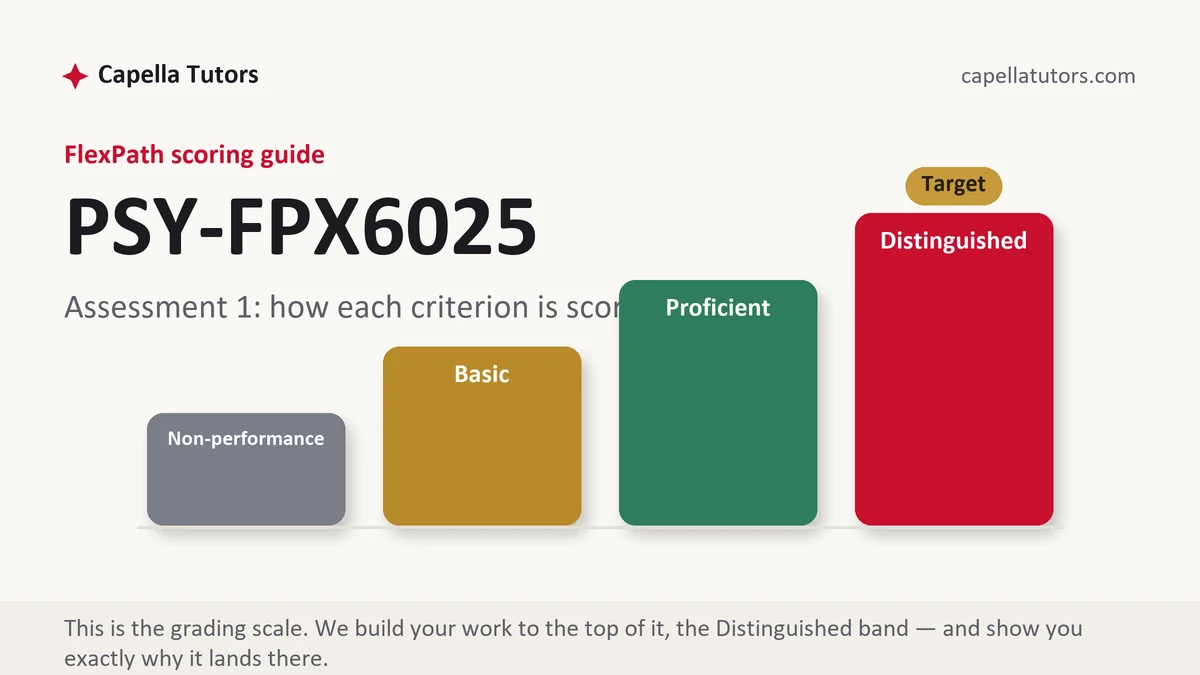
PSY-FPX6025 Assessment 1 grading scale at Capella FlexPath, the criterion levels this assessment is scored on, from Capella Tutors
How Capella FlexPath grades PSY-FPX6025 Assessment 1, visualized by Capella Tutors.

How PSY-FPX6025 Assessment 1 is scored

An evaluator does not add anything up. Each criterion on the guide receives one of four labels, and the label you want is described in words you can copy into your outline:

LevelWhat it means on a study appraisal
DistinguishedDesign, assignment and sample are stated before any result. Effects arrive as magnitudes with intervals, denominators and measurement windows are given, verbs match the design, and the appraisal says what the analysis cannot establish however small the p value.
ProficientThe study is summarised accurately and critiqued sensibly. Correct throughout, and short of the column that requires quantitative honesty about precision and about who measured what.
BasicAn abstract retold. Significance is reported as though it were size, the sample is described as children, and the critique lists generic limitations that would fit any paper.
Non-performanceA required element of the appraisal is absent, most often the methodological evaluation itself. Nothing on the page means nothing to score.

Read the guide's verbs before you read the article. Summarise, evaluate and apply are three different jobs, and an appraisal that describes a study beautifully while never judging it has answered the first criterion three times.

The PSY-FPX6025 Assessment 1 method, step by step

  1. Read the method section first, then the abstract

    Abstracts are written to be quoted and methods are written to be checked. Open the paper at participants and procedure, note the ages in months where the children are under three, note how groups were formed, and only then find out what the authors concluded. Reversing that order is how a student ends up defending a claim the design never licensed.

  2. State the design and the sample before the finding

    Take a school readiness evaluation as the running case. Your first sentence about it should carry the design, the unit of assignment, the number of children and centres, the age range and the follow-up window. A reader who knows that 24 centres were assigned rather than 618 children individually already knows how to weigh whatever comes next.

  3. Interrogate the outcome measure and who administered it

    Name the instrument, the subtest, the scale it reports on and the person holding the clipboard. A readiness composite scored by the same teachers who delivered the programme is a different measurement from one collected by assessors blind to condition, and that single fact usually deserves a paragraph rather than a clause.

  4. Report the effect with its interval, not its p value

    Convert whatever the paper gives you into a standardised difference and quote it with its confidence interval, because an interval running from just above zero to a moderate effect is telling you the study cannot distinguish trivial from useful. Then say what the difference means in the metric a practitioner uses, such as letters named or words understood.

  5. Account for the denominators, the windows and who left

    Chase the sample from enrolment to final analysis. How many were assessed at baseline, how many at follow-up, how long between, and did attrition differ by condition. Percentages reported against the analysed sample rather than the enrolled one flatter a result, and a difference in who stayed is a rival explanation for the whole finding.

  6. Write what the analysis cannot say, then self-score

    A p value is the probability of data at least this extreme if the null were true. It is not the probability that the effect is real, not the probability the hypothesis is true, not a measure of size, and not evidence of durability. Say so in one clean sentence, mark every criterion against the guide, and leave the two business days faculty have for evaluation in your schedule.

A structure that maps to the criteria

Word figures are our tutors' planning aid for an appraisal of a single study; expand any section your guide treats as its own criterion.

SectionWhat it must doGuide word target
The claim under reviewThe published claim stated in the authors' terms, and the question this appraisal will answer about it.~150 words
Design and sampleAssignment, unit, numbers, ages, setting, follow-up window, and how comparison groups were formed.~250 words
MeasurementInstruments, subtests, who administered them, blinding, and the properties reported for this age band.~250 words
Results appraisedEffects as magnitudes with intervals, denominators, attrition, and the verbs the design supports.~300 words
Rival explanationsWhat else could produce this pattern, and which threat the design leaves open.~250 words
Verdict and referencesWhat the study supports, what it does not, what would settle it, and current APA both ways.~200 words

Annotated sample excerpt

Here is an original model paragraph from our writers, cut to the register a top descriptor is asking for. Take the ordering of information and apply it to whichever article your guide assigned.

Sample excerpt: design and sample, stated first Original model · Capella Tutors

The evaluation assigned 24 childcare centres, not children, to the new literacy curriculum or to their usual programme, and enrolled 618 children aged 45 to 58 months, of whom 439 were assessed again eight months later.1 The primary outcome was a letter-naming subtest administered by the classroom teachers, who knew which condition their centre was in, and no assessor blind to condition collected any measure.2 The reported advantage was a standardised difference of 0.19 with a 95 percent confidence interval from 0.02 to 0.36, which is consistent with an effect too small to matter and with one worth having, so the study establishes that the curriculum was associated with slightly higher letter naming and does not establish how much.3

  • 1Unit of assignment, sample size, age in months and the follow-up window all arrive before a single result. The clause about who was reassessed hands the reader the attrition without editorial.
  • 2Names the instrument and the person holding it. Unblinded outcome collection by the people delivering the programme is the strongest single criticism available here, so it gets its own sentence.
  • 3The interval does the arguing, the verb matches the design, and the closing clause separates what was shown from what was not. This is the sentence the evaluation criterion is written for.

The full premium sample for your exact assessment, written fresh to your scoring guide and issue, is free to request. Study it, revise it into your own voice, and submit work you understand.

Get the full sample free

The five mistakes that cost Distinguished

  • Significance reported as size. A small p value with 618 children can sit under an effect no practitioner would notice, and the two questions are not related.
  • The word children standing in for the sample. If the participants were four-year-olds in centre-based care, every sentence should say so, because that is the population the finding belongs to.
  • Causal verbs on a design that cannot carry them. Improved, raised and produced require assignment and control; observational work supports was associated with and predicted.
  • Generic limitations. More research is needed and the sample was small fit every paper ever written, which is why they earn nothing. Name the threat this design leaves open.
  • A framework cited to a textbook. If the authors lean on a developmental theory, attribute it to the person who proposed it and note where the field has since revised the claim.

Pre-submission checklist

  • Design, unit of assignment and sample appear before the first result
  • Ages are given in months for children under three and in years above it
  • Every effect carries a magnitude and an interval, not a p value alone
  • Attrition and the analysed denominator are stated for each outcome
  • One sentence says plainly what a p value cannot establish
  • Theory is attributed to primary sources, in current APA both ways

Study appraisal on your desk?

Send the guide and the article you were assigned. A research analyst pulls the method apart, two QA reviewers check that every figure in the draft matches the paper it came from, and a premium original sample arrives in 24 to 48 hours with free revision until the criteria are met.

Keep going

Online now