This manual is for PSY-FPX6025 Assessment 3, start to submission. The final deliverable in Child Psychology is usually the synthesis one, where a screening result, a family's worry and a mixed longitudinal literature all have to be reconciled into advice a caregiver can use. The competence being graded is knowing what a screening instrument predicts, at what accuracy, in a population with a given base rate, and saying so without either alarming a parent or dismissing them. Master's register throughout, a non-licensure MS in Psychology, and no strong criterion can carry a weak one. Method, structure and an annotated sample excerpt are set out below. Rather not build it yourself? A premium original sample for this exact deliverable reaches you inside 24 to 48 hours, revised without charge until the criteria are clear. Your courseroom may print this as PSY FPX 6025 Assessment 3 or PSY6025 Assessment 3; it is the same deliverable, and PSY-FPX6025 Assessment 3 is what this manual walks through.
One honesty note before the manual: Capella revises courses and scoring guides over time, so always write to the exact scoring guide attached to your assessment in the courseroom. The course identity above is verified on capella.edu; the method and structure below are our tutors' approach to it, not Capella's official rubric text.
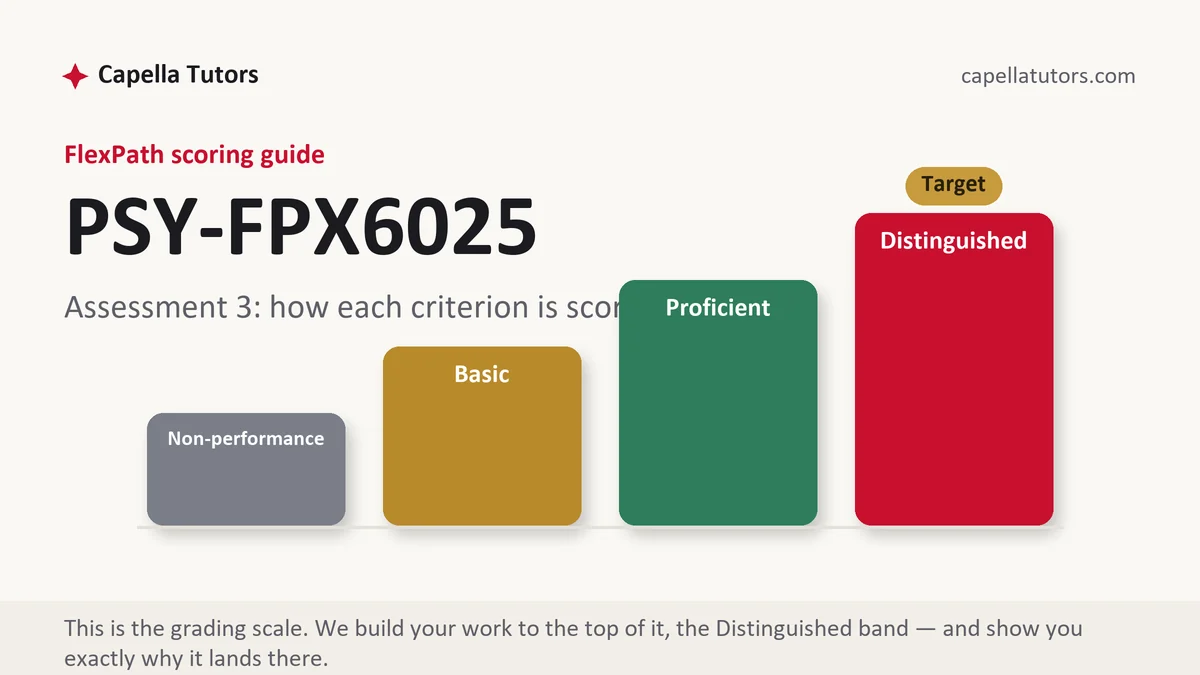
How PSY-FPX6025 Assessment 3 is scored
Every criterion is judged on its own against four written descriptions. There is no total, and a strong section cannot lift a weak one:
| Level | What it means on a synthesis and recommendation |
|---|---|
| Distinguished | The instrument is named with its cut-off and its age band, prediction is reported as accuracy against a base rate rather than as a verdict, the longitudinal evidence arrives with denominators and windows, and the recommendation carries a review date and a statement of what would change it. |
| Proficient | A sound synthesis with a sensible plan. Accurate, and missing the quantitative honesty about what a positive screen actually implies. |
| Basic | A screening result treated as a diagnosis, or dismissed as nothing, with the literature summarised on either side of that choice. |
| Non-performance | The synthesis, the evidence appraisal or the recommendation is absent. Missing content is the only thing a criterion cannot forgive. |
The synthesis criterion in this course rewards holding two things at once: a group-level probability and one particular child. A paper that resolves the tension by picking a side has answered a simpler question than the one on the guide.
The PSY-FPX6025 Assessment 3 method, step by step
-
Separate the construct from the instrument on the first page
Expressive vocabulary is a capacity. A parent-report checklist with a percentile cut-off is a measurement of it. Write both, with the child's age in months, and keep them apart for the rest of the document, because most of the confusion in this literature comes from letting the second stand in for the first.
-
Report the screen as accuracy against a base rate
Take a 26-month-old scoring below a tenth-percentile cut-off on a vocabulary checklist. The graded move is arithmetic, not reassurance. If roughly 15 in 100 children of this age screen positive, and a substantial share of them are speaking within range by school entry, then a positive screen raises the probability of a persisting difficulty without establishing it. Say what proportion of positives resolve, and cite the cohort that gave you the figure.
-
Read the longitudinal evidence with its denominators and windows
Cohort studies of late talkers report resolution rates that vary with the cut-off used, the age at screening, the outcome measured and the age at follow-up. So report those four every time you cite a rate. A figure quoted without its window is not comparable to any other figure, and the criterion that grades evidence use is looking precisely at whether you noticed.
-
Name the predictors the evidence supports, at their strength
Comprehension well below production, few communicative gestures, limited use of word combinations near the second birthday and a family history of language difficulty each shift the odds. They shift them, which is a different sentence from determining the outcome. Attach the design behind each predictor, and keep the verb at predicts rather than causes throughout.
-
Write difference and disorder as two categories
A child learning two languages is not a child with a smaller vocabulary; totals counted across both languages are the relevant comparison. A checklist normed on one population applied to another measures the fit between the child and the norms as much as the child. Where the instrument does not fit, say so plainly and describe what the score can and cannot be read as.
-
Give the recommendation a date, then self-score
Monitoring with no review point is a way of doing nothing. Write the action, the person, the frequency and the date the decision gets revisited, plus the referral route if the indicator has not moved by then. Then score each criterion against the guide yourself, and remember that faculty have two business days to return an attempt.
A structure that maps to the criteria
The figures below suit a synthesis with a recommendation attached; redistribute them if your own guide splits the evidence appraisal into more than one criterion.
| Section | What it must do | Guide word target |
|---|---|---|
| The case and the question | Age in months, the concern as reported, the instrument used, and the decision to be made. | ~180 words |
| Construct and measurement | What the capacity is, what the instrument measures, the cut-off, the norming population, the age band. | ~250 words |
| What the screen implies | Base rate, accuracy, and the probability a positive screen actually supports, in plain arithmetic. | ~250 words |
| Longitudinal evidence | Resolution and persistence rates with cut-offs, windows, denominators and designs attached. | ~300 words |
| Difference, fit and limits | Language exposure, norming fit, and what this score cannot be read as for this child. | ~250 words |
| Recommendation and references | Action, person, frequency, review date, referral route, and current APA in text and list. | ~250 words |
Annotated sample excerpt
The passage below is our own model, written at the height the top descriptor sets. Learn how the probability language is handled and then write your own case with your own instrument.
At 26 months, the child produced 42 words on a parent-report checklist whose cut-off for concern at this age sits at the tenth percentile, and he combined no words into phrases.1 Screens of this kind identify a group in which a meaningful proportion of children reach typical range without intervention by school entry, so the result raises the probability of a persisting difficulty and does not establish one; the two findings that matter more than the total are the absence of word combinations and comprehension the family describes as well ahead of speech.2 The plan therefore treats the score as a reason to measure again on a fixed date rather than as a diagnosis, and states the referral that follows if the phrase count has not moved by 30 months.3
- 1Age in months, the raw count, the instrument's own cut-off and one additional observable. Nothing is characterised before it is measured.
- 2Probability language kept honest in both directions, then the predictors that carry more weight than the headline score. Raises the probability and does not establish is the whole graduate move.
- 3Turns the uncertainty into a dated decision with a named trigger, which is what makes the recommendation criterion scoreable rather than sympathetic.
The full premium sample for your exact assessment, written fresh to your scoring guide and issue, is free to request. Study it, revise it into your own voice, and submit work you understand.
The five mistakes that cost Distinguished
- A screen read as a diagnosis. A cut-off sorts a population into two groups; it does not tell you which group this child belongs in for the next four years.
- Resolution rates quoted without their windows. A percentage that does not say which cut-off, which outcome and which follow-up age cannot be compared with anything.
- Predictors written as determinants. Shifts the odds and decides the outcome are different claims, and only one of them is supported.
- Bilingual exposure counted as a deficit. Vocabulary totalled across both languages is the comparable figure, and a single-language count understates what the child knows.
- Monitoring with no date. Watch and see is not a plan until somebody knows who measures what, and when the decision comes back.
Pre-submission checklist
- Construct and instrument are named separately, with the age band the instrument covers
- The screen's implication is expressed as probability against a base rate
- Every rate carries its cut-off, its outcome, its follow-up age and its denominator
- Predictive language stays at predicts and shifts the odds
- Norming fit and language exposure are addressed for this particular child
- The recommendation names an action, a person, a review date and a referral trigger
Screening case to synthesise?
Send the guide, the case details you have and the instrument involved. A research analyst pulls the cohort evidence, two reviewers check the probability language line by line, and a premium original sample lands in 24 to 48 hours with free revision until every criterion is satisfied.