How to write PSY-FPX6020 Assessment 2

The short answer

This manual is for PSY-FPX6020 Assessment 2, start to submission. The assessment usually asks you to convert the issue you analysed into an advocacy plan and a written product a busy decision maker could act on, which means a named body with authority, the instrument that body would use, the point in its calendar you are aiming at, and an ask carrying an actor, an amount and a date. It is master's work in a non-licensure MS in Psychology, and every criterion on your guide is placed at one of four levels rather than averaged into a grade. Below is our tutors' method, a criterion-mapped structure, and an annotated sample excerpt. Would you rather delegate it? A premium original sample written to this exact assessment arrives inside 24 to 48 hours, revised at no charge until the criteria are met. Your courseroom may print this as PSY FPX 6020 Assessment 2 or PSY6020 Assessment 2; it is the same deliverable, and PSY-FPX6020 Assessment 2 is what this manual walks through.

One honesty note before the manual: Capella revises courses and scoring guides over time, so always write to the exact scoring guide attached to your assessment in the courseroom. The course identity above is verified on capella.edu; the method and structure below are our tutors' approach to it, not Capella's official rubric text.
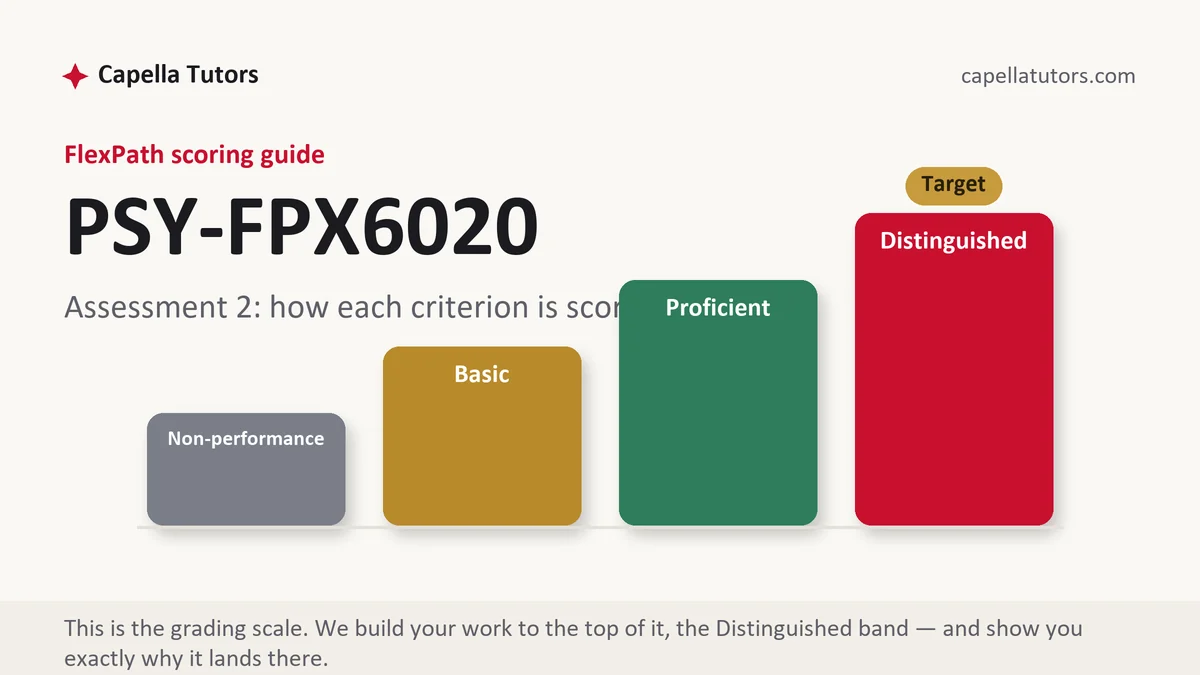
PSY-FPX6020 Assessment 2 grading scale at Capella FlexPath, the criterion levels this assessment is scored on, from Capella Tutors
How Capella FlexPath grades PSY-FPX6020 Assessment 2, visualized by Capella Tutors.

How PSY-FPX6020 Assessment 2 is scored

Nothing here is curved and nothing is averaged. Your guide prints a criterion, four descriptions of what that criterion can look like, and an evaluator picks one:

LevelWhat it means on an advocacy plan
DistinguishedThe request could be granted as written. A real body, a real instrument, a current-year cost, a start date, and a measure the target already collects, with the strongest objection answered on its own terms rather than waved at.
ProficientA coherent plan with an actionable request and sound support. Everything the criterion asked for, without the feasibility detail that makes a reader believe it.
BasicA recommendation addressed to nobody in particular. Raise awareness, increase support and prioritise children all live here, because none of them can be voted on.
Non-performanceAn element the criterion names is missing outright, most often the cost or the opposition. A guide can only score what appears on the page.

The plan and the written product are usually graded on separate criteria, so treat them as two documents with one argument. The plan explains why this target, this instrument and this timing; the product is what the target actually reads.

The PSY-FPX6020 Assessment 2 method, step by step

  1. Start at the decision, not at the topic

    Write three lines before anything else: the body that can act, the instrument it would act through, and the date its calendar makes available. A district board voting on a bell schedule in March, a county commission adopting a budget in June and an agency taking comment for thirty days are three different assignments, and the guide grades whether you knew which one you were in.

  2. Draft the ask until it could be granted

    Work an example. Weak: the district should take adolescent sleep seriously. Strong: the board should move the two comprehensive high schools from a 7:20 start to 8:30 for the coming school year, funded by a three-tier bus rotation costed at a stated annual figure, with tardy arrivals per 100 enrolled students reported each quarter. Actor, action, amount, population, date, measure. Six parts, one sentence.

  3. Price it in this year's money, in both directions

    Give the current-year cost of your request and the current-year cost of the situation as it stands, in the same units, from sources you name. Where you cite a longer-run benefit figure, say what discount rate produced it and what programme intensity it assumed, since a benefit stream valued at three percent and the same stream valued at seven are different arguments.

  4. Match the evidence to the claim, and label the weak links

    Developmental research on adolescent sleep timing is strong on the biological shift in sleep phase and thinner on district outcomes, where most published evaluations are pre-post comparisons in single systems without randomised controls. Report that honestly. A modest claim with its design attached survives a hearing; a large claim borrowed from the most favourable study does not.

  5. Write to the venue, then count your allies

    A brief opens with the ask, keeps paragraphs to four lines, puts every number in a small table, and stops on the second page. Then list who else supports the request and what standing each ally has, because a board is counting as much as it is reading, and three named organisations change the arithmetic of a vote.

  6. Answer the objection, then self-score

    Give the opposition its best case, which here is transport cost, after-school employment and athletics scheduling rather than indifference, and answer each on its own ground. Then mark every criterion against the guide yourself before submitting, and allow the two business days faculty have to evaluate an attempt.

A structure that maps to the criteria

Targets below describe a plan with a two-page brief attached, which is the shape most guides in this course reward; reweight wherever your criteria say otherwise.

SectionWhat it must doGuide word target
The ask, up frontOne sentence carrying actor, action, amount, population, start date and the measure of success.~120 words
Target, instrument, timingWho decides, through what mechanism, at which point in a calendar you can name.~250 words
The problem in numbersThe condition sized for this jurisdiction, with denominators, periods and named sources.~250 words
Evidence warrantWhy this response addresses that condition, study by study, with designs and reported effects.~350 words
Cost, feasibility, objectionCurrent-year figures both ways, assumptions declared, and the best counterargument answered.~300 words
Allies, ethics, referencesNamed supporters with their standing, permissions for any personal material, current APA.~180 words

Annotated sample excerpt

Below is an original opening from our writers, pitched where the top descriptor lives. Study the sequence of moves and rebuild them around your own board and your own numbers.

Sample excerpt: opening of the brief Original model · Capella Tutors

We ask the Board of Education to set the 2027 to 2028 start time at Northside and Grantham High Schools at 8:30 a.m., using the three-tier bus rotation costed by the transportation office at $214,000 for the first year, with tardy arrivals per 100 enrolled students reported to this board each quarter.1 Last year 38 of every 100 students at the two schools were marked tardy at least six times, on a 7:20 first bell that begins the day before the biological shift in adolescent sleep timing has released them.2 Districts that have moved a start time later report reduced tardiness and longer sleep on school nights, in pre-post evaluations without control districts, so we make the modest version of that claim and propose the quarterly measure that would test it here.3

  • 1The whole request lives in sentence one, priced, dated and measurable, with the cost attributed to the office that produced it rather than estimated by the writer.
  • 2A rate with a denominator, then the mechanism in a single clause. The number and the developmental reason for it arrive together.
  • 3Names the design limitation before an opponent can, then converts the weakness into a monitoring commitment. This is the sentence that separates the top two columns.

The full premium sample for your exact assessment, written fresh to your scoring guide and issue, is free to request. Study it, revise it into your own voice, and submit work you understand.

Get the full sample free

The five mistakes that cost Distinguished

  • An ask with no price. A request a decision maker cannot cost is a request they will defer, and the feasibility criterion reads a missing figure as a missing answer.
  • A metric that needs new data collection. If nobody currently counts what you propose to report, you have hidden a second request inside the first.
  • Advocacy inflation. Crisis and epidemic tell a reader you are managing them; the figure that made you reach for the word does the work better.
  • Lobbying rules ignored. A plan that has a charitable organisation running an unrestricted legislative campaign has failed on legal feasibility, whatever its merits.
  • The opposition described rather than answered. Naming an objection and moving on leaves the criterion that pays for the rebuttal unearned.

Pre-submission checklist

  • The ask names an actor, an amount, a population and a start date
  • The decision maker, the instrument and the calendar date are all identified
  • Current-year cost appears for the proposal and for the status quo
  • Any long-run benefit figure carries its discount rate and intensity assumption
  • The strongest objection is stated fairly and answered with evidence
  • Allies are named with their standing, and every number matches everywhere it appears

Advocacy plan due this week?

Send the guide, the issue and the body you intend to ask. A team of eight builds the plan backward from the decision, prices the request, answers the objection, and returns a premium original sample inside 24 to 48 hours. Revisions are free until every criterion is satisfied.

Keep going

Online now