This manual is for PSY-FPX6020 Assessment 1, start to submission. The opening deliverable in Advocacy in Child and Adolescent Development is the analysis everything later in the course stands on: a condition affecting children or adolescents defined so precisely that it can be counted, sized inside a named jurisdiction, and connected to developmental research reported at the strength the research actually carries. It is master's work in a non-licensure MS in Psychology, and it is graded the FlexPath way, criterion by criterion against a scoring guide. What follows is the method our tutors use on it, a structure that maps to the criteria, and an annotated sample excerpt. Rather hand the whole thing over? A premium original sample built for this exact assessment returns in 24 to 48 hours, with free revision until the guide is satisfied. Your courseroom may print this as PSY FPX 6020 Assessment 1 or PSY6020 Assessment 1; it is the same deliverable, and PSY-FPX6020 Assessment 1 is what this manual walks through.
One honesty note before the manual: Capella revises courses and scoring guides over time, so always write to the exact scoring guide attached to your assessment in the courseroom. The course identity above is verified on capella.edu; the method and structure below are our tutors' approach to it, not Capella's official rubric text.
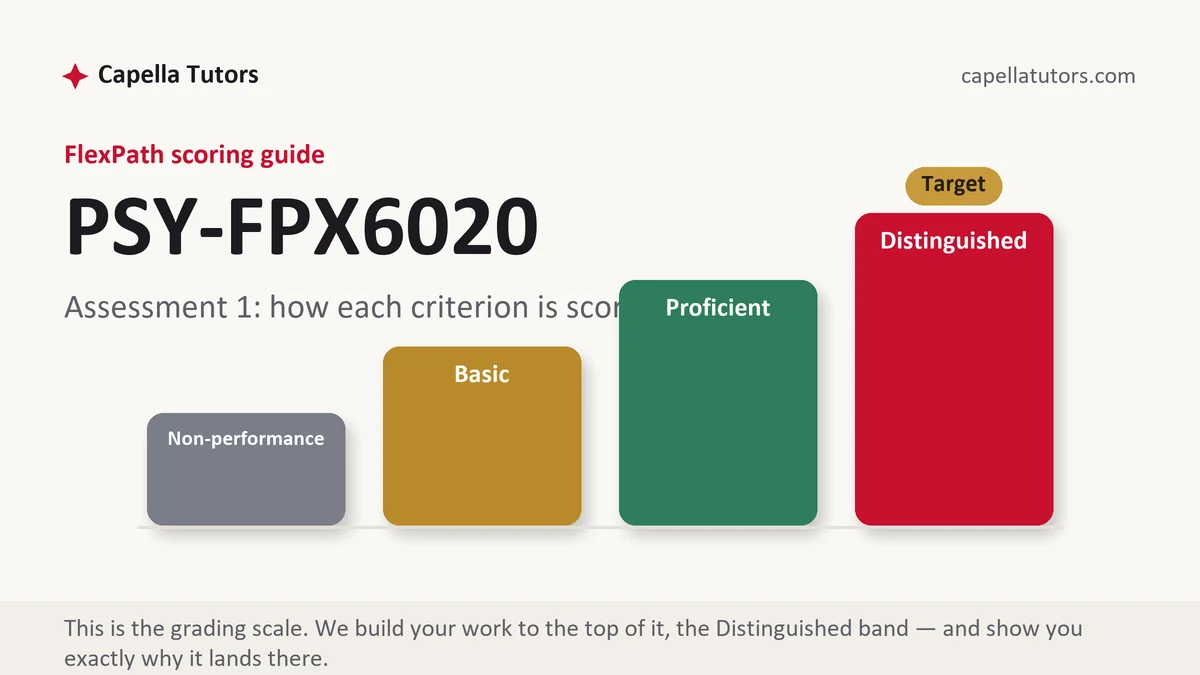
How PSY-FPX6020 Assessment 1 is scored
FlexPath does not award a letter. A scoring guide lists criteria, each criterion is placed at one of four levels, and the wording of those levels is the only brief that matters:
| Level | What it means on an issue analysis |
|---|---|
| Distinguished | The condition is defined as a measured quantity, sized with a denominator from the jurisdiction under discussion, and the developmental evidence is reported with its design and its published magnitude. The writer, not the reader, names what the data cannot establish. |
| Proficient | The issue is described accurately and supported with credible research. Complete, and still short of the column that pays for stated limits and local numbers. |
| Basic | A concerned essay. The problem is real, the sources are respectable, and nothing in the document could be checked by an analyst who wanted to. |
| Non-performance | A required element is absent, most often the quantification or the evidence appraisal. Absent, rather than thin, is what puts a criterion on the floor. |
Treat this assessment as the foundation it is. A later advocacy plan can only ask for something proportionate to a problem that has already been measured, so a vague opening analysis quietly caps the grade on everything that follows it in the course.
The PSY-FPX6020 Assessment 1 method, step by step
-
Turn the criteria into headings, then fix the jurisdiction
Copy each criterion into an outline as its own heading and park the top-level descriptor underneath it. Then write the state, county or district you are analysing on the first line and leave it there. Advocacy analysis that floats above any particular place has no data source and no reader.
-
Convert the concern into one measurable condition
Say the assessment lets you choose the issue. Chronic absence in the early grades is a good choice because it is already counted. Define it the way the record defines it: a student enrolled at least ten days who misses ten percent or more of days enrolled, for any reason, across one school year. An indicator with an inclusion rule, a window and a source is a graduate definition.
-
Find the denominator before you quote the number
A count of affected children is unusable alone. Report the numerator, the population it came out of, the collection year and the exact indicator name, because two similar-sounding attendance measures often count different students. Prefer the district's own published figure over a national estimate; a board recognises its own data and argues with everyone else's.
-
Bring developmental research in at its published size
The evidence has to answer why this condition matters developmentally, and it enters your sentence with its design and its sample. Cohort work linking early absence to later reading and behaviour is largely observational, so the honest verb is associated with rather than causes, and the effect goes in at the magnitude the paper reports rather than at the magnitude that would help you.
-
Disaggregate before you generalise
A district average hides the analysis. Report the condition by grade, by school and by any group the record allows, and say which subgroups carry most of the total. This is also where you name what the numbers cannot separate, such as illness, transport, housing instability and suspension, all of which land in the same column.
-
Self-score the draft, then submit early in the week
Read the draft one criterion at a time and mark yourself at a level, honestly, before an evaluator does. Anything under the top level earns another pass. Faculty have two business days to return an attempt, so a Thursday submission can sit over a weekend for no reason.
A structure that maps to the criteria
These lengths are planning targets our tutors use for an analysis of this kind rather than Capella requirements; stretch any section your own guide weights more heavily.
| Section | What it must do | Guide word target |
|---|---|---|
| The issue introduced | Name the condition, the population and the jurisdiction, and close on the question this analysis answers. | ~150 words |
| Definition and measure | The operational definition, the indicator, the reporting window, and the source that publishes it. | ~200 words |
| Scale and distribution | Counts with denominators, disaggregated by grade or site, with the years compared stated. | ~300 words |
| Developmental warrant | Why the condition matters for development, study by study, with designs, samples and effect magnitudes. | ~350 words |
| Limits and rival explanations | What the indicator cannot distinguish, and the competing causes that produce the same figure. | ~200 words |
| Conclusion and references | The condition restated as measured, the decision it now makes possible, and current APA both ways. | ~150 words |
Annotated sample excerpt
A model paragraph written by our team, set at the register the top of the guide is describing. Read it as study material: take the moves, then build your own version around your own jurisdiction.
In Marion County Public Schools, 1,412 of the 6,940 children enrolled in kindergarten through grade two during the 2024 to 2025 year missed at least ten percent of the days they were enrolled, which the state reports as chronic absence.1 That is 20.3 percent of the youngest cohort in the district, against 11.8 percent in grades three through five, and the figure is a count of days rather than a judgment about families, since it includes excused illness, suspension and transport failures without distinguishing them.2 This analysis establishes the size and the distribution of that condition in one district, then asks what the developmental research does and does not license anyone to conclude from it.3
- 1Numerator, denominator, grade band and school year arrive in a single sentence, with the definition attributed to the body that publishes it. Nothing here has to be taken on trust.
- 2The comparison gives the figure meaning, and the second clause disarms the reading a hostile reader would make. Saying what the indicator lumps together is the move the limits criterion pays for.
- 3States the scope of the paper as an analysis rather than as an argument, which keeps this deliverable out of the advocacy plan's territory.
The full premium sample for your exact assessment, written fresh to your scoring guide and issue, is free to request. Study it, revise it into your own voice, and submit work you understand.
The five mistakes that cost Distinguished
- The adjective in place of the figure. Alarming, widespread and devastating are words a reader discounts, and each one can be swapped for the number that provoked it.
- A count with nothing under it. Two thousand affected children is not a finding until the population, the period and the definition sit next to it.
- National data used for a local decision. A federal estimate establishes that the condition exists; the district's own record establishes that it exists here, which is the only version a board acts on.
- Causal verbs on observational evidence. Cohort studies support associated with, predicts and is followed by, and a paper that writes leads to has claimed a design it does not have.
- The remedy smuggled in early. An analysis that spends its evidence recommending a programme has answered a criterion from a later deliverable and left this one incomplete.
Pre-submission checklist
- Every criterion in the guide has a labelled section of its own
- The condition carries an operational definition with a window and a source
- Each figure appears with its denominator, its collection year and its indicator name
- Every study is named with its design, its sample and the effect it reported
- Causal language is limited to what the designs cited can carry
- One paragraph states plainly what the indicator cannot distinguish
Want this issue analysis handled?
Send the scoring guide, the issue and your county or district. Eight people, including a research analyst and two QA reviewers, return a premium original sample built to the top descriptor in 24 to 48 hours, with unlimited free revision. Every number in it comes back with a denominator and a citation attached.