How to write PSY-FPX6020 Assessment 3

The short answer

This manual is for PSY-FPX6020 Assessment 3, start to submission. The closing deliverable in this course is usually the synthesis one: spoken testimony or a comparable public product, plus the written defence of the evidence behind it, which is where you argue for action while the research supporting the remedy is weaker than the research establishing the harm. That combination is the situation most child advocacy actually occupies, and the criteria are grading whether you can hold it honestly. This is master's work inside a non-licensure MS in Psychology, and the guide attached to your own assessment sets every level on it. Below is the method, the structure, and an annotated sample excerpt. Want it taken off your desk? A premium original sample for this deliverable lands in 24 to 48 hours, and revision stays free until the guide is answered. Your courseroom may print this as PSY FPX 6020 Assessment 3 or PSY6020 Assessment 3; it is the same deliverable, and PSY-FPX6020 Assessment 3 is what this manual walks through.

One honesty note before the manual: Capella revises courses and scoring guides over time, so always write to the exact scoring guide attached to your assessment in the courseroom. The course identity above is verified on capella.edu; the method and structure below are our tutors' approach to it, not Capella's official rubric text.
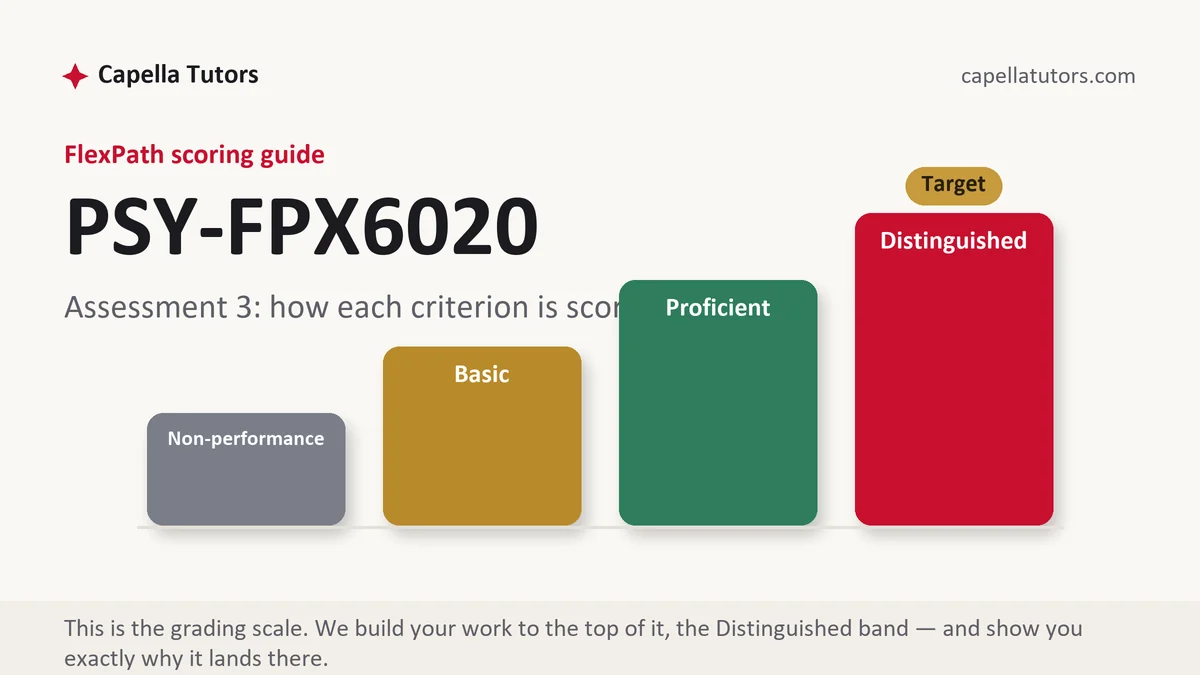
PSY-FPX6020 Assessment 3 grading scale at Capella FlexPath, the criterion levels this assessment is scored on, from Capella Tutors
How Capella FlexPath grades PSY-FPX6020 Assessment 3, visualized by Capella Tutors.

How PSY-FPX6020 Assessment 3 is scored

Four levels, one per criterion, chosen by a reader rather than computed. Read the top level as a set of instructions and the bottom as a description of what an unfinished draft looks like:

LevelWhat it means on testimony with an evidence defence
DistinguishedThree claims are kept apart: that the harm is documented, that this response reduces it, and that the response is worth its cost. Each is supported at the strength its own evidence allows, the assumptions behind any projected figure are printed, and the writer says what finding would change the recommendation.
ProficientA persuasive product with credible sourcing throughout. The claims are correct and still bundled, so the reader cannot see which one is carrying the argument.
BasicConviction with citations. The certainty attached to the documented harm has been borrowed for the proposed remedy, which is the standard failure in this literature.
Non-performanceThe defence, the limits or the ethical treatment of personal material is missing rather than weak, and a criterion with nothing to read scores at the floor.

The synthesis criterion is the one students lose. It rewards a writer who is willing to say the effect expected is modest, the evidence is mixed, and here is the measure that would settle it within two years. That sentence reads as weakness to a first-time advocate and as competence to anyone who has sat on a committee.

The PSY-FPX6020 Assessment 3 method, step by step

  1. Write for the ear and the clock

    Spoken advocacy is a different genre from a paper. Committees allot two or three minutes, chairs enforce it, and a reader who runs long is cut off mid-argument. Draft to roughly 130 words a minute, read it aloud with a timer, and cut adjectives first. Turn every subordinate clause you can into its own short sentence.

  2. Open with who you are and what you want

    Name yourself, your standing, and the request, in that order, in the first fifteen seconds. A subcommittee weighing whether to continue an appropriation is deciding between line items, so the request has to arrive as a line item: continue the current appropriation for the home visiting programme serving adolescent parents at its present level for the coming biennium.

  3. Carry one number and one bounded illustration

    Spoken testimony holds a single statistic well and a second one badly. Choose the figure with the clearest denominator, say it once, and attribute it. If you use a family's experience, you need the guardian's permission and the young person's assent, identifying detail stripped, and a statement of where the material will be heard, because a public hearing is a different exposure from a course paper.

  4. Separate the three claims in the written defence

    Give the harm its own section, with the evidence that establishes it. Give the remedy its own section, with the evaluation literature at the size and design it actually has, which for home visiting means trials with mixed results across outcomes rather than a uniform success story. Give the cost argument its own section. Merging them is what makes an analyst distrust the parts that were solid.

  5. Print your assumptions where a critic would look

    Any figure projecting benefits into the future rests on choices: the discount rate, the programme intensity assumed, the population it was measured on, and the years over which savings accrue. Put those four in a short table. A committee analyst will find them anyway, and finding them yourself is the difference between a caveat and a correction.

  6. Say what would change your mind, then self-score

    Close the written defence by naming the result that would make you withdraw the request, and the indicator that would show it within two years. Then mark each criterion against the guide at a level, revise anything under the top one, and submit with the two business days faculty need for evaluation built into your plan.

A structure that maps to the criteria

The split below assumes a short spoken product plus a longer written defence, which is the common shape here; move the weight if your guide describes a single document.

SectionWhat it must doGuide word target
The spoken productStanding, request, one number, one illustration, one thank you, inside the time limit.~350 words
Audience and venue analysisWho sits on the body, what they decide, and why this moment in the calendar is the one.~200 words
Claim one, the harmThe documented condition, with denominators, periods and the designs behind it.~250 words
Claim two, the responseThe evaluation evidence for this remedy, including null and negative results, at published magnitudes.~300 words
Claim three, the costCurrent-year figures both ways, plus the assumption table behind any projection.~250 words
Ethics, limits, referencesConsent and assent, de-identification, the result that would change the ask, current APA.~200 words

Annotated sample excerpt

What follows is one of our own model openings for spoken testimony, written at the level the top descriptor describes. Learn the sequence, then write yours to your own committee and your own state.

Sample excerpt: opening of testimony Original model · Capella Tutors

Chair Delgado, members of the subcommittee, my name is A. Rivera and I coordinate the parent education programme at Cedar Valley Family Center. We ask you to continue the appropriation for nurse home visiting at its current level for the coming biennium.1 Last year the programme enrolled 412 of the 611 first-time parents under twenty who gave birth in our four counties, and 89 percent of those families were still enrolled at the child's first birthday.2 I want to be plain with you about the research: the trials of this model show clear effects on some outcomes, smaller and inconsistent effects on others, and the honest case for continuing is that enrolment and retention here are strong and the twelve-month indicators are the ones we are willing to be judged on.3

  • 1Standing and request inside two sentences, phrased as the budget action the committee actually takes. No preamble about the importance of children.
  • 2One statistic, with numerator, denominator and geography, plus a retention figure that speaks to delivery rather than to outcome. Spoken testimony can hold this and no more.
  • 3Volunteers the mixed evidence, then offers a measure to be held to. Conceding the limit is what buys credibility for the parts of the record that are strong.

The full premium sample for your exact assessment, written fresh to your scoring guide and issue, is free to request. Study it, revise it into your own voice, and submit work you understand.

Get the full sample free

The five mistakes that cost Distinguished

  • The harm's certainty lent to the remedy. A well documented problem does not make a weakly evidenced programme work, and the synthesis criterion is watching for exactly that transfer.
  • Testimony written as an essay. Long sentences and stacked clauses collapse when read aloud under a timer, and a chair will stop you at the limit whatever you had left.
  • A projection with hidden arithmetic. An unstated discount rate is the first thing a committee analyst asks about, and being asked is worse than disclosing.
  • Only favourable trials cited. A review that reports null results strengthens your position, because it shows the writer read the literature rather than shopped it.
  • A young person's story used without assent. Guardian permission alone is not enough, and confidentiality carried over from paid work does not lift because the hearing is public.

Pre-submission checklist

  • The spoken product has been read aloud against a timer and fits the limit
  • The request is phrased as the action the body actually takes
  • Harm, remedy and cost each occupy their own section with their own evidence
  • Null and negative findings appear alongside the favourable ones
  • Every projected figure carries its rate, its intensity and its population
  • Consent, assent and de-identification are documented for any personal material

Testimony to write and defend?

Send the guide, the committee or venue, and the programme you are defending. Eight people build the testimony to the clock, split the three claims, print the assumptions, and return a premium original sample in 24 to 48 hours. Free revision until the criteria are clear.

Keep going

Online now