This manual is for PSY-FPX6010 Assessment 3, start to submission. The closing deliverable in Human Prenatal Development usually asks you to evaluate a screening or measurement practice rather than to describe one: what the instrument was built to do, what its development paper reports about reliability and validity, whether its validation sample resembles the people it is used on, what a positive result actually means at the prevalence in that setting, and the conditions under which its use is defensible. Your scoring guide decides the sections. One fact governs the whole deliverable, which is that a screen returns a change in probability rather than a finding. Below is the method our tutors use for it, a structure that maps to the criteria, and an annotated sample excerpt. Prefer to hand it off? A premium original sample for this exact assessment comes back in 24 to 48 hours, revised free until it meets the guide. Your courseroom may print this as PSY FPX 6010 Assessment 3 or PSY6010 Assessment 3; it is the same deliverable, and PSY-FPX6010 Assessment 3 is what this manual walks through.
One honesty note before the manual: Capella revises courses and scoring guides over time, so always write to the exact scoring guide attached to your assessment in the courseroom. The course identity above is verified on capella.edu; the method and structure below are our tutors' approach to it, not Capella's official rubric text.
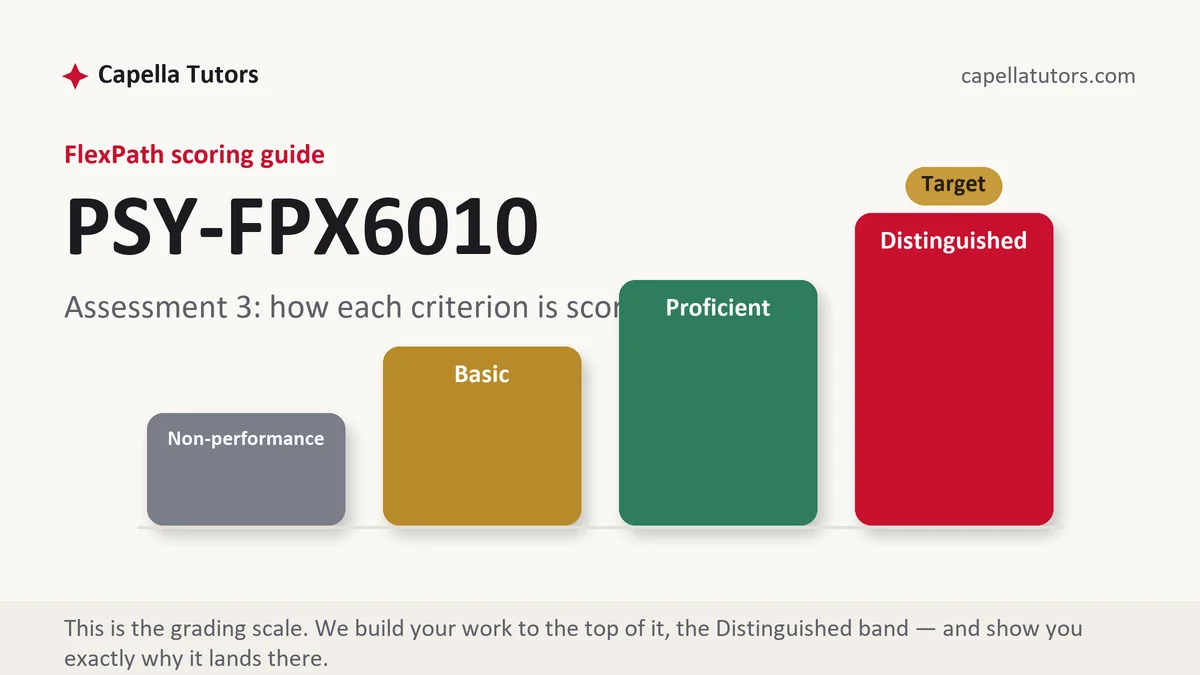
How PSY-FPX6010 Assessment 3 is scored
There are no letter grades in FlexPath. Each criterion on the scoring guide lands on one of four levels, and the level language is the writing brief:
| Level | What it means on a critique of a screening instrument |
|---|---|
| Distinguished | Reliability and validity are treated as separate questions with numbers attached, the validation sample is compared with the population of use, and the meaning of a positive result is worked as arithmetic with the assumptions stated on the page. |
| Proficient | The instrument is described accurately and its limitations are listed. Competent, and stopping where the evaluation was supposed to start. |
| Basic | A reliable and valid instrument asserted from the publisher's own description, with a positive result written as though it settled something. |
| Non-performance | A required element is absent, most often the use conditions or the psychometric evidence itself. The lowest row answers to absence rather than to depth. |
A cutoff is a decision somebody made, not a property of the condition. Every critique in this deliverable eventually reduces to that sentence, because whoever chose the threshold also chose which errors to make, and a reader who cannot see that tradeoff has not been told the truth about the instrument.
The PSY-FPX6010 Assessment 3 method, step by step
-
Name the instrument exactly, then find the paper that built it
Version, number of items, response format, recall period, and the article in which it was developed. The development paper is the one place the intended use and the original psychometrics are reported together, and a critique built from a publisher page or a summary table has been written about a description of the tool rather than about the tool.
-
Keep reliability and validity apart, with figures
Internal consistency and test-retest stability say whether the instrument measures something consistently. Validity asks whether that something is the construct you want, and it is argued from content, from relationships with other measures, and from performance against a diagnostic reference standard. A consistent instrument can be consistently measuring the wrong thing.
-
Compare the validation sample with the people it is used on
Age range, language, literacy demands, setting, and whether the reference standard was applied to everyone or only to those who screened positive. If the tool was validated in a specialty clinic and is used at a first visit in a general practice, its reported performance is a claim about a different population.
-
Read the items for construct contamination
In a prenatal population, items about fatigue, appetite change and disturbed sleep may be picking up an ordinary pregnancy rather than the construct, which inflates scores without inflating the condition. Say which items are at risk and what the developers did about it, and note translation and reading level, since a validated instrument delivered in an unvalidated translation is a different instrument.
-
Work the arithmetic of a positive result
State your assumed prevalence, detection rate and false-positive rate, then carry counts through a hypothetical thousand. Report the positive predictive value and the negative one, and say how many people who do meet criteria the cutoff misses. Numbers change with the setting, so the assumptions belong in the paragraph and the sources for them belong in the citation.
-
Write the use conditions, then self-score
What a positive result triggers, who sees the score, where it is recorded, what response protocol exists before anybody is screened, and what is said to the person being screened about all of it. Keep the language person-first, then mark each criterion yourself and submit early in the week, since faculty have two business days per attempt.
A structure that maps to the criteria
Word counts are planning targets our tutors use for a typical measurement critique, not Capella rules; expand wherever your scoring guide asks for more.
| Section | What it must do | Guide word target |
|---|---|---|
| The instrument and its purpose | Version, items, format, recall period, the population it was built for, and the decision it is meant to inform. | ~250 words |
| Reliability evidence | Internal consistency and stability figures from the development work and from later studies, with samples named. | ~250 words |
| Validity evidence | Content, relationships with other measures, and performance against a reference standard, kept as separate arguments. | ~300 words |
| Sample and setting fit | The validation sample beside the population of use, with language, literacy and referral route compared. | ~250 words |
| What a positive means here | The predictive-value arithmetic with assumptions stated, both directions reported, and the misses counted. | ~300 words |
| Use conditions and references | Triggered actions, who sees results, the response protocol, consent, and current APA both ways. | ~250 words |
Annotated sample excerpt
An original model excerpt from our team, showing the register that scores at the top of the guide. It is study material: learn the moves, then write your own version.
Assume, for this clinic and with these figures cited, that 10 of every 100 patients attending a first prenatal visit would meet criteria on a full diagnostic interview, that the questionnaire at its published cutoff identifies about 80 percent of them, and that it also flags about 15 percent of those who would not meet criteria.1 Carried through 1,000 patients, 80 of the 100 who would meet criteria screen positive, 135 of the remaining 900 screen positive as well, and the 215 positive results therefore contain 80 correct ones, so a positive is right rather less than half the time.2 The same arithmetic makes a negative far more informative, since 765 of the 785 negatives are correct, and it prices the cutoff honestly: 20 patients who would meet criteria screen negative, and lowering the threshold to reach them buys those 20 with a larger number of false alarms rather than removing the tradeoff.3
- 1Puts the assumptions on the page before the numbers, so a reader with a different prevalence can substitute their own. Every predictive value depends on that figure, and hiding it makes the paragraph unusable.
- 2Carries counts rather than percentages alone, which is what makes the conclusion checkable by hand in the margin.
- 3Reports the negative alongside the positive and names what the threshold costs. A cutoff is a decision about which errors to make, and saying so is the move the top descriptor is paying for.
The full premium sample for your exact assessment, written fresh to your scoring guide and issue, is free to request. Study it, revise it into your own voice, and submit work you understand.
The five mistakes that cost Distinguished
- Reliable and valid used as one word. They are separate claims with separate evidence, and an instrument can be perfectly stable while measuring something other than the construct.
- Psychometrics taken from the publisher. A vendor page reports the flattering figures; the development paper reports the sample they came from.
- A positive screen written as a diagnosis. The arithmetic of a moderately common condition still leaves most positives wrong at a low cutoff, which makes the error consequential rather than merely imprecise.
- Validation sample never compared. Performance figures belong to the population they were measured in, and a critique that skips the comparison has copied a number rather than evaluated it.
- Use conditions left implied. Who sees the score, what it triggers, and what protocol exists before screening starts are part of the instrument in practice, not administrative detail.
Pre-submission checklist
- Every scoring-guide criterion has its own clearly labeled section
- Instrument named by version, items, format and recall period, with its development paper cited
- Reliability and validity argued separately, each with figures and the sample they came from
- Validation sample compared with the population of use on language, literacy and referral route
- Predictive-value arithmetic worked with stated assumptions, both directions reported, misses counted
- Use conditions, response protocol and person-first language present, current APA both ways
Want this assessment done with backup?
Send the scoring guide and the instrument the prompt names. A team of eight returns a premium original sample built to the top descriptor in 24 to 48 hours, with one reviewer doing nothing but recomputing the predictive-value arithmetic against your stated assumptions, and revisions until each criterion clears.