This manual is for PSY-FPX6010 Assessment 1, start to submission. The opening deliverable in Human Prenatal Development usually asks you to explain a developmental process in a stated period: the sequence, the mechanism behind it, the window in which it can be disturbed, and what a specified reader is supposed to do with the explanation. Your scoring guide decides the sections. One habit decides more of the grade than any content choice, which is whether you write time with a reference point, because clinical dating counts from the first day of the last menstrual period and embryology counts from fertilization, and the two clocks run about two weeks apart. Below is the method our tutors use for it, a structure that maps to the criteria, and an annotated sample excerpt. Prefer to hand it off? A premium original sample for this exact assessment comes back in 24 to 48 hours, revised free until it meets the guide. Your courseroom may print this as PSY FPX 6010 Assessment 1 or PSY6010 Assessment 1; it is the same deliverable, and PSY-FPX6010 Assessment 1 is what this manual walks through.
One honesty note before the manual: Capella revises courses and scoring guides over time, so always write to the exact scoring guide attached to your assessment in the courseroom. The course identity above is verified on capella.edu; the method and structure below are our tutors' approach to it, not Capella's official rubric text.
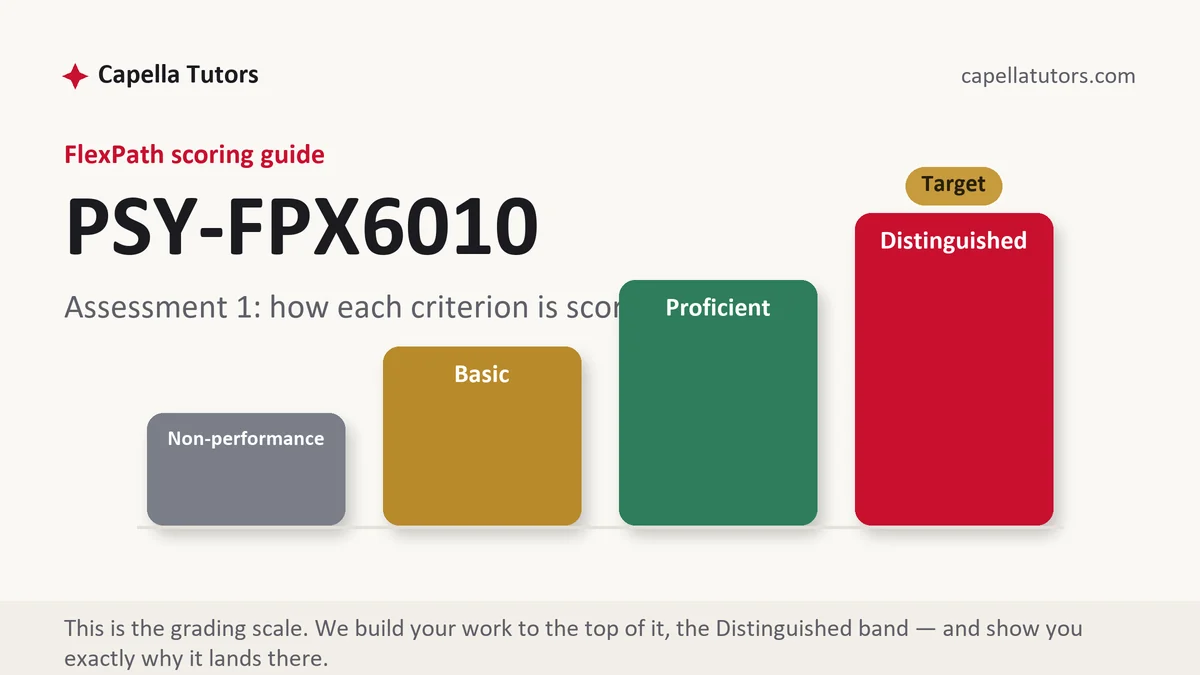
How PSY-FPX6010 Assessment 1 is scored
There are no letter grades in FlexPath. Each criterion on the scoring guide lands on one of four levels, and the level language is the writing brief:
| Level | What it means on a developmental process explanation |
|---|---|
| Distinguished | One dating convention is declared and held, the sequence is exact, the mechanism is explained rather than the outcome restated, and every borrowed figure has been converted to your clock instead of copied. |
| Proficient | Accurate staging and a correct account of the process. Solid, with timing given in weeks that a reader has to take on trust. |
| Basic | A description of what happens with no reference point for the weeks, and effects named where a mechanism was asked for. The most common landing spot for first submissions here. |
| Non-performance | A required element is absent, most often the audience-facing section or the sourcing for a timing claim. Missing, not vague, is what puts a criterion on the floor. |
Write the process for a reader who has to act on it. Criteria in this course routinely name an audience, and a paragraph that would satisfy an embryology examiner can still fail a criterion asking what a caseworker, a parent or a program should do with the information.
The PSY-FPX6010 Assessment 1 method, step by step
-
Convert the criteria into headings, then declare the clock
Each criterion becomes a section with its top-level wording pasted underneath. Then write your dating convention into the first paragraph and keep it visible while you draft, because the single most expensive edit in this course is discovering at the end that half your weeks came from a source using the other convention.
-
Name the audience and hold its register
Decide whether this section speaks to a practitioner, a family or a program, and write for that reader throughout. Mixing an academic explanation and a guidance sheet inside one section is why strong material lands in the middle columns, since each criterion is scored against the register it asked for.
-
Get the sequence exact before adding detail
The germinal weeks of cell division and implantation, the embryonic period in which the organ systems are laid down, then the long fetal period of growth, differentiation and functional maturation. Put the boundaries in weeks on your declared clock. Detail added to a wrong sequence costs more credit than detail left out of a right one.
-
Explain the mechanism, not the outcome
A criterion asking how something develops wants the process: which structures form, in what order, from which precursor, and what the timing depends on. Restating the outcome in longer words is the commonest way a well-written paragraph scores Basic. Test each sentence by asking whether it would let a reader predict something they did not already know.
-
Cite the source type that fits the claim
Embryology and human development reference texts carry staging, timing and anatomical sequence, and this is the one place a current textbook is the correct citation rather than a shortcut. Empirical claims go to peer-reviewed journals through PubMed, PsycINFO and the Capella library. Guidance from a public health agency or a professional college is cited with the issuing body and the year, because recommendations move.
-
Sweep every number, then self-score
Read the draft once looking only at figures: each week count, each duration, each range. Confirm that every one sits on your declared clock and that any converted figure says so. Then mark each criterion yourself and submit early in the week, since faculty have two business days to evaluate an attempt.
A structure that maps to the criteria
Word counts are planning targets our tutors use for a typical process explanation, not Capella rules; expand wherever your scoring guide asks for more.
| Section | What it must do | Guide word target |
|---|---|---|
| Scope and dating convention | The period addressed, the clock declared, and the rule for converting figures borrowed from sources using the other one. | ~200 words |
| The periods in sequence | Germinal, embryonic and fetal with their boundaries in weeks, and what distinguishes each from the next. | ~300 words |
| The process explained | The mechanism itself: structures, order, precursors, and what the timing of each step depends on. | ~400 words |
| Windows of susceptibility | When this process can be disturbed and why that window rather than another, with the principle stated generally. | ~250 words |
| What it means for the reader | The action, question or decision your named audience takes from the explanation, in their language. | ~250 words |
| Language and references | Person-first description, identifying detail removed, and current APA matched in both directions. | ~200 words |
Annotated sample excerpt
An original model excerpt from our team, showing the register that scores at the top of the guide. It is study material: learn the moves, then write your own version.
Every week in this guidance for the county home-visiting team is counted from fertilization, and where a source used clinical dating from the first day of the last menstrual period its figures have been reduced by about two weeks and marked as converted.1 On that clock the first two weeks cover cell division, passage along the uterine tube and implantation, weeks three through eight are the embryonic period in which the organ systems are laid down, and week nine onward is the fetal period of growth, differentiation and functional maturation.2 The working consequence for a visitor is that a client whose chart says ten weeks is roughly eight weeks past fertilization and therefore at the end of organ formation rather than in the middle of it, which changes which questions about the first month are still worth asking.3
- 1Declares the clock in the first sentence and states the conversion rule for borrowed figures. The timing criterion is scored on whether a reader can check a number, and this makes every later number checkable.
- 2Gives all three periods with their boundaries in one sentence, in order, so nothing later in the document has to re-establish the frame.
- 3Turns the convention into a decision the named audience actually makes. Written for a home visitor rather than for a grader, which is what an audience criterion is asking for.
The full premium sample for your exact assessment, written fresh to your scoring guide and issue, is free to request. Study it, revise it into your own voice, and submit work you understand.
The five mistakes that cost Distinguished
- Weeks with no reference point. A figure that could belong to either clock cannot be verified, and verifiability is what the timing criterion measures.
- A borrowed figure imported unconverted. Two sources on different clocks inside one paragraph will contradict each other, and the contradiction is visible to anyone who knows the field.
- Outcome dressed as mechanism. Saying that a structure fails to form does not explain how it forms, and the criterion asking how is scored on the process.
- Audience abandoned mid-section. A guidance section that drifts into academic register has stopped answering the criterion that named the reader.
- Consumer sources for staging. Pregnancy websites and app timelines rarely say which clock they use, which is exactly the flaw the assessment is designed to punish.
Pre-submission checklist
- Every scoring-guide criterion has its own clearly labeled section
- One dating convention declared in the opening paragraph and used everywhere after it
- Germinal, embryonic and fetal boundaries stated in weeks on that clock
- Each borrowed figure converted and marked, with the source's own convention noted
- The mechanism explained in steps a reader could use to predict something
- Audience register held throughout, person-first language, current APA both ways
Want this assessment done with backup?
Send the scoring guide, the period you were assigned, and the audience the prompt names. A team of eight returns a premium original sample built to the top descriptor in 24 to 48 hours, with one pass reserved for verifying that every gestational figure in the document sits on the same reference point, and revisions until each criterion clears.