How to write PSY-FPX6010 Assessment 2

The short answer

This manual is for PSY-FPX6010 Assessment 2, start to submission. The middle deliverable in Human Prenatal Development usually asks you to appraise the evidence on an exposure rather than to summarize it: what the studies are, what their designs can and cannot license, how the exposure relates to dose and to timing, which outcomes were measured and how they were defined, and what remains unexplained after all of it. Your scoring guide decides the sections. The intellectual centre of the course sits in this deliverable, because no review board will assign a pregnant participant to a suspected harm, so almost every human estimate you will cite is observational and arrives with the exposure's social company attached. Below is the method our tutors use for it, a structure that maps to the criteria, and an annotated sample excerpt. Prefer to hand it off? A premium original sample for this exact assessment comes back in 24 to 48 hours, revised free until it meets the guide. Your courseroom may print this as PSY FPX 6010 Assessment 2 or PSY6010 Assessment 2; it is the same deliverable, and PSY-FPX6010 Assessment 2 is what this manual walks through.

One honesty note before the manual: Capella revises courses and scoring guides over time, so always write to the exact scoring guide attached to your assessment in the courseroom. The course identity above is verified on capella.edu; the method and structure below are our tutors' approach to it, not Capella's official rubric text.
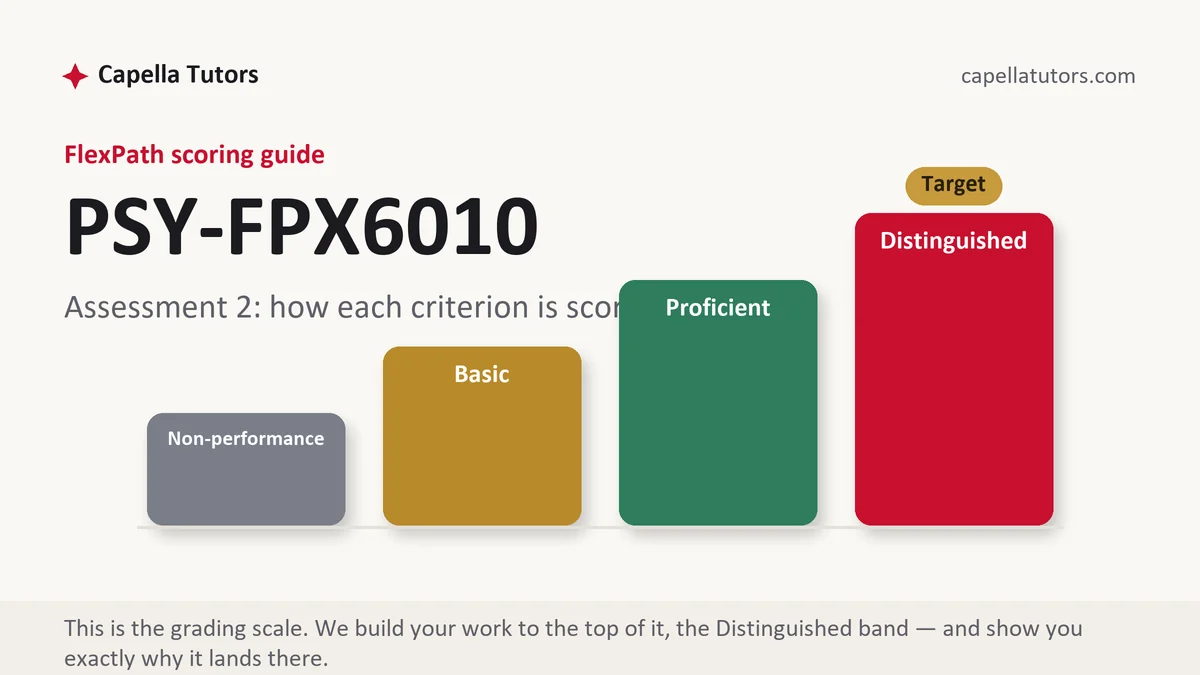
PSY-FPX6010 Assessment 2 grading scale at Capella FlexPath, the criterion levels this assessment is scored on, from Capella Tutors
How Capella FlexPath grades PSY-FPX6010 Assessment 2, visualized by Capella Tutors.

How PSY-FPX6010 Assessment 2 is scored

There are no letter grades in FlexPath. Each criterion on the scoring guide lands on one of four levels, and the level language is the writing brief:

LevelWhat it means on an appraisal of exposure evidence
DistinguishedThe design constraint is stated before the findings, confidence is built from convergence across several kinds of evidence, dose and window are handled separately, and the confound that survives is named by the writer rather than found by the reader.
ProficientThe evidence is reported accurately with limitations acknowledged. Careful, and still reading as a summary rather than an appraisal.
BasicAn exposure blamed from a set of studies whose designs are not distinguished, with the social circumstances travelling alongside it left unmentioned.
Non-performanceA required element is absent, most often the design appraisal itself or the measurement definitions the outcomes depend on. What is not in the document, rather than what is thin in it, produces this level.

Depth on one exposure earns more than coverage of six. Take a single agent, carry it through mechanism, window, dose, outcome definition and design limits, and every row the criterion asked for has been answered by one argument instead of six paragraphs of gesture.

The PSY-FPX6010 Assessment 2 method, step by step

  1. Say the design out loud before the findings

    Open the appraisal by stating that the human evidence on this exposure is observational and why it has to be, then name what that costs. A reader who learns the design constraint in the first sentence will read every later number correctly, and a reader who learns it in a closing limitation will feel handled.

  2. Build confidence from convergence, not from one study

    The pattern that raises confidence has parts: a dose gradient rather than an effect only at the extreme, an association concentrated in the window the mechanism predicts, sibling or within-family comparisons that hold family circumstances constant, natural experiments created by a policy or a shortage nobody chose, and animal work supplying mechanism. Write the convergence as one paragraph and say which part is missing.

  3. Separate dose from timing

    Susceptibility depends on when, and it independently depends on how much, and the dose that matters is what reaches the embryo rather than what was consumed or inhaled. An agent acting during organ formation produces structural effects while the same agent later affects growth and functional maturation, so timing changes the presentation rather than the presence of risk.

  4. Keep the outcome variables distinct

    Preterm means born before 37 completed weeks. Low birth weight means under 2,500 grams. Small for gestational age means below the expected weight for the weeks completed. An infant can be any one without being the others, and conflating them is the fastest way to lose the measurement criterion no matter how good the argument above it is.

  5. Report the size with its precision, and hold the verbs

    Give the effect size and the interval around it, then size your claim to the interval. Associated with, higher among and consistent with are the verbs an observational literature supports; caused and reduced are not. A p value says how surprising the data would be if there were no association at all, and it cannot tell you the magnitude, the probability that the exposure is harmful, or whether the difference matters to an infant.

  6. Label animal work, check the language, self-score

    Any claim resting on animal studies says so in the sentence that uses it, with species and exposure level carried across rather than translated silently into a human dose. Write person-first throughout, remove detail identifying a clinic, an employer or a partner, then mark each criterion yourself and submit early in the week.

A structure that maps to the criteria

Word counts are planning targets our tutors use for a typical exposure appraisal, not Capella rules; expand wherever your scoring guide asks for more.

SectionWhat it must doGuide word target
Exposure and questionThe agent, its route into the pregnancy, the outcome in question, and the population the appraisal concerns.~250 words
The evidence baseThe studies grouped by design, each with sample and setting, and what each design can license.~350 words
Dose and windowThe exposure-response relationship and the developmental period in which the mechanism predicts an effect.~300 words
Outcomes and measurementEach outcome defined precisely, with weeks, grams and expected-for-age kept apart, and how exposure was measured.~250 words
Convergence and what survivesThe pattern that raises confidence, the confound that cannot be removed, and the claim sized to both.~300 words
Language and referencesPerson-first phrasing, animal work labeled, guidance cited by body and year, current APA both ways.~200 words

Annotated sample excerpt

An original model excerpt from our team, showing the register that scores at the top of the guide. It is study material: learn the moves, then write your own version.

Sample excerpt: convergence and what survives Original model · Capella Tutors

No review board will assign a pregnant participant to breathe polluted air, so every human estimate linking fine particulate exposure to birth weight is observational, and the exposure travels with the circumstances that place a household beside an arterial road.1 Four features of the literature pull the same way: comparisons between siblings born before and after a family moved report smaller associations than comparisons between families without erasing them, the association is graded across exposure levels rather than appearing only at the top, it concentrates in the weeks a placental mechanism would predict, and closures of large local emitters have been followed by measurable rises in birth weight that nobody arranged.2 What none of that removes is residual confounding by household income and by co-pollutants measured at the same monitor, so the defensible claim is a small association supported by convergence rather than a quantified causal effect, and it matters most at the low tail of the weight distribution rather than for the average infant.3

  • 1States the design constraint and its reason before any finding, so nothing later has to be walked back. This is where an appraisal criterion begins to score.
  • 2Argues from four kinds of evidence at once rather than from one impressive cohort, and ties the timing to a mechanism instead of leaving it as a coincidence.
  • 3Names the confound that survives, sizes the claim to it, and says where the finding is practically relevant. Confidence stated precisely is what separates the top column from the middle ones.

The full premium sample for your exact assessment, written fresh to your scoring guide and issue, is free to request. Study it, revise it into your own voice, and submit work you understand.

Get the full sample free

The five mistakes that cost Distinguished

  • An exposure blamed with its confounds unnamed. Observational evidence carries the social circumstances of the exposure, and a paper that ignores them overstates the effect it reports.
  • One cohort carrying the whole argument. A single large study is impressive and cannot substitute for convergence, which is the only route to confidence when randomization is unavailable.
  • Weeks and grams used interchangeably. Preterm, low birth weight and small for gestational age are three variables, and the measurement criterion is scored on keeping them apart.
  • An animal exposure level carried across as a human one. Species, route and exposure level all have to travel with the citation or the sentence misleads its reader.
  • Causal verbs on observational data. Caused and reduced claim more than the design supports, and this is the cheapest credit in the course to give away.

Pre-submission checklist

  • Every scoring-guide criterion has its own clearly labeled section
  • The observational design constraint is stated before the first finding
  • Confidence argued from convergence, with the missing piece of the pattern named
  • Dose and window handled as separate questions, with the dose that reaches the embryo specified
  • Preterm, low birth weight and small for gestational age defined and used consistently
  • Effect sizes carry intervals, verbs stay at association, and animal work is labeled as such

Want this assessment done with backup?

Send the scoring guide and the exposure the prompt names. A team of eight returns a premium original sample built to the top descriptor in 24 to 48 hours, with every claim carrying its window, its dose relationship and the confound the design could not remove, and revisions until each criterion clears.

Keep going

Online now