This manual is for PSY FPX 5140 Assessment 2, start to submission. The middle deliverable in Program Evaluation usually turns your plan into a design: the comparison you will use, the outcome measures and their windows, the records and instruments the data will come from, the fidelity information that tells a reader whether the program actually happened, and the ethical procedures that govern all of it. Your scoring guide decides the sections. The criteria are realistic about what a real site permits, and they pay for a writer who takes the strongest comparison available and then states what it leaves unresolved. Below is the method our tutors use for it, a structure that maps to the criteria, and an annotated sample excerpt. Prefer to hand it off? A premium original sample for this exact assessment comes back in 24 to 48 hours, revised free until it meets the guide. Capella's catalog lists the course as PSY-FPX5140, and some courserooms print PSY5140; both point to this same Assessment 2.
One honesty note before the manual: Capella revises courses and scoring guides over time, so always write to the exact scoring guide attached to your assessment in the courseroom. The course identity above is verified on capella.edu; the method and structure below are our tutors' approach to it, not Capella's official rubric text.
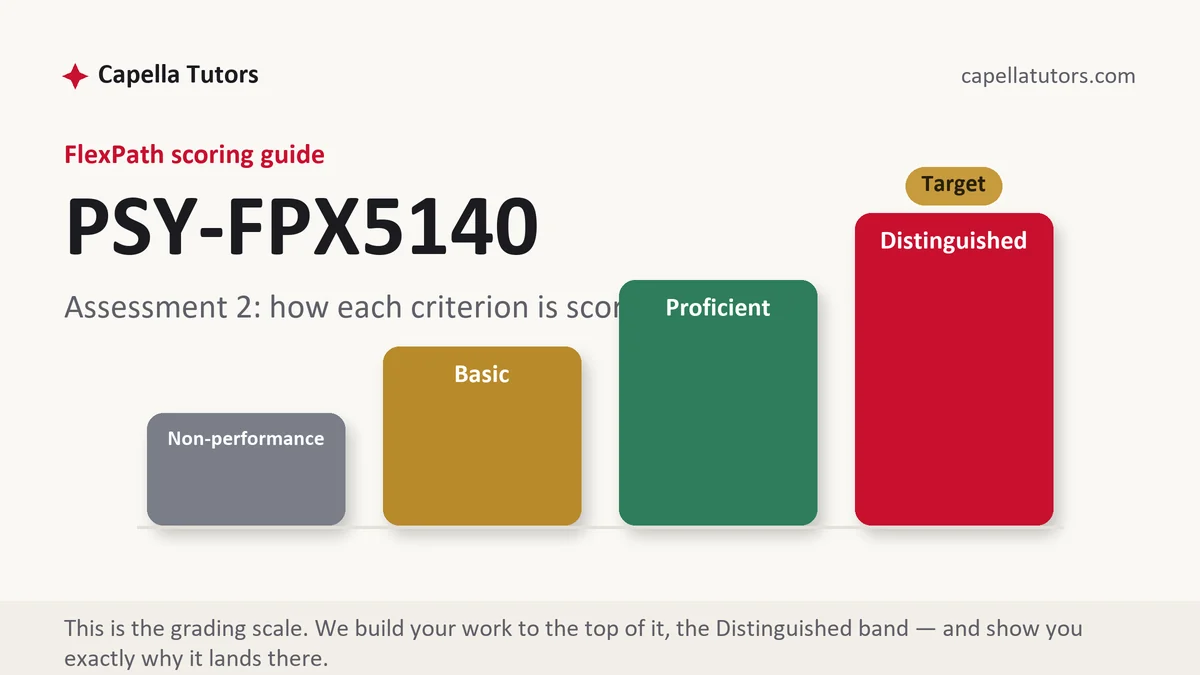
How PSY FPX 5140 Assessment 2 is scored
There are no letter grades in FlexPath. Each criterion on the scoring guide lands on one of four levels, and the level language is the writing brief:
| Level | What it means on an evaluation design |
|---|---|
| Distinguished | The design is the best one the setting allows, its rival explanations are ranked rather than listed, and the writer says which one survives and what would remove it. Measures arrive with their windows and their sources. |
| Proficient | A workable design with defined measures and a named data source for each. Defensible, and silent about its own limits. |
| Basic | A single group measured before and after, with maturation and history left standing and unmentioned. This is where most first attempts land in the design section. |
| Non-performance | A required element is absent, usually the fidelity data or the consent and confidentiality procedures. Omission rather than weakness is what earns this level. |
The trap in this deliverable is ambition. A design that requires a randomized trial nobody will authorize scores worse than a matched comparison you could actually run, because feasibility is one of the four standards the field grades itself on and your reader knows the difference.
The PSY FPX 5140 Assessment 2 method, step by step
-
Sort the criteria by the verb
Design, justify, and address are three different jobs, and the guide usually asks for all three. Make each criterion a heading, then write one line under it saying whether that section produces a plan, an argument, or a procedure. Sections written in the wrong mode are the most common reason strong material scores in the middle.
-
Rank the comparisons, then take the highest one available
Write the ladder out: random assignment where a waiting list or an oversubscribed lottery already exists, a matched comparison built on the same baseline measure, participants against similar non-participants, an interrupted time series where the site has several years of one measure, and a single group before and after when nothing else can be had. Name where you landed and why the rung above was unavailable.
-
Define each measure with its window and its source
An outcome is not defined until a reader knows what is counted, over what period, and from which record. Attendance from the student information system across the fall term is a measure; improved engagement is a wish. Say who holds each record, who has to approve access, and what the measure was originally collected for, because instruments repurposed from administrative use carry their own limits.
-
Plan the fidelity data before the outcome data
Decide now how you will know whether the program was delivered as designed: sessions offered against sessions held, staff trained, average dose received, and the share of enrolled participants who received a minimum amount. Without those numbers a null result cannot be interpreted, and the interpretation criterion later in the course depends on the collection decision you make here.
-
Write the threats you cannot remove
For your chosen design, name the rival explanations still standing: selection when entry was by referral, maturation when participants are children, regression toward the mean when entry was by low scores, history when a district changed something the same year. Rank them by how much they could move your estimate, and say which additional data would settle the largest.
-
Write the procedures, then self-score
Consent or the reason records can be used without it, who holds identifiers, how small cells will be suppressed, and where student education records sit under the Family Educational Rights and Privacy Act, which the district office interprets rather than you. Then mark each criterion against the guide yourself and submit early in the week, since faculty have two business days to evaluate an attempt.
A structure that maps to the criteria
Word counts are planning targets our tutors use for a typical design deliverable, not Capella rules; expand wherever your scoring guide asks for more.
| Section | What it must do | Guide word target |
|---|---|---|
| Questions restated | The evaluation questions this design answers, each with the decision it feeds, carried forward from your plan. | ~200 words |
| Design and comparison | The comparison chosen, the ladder it came from, and why the stronger option was not available at this site. | ~350 words |
| Measures and windows | Each outcome defined by what is counted, over what period, from which record, and who approves access. | ~300 words |
| Fidelity and process data | Delivery, dose and reach measures, with the minimum dose that will count as having received the program. | ~250 words |
| Threats and limitations | Rival explanations ranked, the surviving one named, and the data that would remove it. | ~250 words |
| Ethics, use and references | Consent, confidentiality, small cells, who receives the report, and current APA matched both ways. | ~250 words |
Annotated sample excerpt
An original model excerpt from our team, showing the register that scores at the top of the guide. It is study material: learn the moves, then write your own version.
The Cordell workforce board placed 640 of 1,180 eligible applicants into six-week paid summer positions, and because applications exceeded slots the board already assigns places by random draw inside each age band, which supplies a comparison group nobody had to invent.1 The design compares drawn and undrawn applicants on three outcomes that exist for both groups in records the board can lawfully reach: fall school enrollment, credits attempted in the fall term, and any wage record in the two quarters after placement, measured from the July start date through the following March.2 The draw protects the comparison at the moment it happens and not afterward, since 71 of the 640 placed youth never reported and 44 left before the fourth week, so the primary analysis keeps every applicant in the group they were drawn into and a second analysis reports outcomes by weeks worked, labeled as the weaker of the two.3
- 1Takes the strongest comparison the site already contained instead of proposing a trial nobody would fund. Oversubscription is where real programs hide their random assignment.
- 2Each outcome arrives with its record, its window, and the access question answered. A reader can now check whether the numbers could exist.
- 3Separates what the design protects from what happened after it, then marks the dose analysis as the weaker of the pair rather than leading with the friendlier number.
The full premium sample for your exact assessment, written fresh to your scoring guide and issue, is free to request. Study it, revise it into your own voice, and submit work you understand.
The five mistakes that cost Distinguished
- A design the site would never approve. Proposing random assignment inside a program that has no waiting list reads as unfamiliarity with the setting, and feasibility is graded.
- Measures without windows. Reading achievement is not a measure until a reader knows which assessment, which administration dates, and which record holds it.
- Fidelity postponed. Deciding to collect delivery and dose data later means never, and a null result then has two explanations you can no longer separate.
- Threats listed alphabetically. Naming six rival explanations without saying which one could actually move your estimate is a vocabulary exercise.
- Ethics as a closing paragraph. Consent, identifiers and small-cell suppression are procedures inside the design, and a criterion that asks for them is asking what you will do.
Pre-submission checklist
- Every scoring-guide criterion has its own clearly labeled section
- The comparison is named, placed on the ladder, and justified against the rung above it
- Each outcome has a definition, a window, a source record, and an access route
- Fidelity, dose and reach measures are specified alongside the outcomes
- Rival explanations ranked, the surviving one named, and the data that would remove it stated
- Consent, confidentiality and small-cell handling written as procedures, self-scored before submitting
Want this assessment done with backup?
Send the scoring guide, your program, and a list of what the site already measures. An eight-person pipeline with a research analyst and two QA readers inside it returns a premium original sample aimed at the top descriptor in 24 to 48 hours, revised free until it gets there. The design section is where an evaluation is won or quietly lost.