How to write PSY-FPX5140 Assessment 1

The short answer

This manual is for PSY-FPX5140 Assessment 1, start to submission. The opening deliverable in Program Evaluation usually asks you to describe a real program and lay out the logic that will later be judged: the inputs, the activities those inputs pay for, the outputs they produce, the staged outcomes they are supposed to cause, and a set of evaluation questions each tied to a decision somebody is waiting to make. Your scoring guide decides the sections and their weight, and what the criteria test is whether your chain of reasoning holds rather than how much you know about the program. Below is the method our tutors use for it, a structure that maps to the criteria, and an annotated sample excerpt. Prefer to hand it off? A premium original sample for this exact assessment comes back in 24 to 48 hours, revised free until it meets the guide. Your courseroom may print this as PSY FPX 5140 Assessment 1 or PSY5140 Assessment 1; it is the same deliverable, and PSY-FPX5140 Assessment 1 is what this manual walks through.

One honesty note before the manual: Capella revises courses and scoring guides over time, so always write to the exact scoring guide attached to your assessment in the courseroom. The course identity above is verified on capella.edu; the method and structure below are our tutors' approach to it, not Capella's official rubric text.
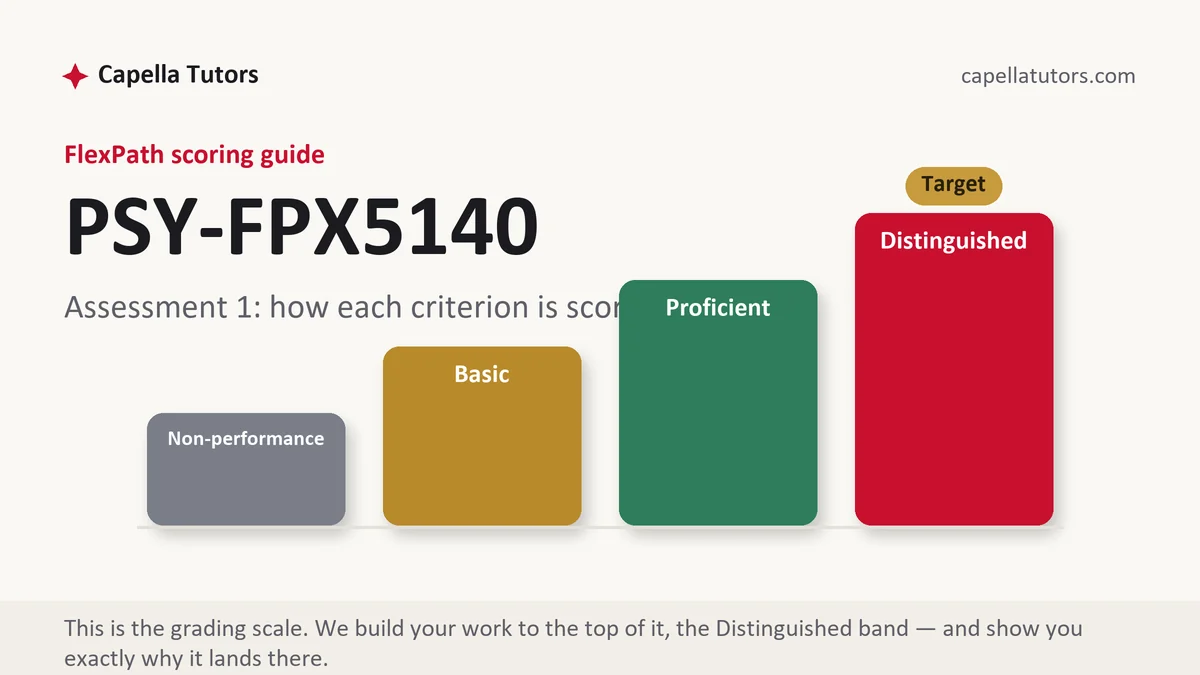
PSY-FPX5140 Assessment 1 grading scale at Capella FlexPath, the criterion levels this assessment is scored on, from Capella Tutors
How Capella FlexPath grades PSY-FPX5140 Assessment 1, visualized by Capella Tutors.

How PSY-FPX5140 Assessment 1 is scored

There are no letter grades in FlexPath. Each criterion on the scoring guide lands on one of four levels, and the level language is the writing brief:

LevelWhat it means on a program description and logic model
DistinguishedThe model is defended rather than drawn. Every arrow carries an assumption you are willing to state, the weakest link in the chain is named by you before a reader finds it, and each evaluation question is attached to a decision on somebody's calendar.
ProficientThe program is described accurately and the model is complete and internally consistent. Correct, and nothing has been risked.
BasicA description of the program with sessions delivered and families contacted sitting in the outcome column. The most common landing spot for a first attempt in this course.
Non-performanceA required element is absent, most often the stakeholders or the evaluation questions themselves. An element left out, rather than one written thinly, is what sends a criterion to the bottom row.

Treat this deliverable as load bearing rather than introductory. Everything later in the course reads back to it: the design you can defend depends on how participants enter the program, and the findings you may claim depend on which outcomes you were honest enough to put in the model.

The PSY-FPX5140 Assessment 1 method, step by step

  1. Read the criteria, then pick a program you can get paper about

    Make each criterion a heading and park its top-level wording underneath before you choose anything. Then choose a program small enough to describe honestly and documented enough to describe at all. A grant application, an intake form, an attendance export and one conversation with a coordinator are enough; a program you admire but cannot get records for will stall you in the design section two weeks from now.

  2. Describe the program around its entry route

    Say what the program does, who runs it, how long it has operated, what it costs, and above all how a participant arrives. Referral by a teacher, an automatic assignment by test score, and a voluntary sign-up produce three different evaluations. Write the route in the description section, precisely, because it silently decides which comparison is available to you later.

  3. Name the stakeholders and give each question a decision

    List who commissioned the work, who delivers the program, who receives it, and who will act on the report. Then write your evaluation questions so each one ends in a decision: whether to renew the grant, whether to change the entry criterion, whether to add a second session a week. A question with no decision behind it fails the utility test that the standards are built on.

  4. Build the model backwards from the outcome

    Start at the far right with the change you claim the program produces in people, then work left through the activities that could plausibly cause it and the inputs that pay for those activities. Working forwards produces a list of things the program does. Working backwards exposes the step where the chain has no evidence behind it, which is the step your reader will ask about.

  5. Separate outputs from outcomes, then mark the weak link

    Sessions held, tutors trained, flyers mailed and hours logged are outputs, and none of them is evidence that a person changed. Put them in their own column, then choose the arrow you trust least and say why in a sentence. Naming your own weak link is the move that reads as competence, and it is usually what the top descriptor is paying for.

  6. Declare the purpose and self-score before you submit

    State whether this evaluation is formative or summative, in Michael Scriven's sense, and say who will use the finding, which is Michael Quinn Patton's test. Then read the draft against the guide one criterion at a time and mark each one honestly. Faculty have two business days to evaluate an attempt, so submit early in the week rather than on a Friday.

A structure that maps to the criteria

Word counts are planning targets our tutors use for a typical first evaluation deliverable, not Capella rules; expand wherever your scoring guide asks for more.

SectionWhat it must doGuide word target
Program and settingWhat the program does, who it serves, how it is staffed and funded, and exactly how participants enter it.~300 words
Purpose of the evaluationFormative or summative, who asked for it, what decision is pending, and what the report will be used for.~200 words
StakeholdersEach group named, what it needs answered, and what it stands to gain or lose from the finding.~250 words
Logic modelInputs, activities, outputs and staged outcomes, with the assumption behind each arrow written out.~400 words
Evaluation questionsThree to five questions, each traced to a stakeholder and to a decision, and each answerable with data that exists.~250 words
Feasibility and referencesWhat is already measured, what would have to be collected, the small-cell and consent issues, current APA both ways.~250 words

Annotated sample excerpt

An original model excerpt from our team, showing the register that scores at the top of the guide. It is study material: learn the moves, then write your own version.

Sample excerpt: program and setting Original model · Capella Tutors

Bellhaven Community College runs a drop-in writing centre staffed by six peer tutors and one half-time coordinator, funded from a three-year student success grant now entering its final year, which is why a renewal decision is due in March.1 Students arrive by three routes that are not equivalent: some are sent by a composition instructor as a condition of revising a failed draft, some are contacted by advising after a midterm alert, and some walk in unprompted, so any later comparison between users and non-users compares people who already differed.2 The centre logs date, tutor, and minutes, and records nothing about what the student brought in, so the only participation measures available are reach and dosage, and the only outcome the college already holds is course grade with next-term enrollment.3

  • 1Names the funding and its horizon in the first sentence, so the reader knows which decision the evaluation feeds. A plan with no pending decision has no user.
  • 2States the entry route inside the description rather than saving it for the design section, and says out loud what it costs. Referral is a selection mechanism, and admitting that early protects every later claim.
  • 3Separates what is measured from what is wanted before promising anything. Distinguished work commits to the records that exist, then asks for the ones it needs.

The full premium sample for your exact assessment, written fresh to your scoring guide and issue, is free to request. Study it, revise it into your own voice, and submit work you understand.

Get the full sample free

The five mistakes that cost Distinguished

  • Outputs in the outcome column. Tutoring hours delivered describes how busy the centre was, and the outcome criterion is scored on a change in the people it served.
  • A program nobody can document. Choosing an admired program with no attendance data or written plan produces a description built on adjectives, and the model that follows has nothing under it.
  • Stakeholders as a list. Four groups named and no question traced back to any of them fails the utility standard, which is the one the field puts first.
  • Arrows with no assumptions. A diagram where activities point at outcomes without a stated reason is a picture, and the criterion asks for an argument.
  • Entry route left vague. Write who gets in and how, or you will discover in the design section that your comparison group was never comparable.

Pre-submission checklist

  • Every scoring-guide criterion has its own clearly labeled section
  • The entry route into the program is described precisely enough to predict the comparison
  • Outputs and outcomes sit in separate columns, with staged outcomes in time order
  • Each evaluation question names a stakeholder and the decision it feeds
  • One arrow in the model is identified by you as the weakest, with a reason
  • Formative or summative purpose declared, current APA both ways, self-scored before submitting

Want this assessment done with backup?

Send the scoring guide, the program you have chosen, and whatever the site already measures. A team of eight, including a research analyst and two QA reviewers, returns a premium original sample built to the top descriptor in 24 to 48 hours, with revisions until it lands there. The model you submit here is the spine of every later deliverable in the course.

Keep going

Online now