This manual is for PSY FPX 5140 Assessment 3, start to submission. The closing deliverable in Program Evaluation usually asks you to report findings and recommend action, written for the person who commissioned the work rather than for a grader: the results with their denominators and windows, the comparison and the uncertainty around it, the fidelity picture standing beside the outcome, recommendations someone could start on Monday, and a plan for who receives what. Your scoring guide decides the sections. The criterion that separates the top column here is nerve, because a report that softens an unwelcome result has given away the only thing the role is for. Below is the method our tutors use for it, a structure that maps to the criteria, and an annotated sample excerpt. Prefer to hand it off? A premium original sample for this exact assessment comes back in 24 to 48 hours, revised free until it meets the guide. Capella's catalog lists the course as PSY-FPX5140, and some courserooms print PSY5140; both point to this same Assessment 3.
One honesty note before the manual: Capella revises courses and scoring guides over time, so always write to the exact scoring guide attached to your assessment in the courseroom. The course identity above is verified on capella.edu; the method and structure below are our tutors' approach to it, not Capella's official rubric text.
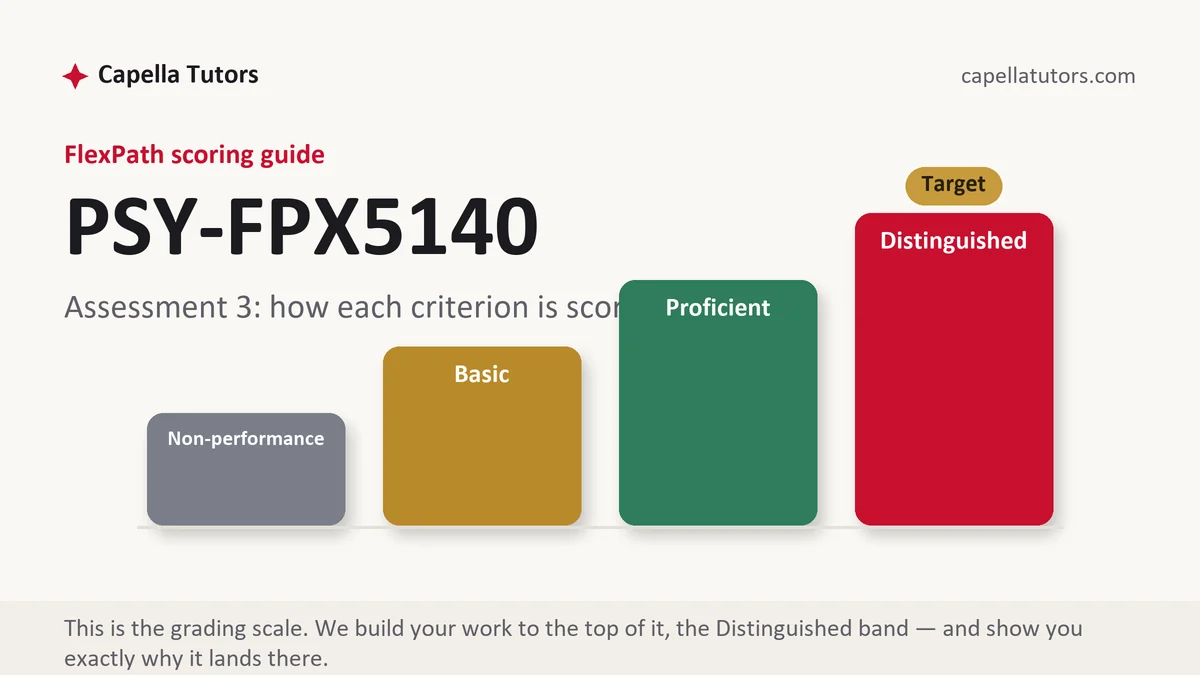
How PSY FPX 5140 Assessment 3 is scored
There are no letter grades in FlexPath. Each criterion on the scoring guide lands on one of four levels, and the level language is the writing brief:
| Level | What it means on a findings and recommendations report |
|---|---|
| Distinguished | Every number carries its denominator, its window and its comparison, the estimate arrives with an interval, the verbs stay at association where the design cannot license more, and an unfavorable finding is reported without cushioning. |
| Proficient | Findings reported accurately with recommendations that follow from them. Sound, and reads as though precision were optional in the framing. |
| Basic | Percentages with no visible denominator, a before-and-after gain credited to the program, and recommendations larger than the evidence behind them. |
| Non-performance | A required element is missing, most often the reporting and use plan or the fidelity information the findings depend on. The bottom row is reserved for what is not there rather than for what is thin. |
Two failures look identical in a results table and carry opposite recommendations. A theory failure is a program delivered as planned whose intended outcome still did not arrive. An implementation failure means the outcome did not follow because half the intended service never reached anybody. Recommending redesign for what was really an attendance problem is the most expensive error available in this deliverable.
The PSY FPX 5140 Assessment 3 method, step by step
-
Rebuild the outline from the criteria, then write results before conclusions
Each criterion becomes a heading, in the guide's order rather than in the order you found things out. Then write the findings section first and leave the recommendations empty until it is done, because recommendations drafted early quietly reshape the numbers that follow them.
-
Put the denominators on the page before any rate
Registered, started, and completed are three populations, and a percentage is meaningless until a reader knows which one it describes. Report the intention-to-treat figure that counts everyone enrolled and the dose-based figure that counts those who received a stated minimum, label which is which, and give the measurement window with both.
-
Report the comparison and the uncertainty in the same breath
A change in participants is not a program effect until you say what happened to comparable people who did not participate. Give the difference, then the interval around it, and size the claim to the interval rather than to the point estimate. A p value tells you how surprising the data would be if the program did nothing; it cannot tell you the size of the effect, the probability the program worked, or whether the difference matters to a child.
-
Keep the verbs at the level the design earns
Where assignment was voluntary or by referral, participants are associated with outcomes rather than causing them, and the words to use are associated with, higher among, and consistent with. Reserve reduced, improved and produced for designs that support them. This is the cheapest paragraph of credit in the whole course and the one most often given away.
-
Set the fidelity picture beside the outcome
Report sessions offered against sessions held, average dose received, and the share who got the minimum, in the same section as the results. Then say which of the two failures your evidence supports, and if it cannot distinguish them, say that instead of choosing the flattering one.
-
Write recommendations someone owns, then the use plan
Each recommendation names what changes, who owns it, what it costs in staff hours, and when you would look again. Then write who receives the report, in what form, and how small cells are suppressed, since a table cell holding four children identifies those children to anyone in the building. Mark every criterion against the guide yourself, then submit in the first half of the week.
A structure that maps to the criteria
Word counts are planning targets our tutors use for a typical findings report, not Capella rules; expand wherever your scoring guide asks for more.
| Section | What it must do | Guide word target |
|---|---|---|
| Purpose and questions | What was asked, by whom, and which decision this report feeds, in a form a sponsor reads in one minute. | ~200 words |
| What was actually done | The design as implemented, the sample sizes at each stage, and anything that departed from the plan. | ~250 words |
| Findings | Results by question, each with its denominator, window, comparison and interval, subgroups where counts allow. | ~400 words |
| Fidelity and interpretation | Delivery and dose beside the outcomes, then which failure the evidence supports and which it cannot rule out. | ~250 words |
| Recommendations | Two to four actions, each with an owner, a cost, a measure and a date to look again. | ~250 words |
| Reporting, ethics and references | Who gets what and when, confidentiality and small-cell handling, and current APA matched both ways. | ~200 words |
Annotated sample excerpt
An original model excerpt from our team, showing the register that scores at the top of the guide. It is study material: learn the moves, then write your own version.
Of the 412 children registered for the county library summer reading program, 268 logged at least one week and 149 logged the six weeks the program itself calls completion, so three populations exist and each answers a different question.1 On the district reading screen administered in September, 61 of the 149 who completed scored at or above benchmark, which is 41 percent; counted across all 412 registrants the figure is 122, or 30 percent, and among the 1,860 children in the same grades who never registered it was 27 percent.2 The difference between all registrants and non-registrants is 3 percentage points, with a 95 percent interval running from about 2 points below zero to 8 points above it, so this evaluation cannot separate a small benefit from none, and because families signed themselves up, registrants differ from non-registrants in ways the library does not measure.3
- 1Puts all three denominators on the page before a single percentage appears, so no reader has to guess which population a rate describes.
- 2Reports the completer figure and the figure for everyone enrolled side by side, with the comparison group in the same sentence and the measurement date named.
- 3Sizes the claim to the interval rather than the point estimate, keeps the verbs at association, and names the selection nobody can remove. A sponsor cannot be misled by this paragraph, which is exactly why it scores.
The full premium sample for your exact assessment, written fresh to your scoring guide and issue, is free to request. Study it, revise it into your own voice, and submit work you understand.
The five mistakes that cost Distinguished
- The completer rate reported alone. Counting only the children who finished is the friendliest number available and the one a sponsor is most likely to be misled by.
- A gain credited to the program. Children improve across a school year without help, so a before-and-after rise with no comparison group has measured the calendar.
- Causal verbs on a voluntary program. Improved and reduced claim more than self-selection can support, and the analysis criterion is scored on that distinction.
- A p value doing an effect size's job. Significance is not magnitude, and a sponsor asking whether the program is worth renewing needs the size and the interval.
- The uncomfortable result managed. An evaluator who trims a finding to protect a sponsor has failed the propriety criterion, and faculty read that section looking for exactly this.
Pre-submission checklist
- Every scoring-guide criterion has its own clearly labeled section
- Every rate carries its denominator, its measurement window and its comparison
- The main estimate is reported with an interval, and the claim is sized to the interval
- Verbs match the design, with association language wherever assignment was not controlled
- Fidelity and dose reported beside the outcomes, with theory and implementation failure separated
- Recommendations carry an owner, a cost and a recheck date, and small cells are suppressed
Want this assessment done with backup?
Send the scoring guide, your design section, and whatever data the site handed you. Eight people, one of them a research analyst and two of them QA readers, return a premium original sample written to the top descriptor inside 24 to 48 hours and revise it free until it clears. One reviewer does nothing but recompute your numbers and check the prose against the tables.