How to write PSY-FPX5110 Assessment 1

The short answer

This manual is for PSY-FPX5110 Assessment 1, start to submission. An opening deliverable in this course is normally an ethical analysis with an instrument inside it: a situation described in facts, the enforceable standards it triggers cited by number, the competing obligations set against each other, and a decision you could defend to the party it disadvantages. The assessment usually asks for a recommendation rather than a discussion, and your scoring guide decides the sections and their order. Below is the method our tutors use for it, a structure that maps to the criteria, and an annotated sample excerpt set in a scholarship office. Prefer to hand it off? A premium original sample for this exact assessment comes back in 24 to 48 hours, revised free until it meets the guide. Your courseroom may print this as PSY FPX 5110 Assessment 1 or PSY5110 Assessment 1; it is the same deliverable, and PSY-FPX5110 Assessment 1 is what this manual walks through.

One honesty note before the manual: Capella revises courses and scoring guides over time, so always write to the exact scoring guide attached to your assessment in the courseroom. The course identity above is verified on capella.edu; the method and structure below are our tutors' approach to it, not Capella's official rubric text.
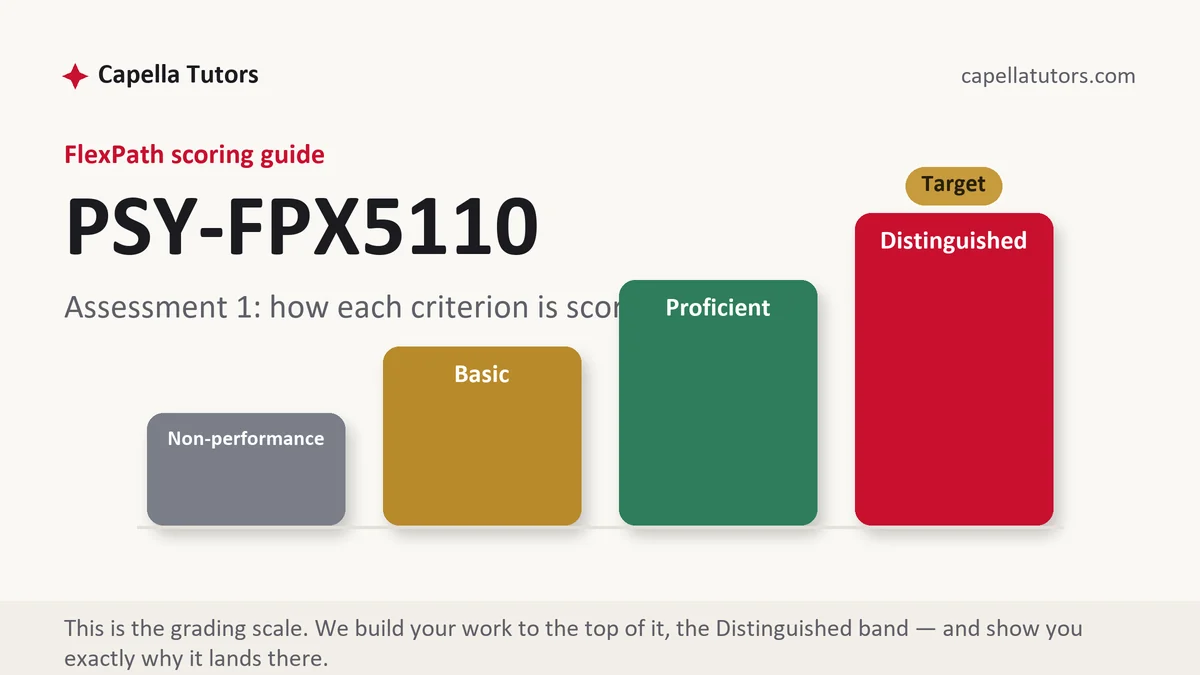
PSY-FPX5110 Assessment 1 grading scale at Capella FlexPath, the criterion levels this assessment is scored on, from Capella Tutors
How Capella FlexPath grades PSY-FPX5110 Assessment 1, visualized by Capella Tutors.

How PSY-FPX5110 Assessment 1 is scored

No letter grades exist in this model. Each criterion sits at one of four levels, and the sentence describing the top level is the specification you write to:

LevelWhat it means on an ethical analysis
DistinguishedFacts are separated from inferences, the enforceable standards arrive with their numbers, two obligations are held in genuine tension, and the measurement claim in the scenario is sized honestly. The decision is one you could defend to the person it goes against.
ProficientThe right standards are found and applied accurately, and the decision follows from them. Correct, and one move below the top, because nothing in the analysis was hard.
BasicA worried retelling of the scenario, with ethics argued from values and the instrument accepted at face value. The most frequent first submission in this course.
Non-performanceA required element is absent outright, most often the standard numbers or any statement of the writer's own scope.

The two halves of this course are graded as one problem, and a paper that answers only the ethical half loses the integration rows even when the ethics is right. Almost every applied ethical question here is also a question about measurement confidence: whether the instrument was validated for this use, whether one score can carry the decision hanging on it, and whether a finding about a group says anything at all about the person in front of you.

The PSY-FPX5110 Assessment 1 method, step by step

  1. Read the guide before the scenario

    The scenario pulls toward storytelling and the criteria are what pay. Turn each criterion into a heading, then mark which ones want a standard cited, which want a measurement judgment, and which want a defended decision. Anything in your draft that is none of the three is filler occupying space you need.

  2. Write the facts, then the inferences, in separate lists

    Scenarios in this course are written with tempting gaps. Put what you were actually told on one side and what you are assuming on the other, then keep the assumptions labelled as assumptions in the draft. Evaluators reward that discipline because it is what a defensible applied decision looks like.

  3. Find the enforceable standards and cite them by number

    The five General Principles opening the code are aspirational and unenforceable; the numbered Ethical Standards are the ones a criterion means. Paraphrase the obligation, put the number in parentheses, quote sparingly, and reference the code as a document rather than the chapter that described it.

  4. Size the instrument before you argue about it

    Find what the scale actually predicts and how strongly, then say whether that is enough for the decision being proposed. A weak group-level predictor can be genuinely useful for describing a cohort and still be indefensible as a reason to act against one named person.

  5. Set two obligations against each other and pick

    Name what each party is owed, find the two duties that pull in opposite directions, then say which one you subordinate and why. An analysis where every obligation agrees has not located the problem the scenario was built to contain.

  6. End in an action, a consultation, a record, then self-score

    Say what you would do, who would be consulted, what you would document, and what your own non-licensure scope does not let you decide. Then mark every criterion at one of the four levels yourself and rewrite anything short of the top.

A structure that maps to the criteria

Word counts our tutors plan with for a graduate ethical analysis, not Capella rules; follow your own guide wherever it asks for more.

SectionWhat it must doGuide word target
The situationFacts as given, inferences flagged as inferences, and the decision at stake named in one sentence.~180 words
Standards engagedEach enforceable standard by number, with the obligation paraphrased and tied to a specific fact.~300 words
What the instrument can carryWhat the scale predicts, how strongly, in which population, and what it was never validated to decide.~300 words
Competing obligationsWhat each party is owed, the two duties in conflict, and which one you subordinate.~250 words
Recommendation and recordThe action, the consultation, the documentation, and your own scope limit stated plainly.~220 words
Language and referencesBias-free terminology, the code cited directly, current APA matched both ways.as needed

Annotated sample excerpt

An original model paragraph from our team, written to show what the upper columns sound like in this course. Read it for the moves, then build the version your own scenario needs.

Sample excerpt: standards paragraph Original model · Capella Tutors

The advising office proposes to renew or withhold a scholarship on the strength of a twelve-item self-report of perseverance, so the first thing to write down is what that instrument can carry.1 Meta-analytic work places its association with academic performance in the low .2 range and finds little prediction remaining once conscientiousness is accounted for, which makes it a modest group-level predictor and no basis whatever for a funding decision about one named student.2 Standard 9.02 obliges an instrument to be used for the purpose and population its validation supports, and Standard 3.04 obliges reasonable steps to avoid foreseeable harm, so my recommendation is that renewal be decided from the prior-term record and an advising interview, that the questionnaire inform offers of support rather than withdrawals of money, and that the reasoning be documented in a memo an appeals committee could read.3

  • 1Opens by asking what the measurement can support rather than whether the plan feels wrong. The measurement question is the ethical question in this course.
  • 2Gives the size and the incremental prediction, then draws the line between describing a cohort and acting against an individual. That line is where the integration rows are won.
  • 3Two standards arrive with numbers attached to specific obligations, and the paragraph closes on an action, an alternative and a written record.

The full premium sample for your exact assessment, written fresh to your scoring guide and issue, is free to request. Study it, revise it into your own voice, and submit work you understand.

Get the full sample free

The five mistakes that cost Distinguished

  • Principles quoted where standards were wanted. Beneficence is aspirational; the enforceable obligation has a number, and the number is the cheapest credit available.
  • The instrument taken on trust. Accepting a scale as a measure of what its name suggests skips the appraisal the measurement criterion is scored on.
  • A group finding used on a person. Prediction across a cohort is not prediction for one applicant, and a decision about one person has to rest on that person's own record.
  • Obligations that never conflict. If nothing in your analysis had to be given up, the ethical problem was walked around.
  • Scope unwritten. A recommendation phrased as though you could authorize it yourself contradicts the degree the assessment is submitted inside.

Pre-submission checklist

  • Every criterion has its own labeled section, in the guide's order
  • Facts and inferences appear separately, with assumptions marked as such
  • Each obligation cited by standard number, the code referenced as a document
  • The instrument appraised for purpose, population and strength of prediction
  • Two obligations in genuine tension, with the subordinated one named
  • An action, a consultation, a record, and your own scope limit written plainly

Ethics analysis due this week?

Send the scenario, the scoring guide and the instrument if one is named. One of the eight passes on every draft exists purely to confirm that each standard number matches the obligation described beside it. Premium original sample in 24 to 48 hours, revised free until every row clears.

Keep going

Online now