How to write PSY-FPX5110 Assessment 2

The short answer

This manual is for PSY-FPX5110 Assessment 2, start to submission. A middle deliverable in this course is normally a measurement appraisal: an instrument or a group comparison examined for what it was validated to do, with reliability, standard error and the reference sample kept in the same paragraph as any score being interpreted. The assessment usually asks whether a use is defensible rather than whether a test is good, and your scoring guide decides the section count. Below is the method our tutors use for it, a structure that maps to the criteria, and an annotated sample excerpt taken from a certification examination review. Prefer to hand it off? A premium original sample for this exact assessment comes back in 24 to 48 hours, revised free until it meets the guide. Your courseroom may print this as PSY FPX 5110 Assessment 2 or PSY5110 Assessment 2; it is the same deliverable, and PSY-FPX5110 Assessment 2 is what this manual walks through.

One honesty note before the manual: Capella revises courses and scoring guides over time, so always write to the exact scoring guide attached to your assessment in the courseroom. The course identity above is verified on capella.edu; the method and structure below are our tutors' approach to it, not Capella's official rubric text.
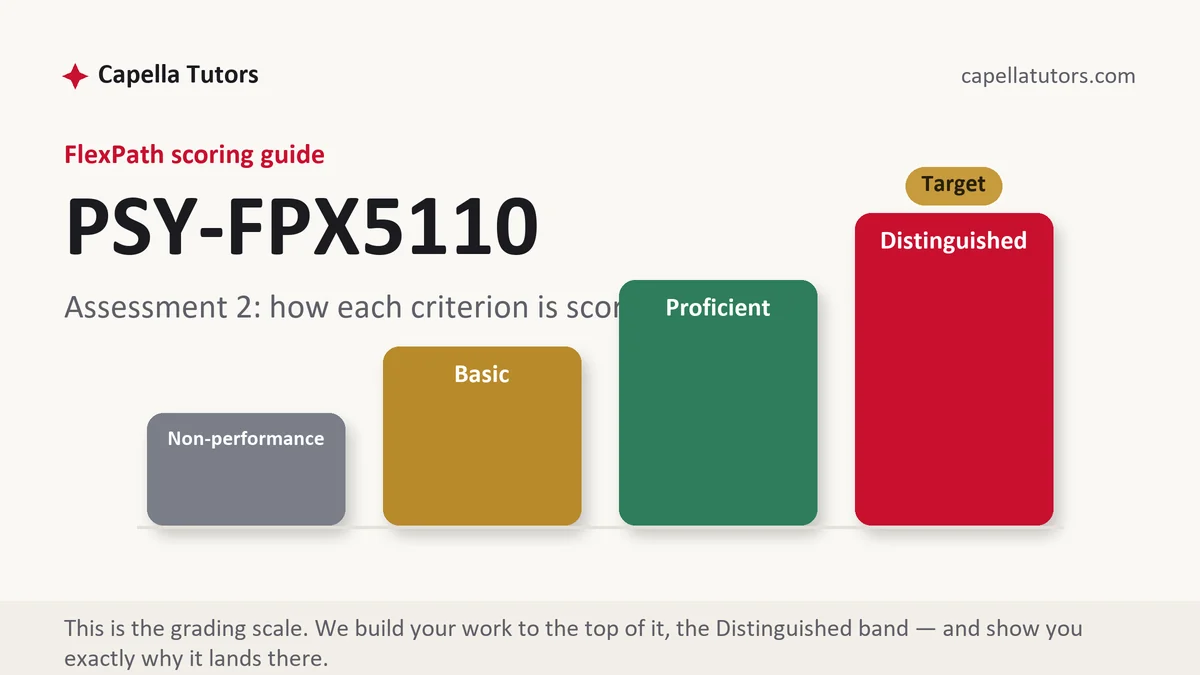
PSY-FPX5110 Assessment 2 grading scale at Capella FlexPath, the criterion levels this assessment is scored on, from Capella Tutors
How Capella FlexPath grades PSY-FPX5110 Assessment 2, visualized by Capella Tutors.

How PSY-FPX5110 Assessment 2 is scored

Each criterion in the guide is placed at one of four levels rather than converted into a percentage, and the level wording tells you what the paragraph beneath it owes:

LevelWhat it means on a measurement appraisal
DistinguishedScores are written as intervals, group differences are translated into overlap, fairness is tested at the item and prediction level rather than inferred from an average, and any mismatch between the validation population and this use is named by the writer.
ProficientReliability, validity and norms are reported accurately and the interpretation is defensible. Correct, and one level short, because the numbers were not translated into what they mean for a decision.
BasicPsychometric terms defined correctly and then set aside, with scores treated as exact and a mean difference read as bias. Where this deliverable most often lands.
Non-performanceA required element is missing, most often the reference sample, the error band, or any statement of the use the instrument was validated for.

One habit carries this whole strand: read a person as a position in a distribution rather than as a kind of person. Trait and ability scores are continuous, carry error, and are normed against a comparison group you can name, while types are claims about categories, and most instruments handing out types have cut a continuous variable near its middle and labelled both halves.

The PSY-FPX5110 Assessment 2 method, step by step

  1. Write the use before you write the test

    Validity is a property of an interpretation for a purpose, not a badge an instrument wears. Start with the decision the score is being asked to support, in one sentence, because every judgment in the paper is a judgment about the fit between that decision and the evidence behind the instrument.

  2. Name the reference sample and the technical manual it came from

    A percentile means nothing until a reader knows who the comparison group was. Report who was in the norming sample, when it was collected, and how closely it resembles the people this instrument is now being used on, then cite the manual rather than a summary of it.

  3. Put an interval around every individual score

    An ability composite of 108 with a standard error of measurement of three points carries a 95 percent interval running from roughly 102 to 114, which places the person in the average band and makes the gap between 108 and 112 unusable as an argument. Any interpretation turning on four points is reading noise.

  4. Convert every group difference into overlap

    Report the effect size, then say what it means for two people. A difference of half a standard deviation puts the higher group's average above about 69 percent of the other group, and a randomly drawn pair still runs against the group difference roughly 36 times in 100. That sentence keeps a real finding from hardening into a stereotype.

  5. Test fairness technically, or say it was not tested

    Three findings count as bias evidence: differential item functioning, differential prediction, and a failure of measurement invariance. A gap in outcomes is none of them. Say which of the three your source examined, and if it examined none, write that sentence plainly.

  6. State the scope limit, then self-score

    Say what a non-licensure master's lets you conclude here, who owns the decision, and what you would consult and document. Then grade each criterion yourself at one of the four levels and rewrite everything below the top before submitting.

A structure that maps to the criteria

These are planning targets from our tutors for a graduate measurement appraisal, not Capella rules; expand the section your guide weights hardest.

SectionWhat it must doGuide word target
The proposed useThe decision the score is meant to support, and the population it would be applied to.~180 words
The instrument and its normsConstruct, format, reference sample, reliability estimates, standard error, and the validated purpose.~300 words
Evidence on the differenceWhat the research reports, with design and sample, effect sizes translated into overlap.~300 words
Fairness examinedItem functioning, differential prediction and invariance, with what was tested and what was not.~280 words
Judgment and scopeWhether the use is defensible, what you would change, and the limit of your own authority.~200 words
Language and referencesTerminology chosen deliberately, testing standards and manuals cited directly, current APA.as needed

Annotated sample excerpt

One original model paragraph from our team, showing the register that clears the top row. Learn the pattern, then apply it to the instrument your own assessment names.

Sample excerpt: fairness paragraph Original model · Capella Tutors

The vendor's report gives a pass rate of 74 percent among the 1,412 candidates who sat the examination in their first language and 61 percent among the 388 who did not, both figures taken from a single administration window in one year.1 That is a difference in outcomes, and it is not by itself evidence of bias, because bias is a property of measurement established by differential item functioning, by differential prediction, or by a failure of measurement invariance, and the report examines none of the three.2 Two of them can be examined with data already in hand: fitting invariance models across the two groups would show whether the items relate to the construct in the same way in each, and an item-level analysis conditioning on total score would locate any item whose odds of a keyed response differ by group among candidates of equal standing.3

  • 1Denominators and the measurement window sit beside the percentages, so a reader can see how much weight each figure will bear before any argument is built on it.
  • 2Names the three technical criteria and then says which of them the source tested, which is the distinction the fairness row is written to find.
  • 3Turns the objection into a specific analysis somebody could run, rather than ending on a complaint about the vendor.

The full premium sample for your exact assessment, written fresh to your scoring guide and issue, is free to request. Study it, revise it into your own voice, and submit work you understand.

Get the full sample free

The five mistakes that cost Distinguished

  • Bias equated with a gap. Fairness is a claim about items and prediction, and a paper skipping that distinction has answered a question nobody asked.
  • Scores treated as exact. An interpretation that turns on a handful of points is reporting measurement error as information.
  • Effect sizes left untranslated. A number with no overlap statement invites the reader to imagine two separated populations that do not exist.
  • Norms without a reference sample. A percentile is uninterpretable until the comparison group is described, including when it was collected.
  • A quiz site standing in for an instrument. Consumer personality pages and popular summaries cannot support a psychometric claim, and the technical manual can.

Pre-submission checklist

  • The proposed use is stated before any judgment about the instrument
  • Reference sample, reliability and standard error appear beside every score interpreted
  • Individual scores written as intervals, not as points
  • Every group difference carries an effect size and an overlap statement
  • Fairness addressed at item and prediction level, with untested criteria named as untested
  • Testing standards and technical manuals cited directly, references matched both ways

Measurement appraisal due?

Send the guide, the instrument and any report you have been asked to evaluate. A research analyst pulls the technical manual, and one reviewer does nothing but check that every number in the narrative matches the source it came from. Premium original sample in 24 to 48 hours, revised free.

Keep going

Online now