This manual is for PM FPX 4080 Assessment 1, start to submission. The first criterion in this course catches submissions that treat iterative delivery as obviously better. The assessment usually asks you to compare the work in front of you against the conditions each approach needs, say which of those conditions your scenario satisfies and which it fails, and recommend accordingly, including the hybrid arrangement where different components answer differently. Your scoring guide decides whether that arrives as an approach comparison, a recommendation to a sponsor, or a suitability section inside a larger plan. Below is how we build one, with the structure it produces and a sample excerpt carrying notes. Prefer to hand it off? A premium original sample is with you within 24 to 48 hours, and free revision runs until the criteria are answered. Capella's catalog lists the course as PM-FPX4080, and some courserooms print PM4080; both point to this same Assessment 1.
One honesty note before the manual: Capella revises courses and scoring guides over time, so always write to the exact scoring guide attached to your assessment in the courseroom. The course identity above is verified on capella.edu; the method and structure below are our tutors' approach to it, not Capella's official rubric text.
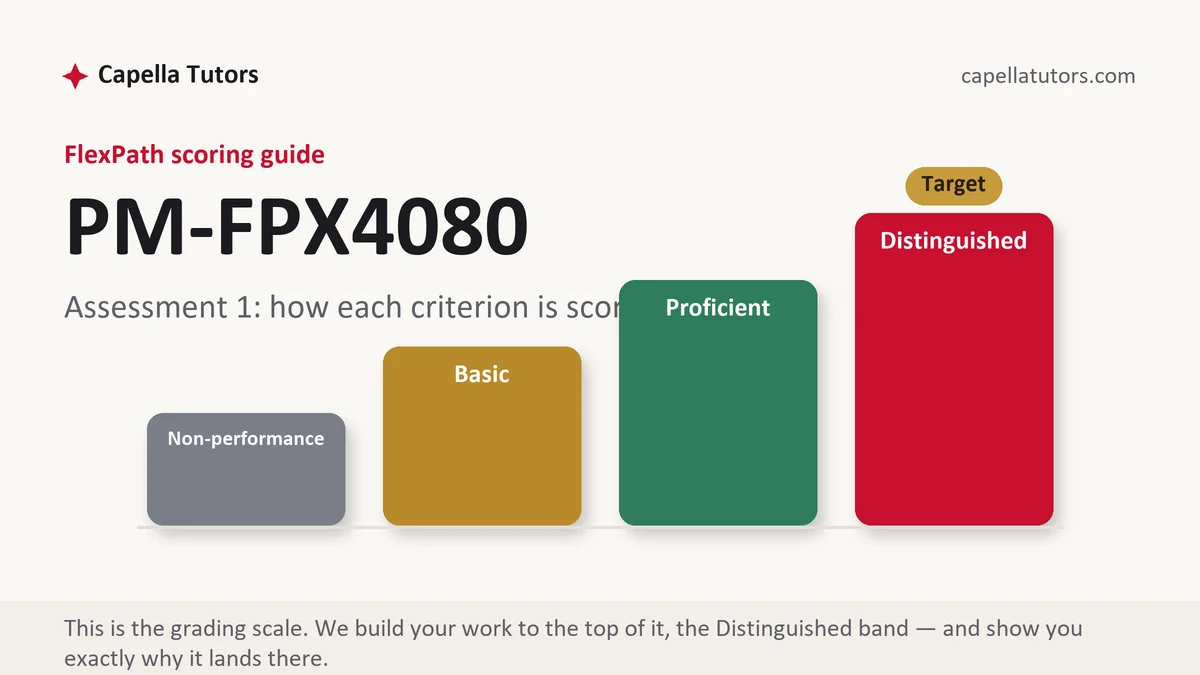
How PM FPX 4080 Assessment 1 is scored
Criteria are graded one at a time, and on a suitability deliverable the four levels turn on whether the conditions were tested:
| Level | What it means on an approach suitability comparison |
|---|---|
| Distinguished | Each approach is described by the conditions it needs, the scenario is tested against every one of them including the ones it fails, any hybrid is split by component, and the condition that would change the recommendation is named. |
| Proficient | A correct and complete comparison ending in a defensible recommendation. The conditions are described accurately and the scenario is never tested against the ones it fails. |
| Basic | A list of advantages and disadvantages, then a preference for iteration on the grounds that it is flexible and modern, which skips the criterion entirely. |
| Non-performance | A required comparison is absent, or an approach is named with no conditions behind it at all, which leaves the justification criterion nothing to grade. |
The most persuasive sentence in a suitability paper is the one admitting where iteration does not fit. A submission naming the two conditions its scenario fails and then recommending anyway, with the compensating arrangement stated, reads as judgment, and a submission that finds every condition satisfied reads as enthusiasm.
The PM FPX 4080 Assessment 1 method, step by step
-
Ask four questions of the scenario, in writing
Will the requirements change as people see working output, or are they fixed by a contract, a regulation or physics. Can somebody with authority over priorities be available weekly, or does that sit with a committee. Can the work be delivered in slices that are individually usable. Does the organization tolerate a plan committing to a direction rather than a date.
-
Describe each approach by what it needs, not by what it is
Iterative delivery needs genuine requirement uncertainty, a continuously available customer and releasable increments. Predictive delivery needs a specification that can be approved and change that is expensive once the work starts. Written that way the comparison becomes a test rather than a summary.
-
Test the scenario against every condition, including the failures
Answer each condition yes or no about your project and say why. Two or three affirmatives point to iteration, one or none points to a plan-driven approach, and a split points to a hybrid. The failures are the part evaluators read closely, because that is where the judgment lives.
-
Split the hybrid by component if you recommend one
Name which part runs which way and give the reason for each half. A hybrid recommended without that division is a way of avoiding the choice, and the criterion reads it as one. Sequential phases with iterative build inside them is a legitimate structure when you say so explicitly.
-
Say what the approach costs the organization
Iteration asks for a customer representative every fortnight, a team that is not reassigned mid-release, and a sponsor who accepts a range instead of a date. Those are real costs and naming them is what stops the recommendation reading as a free lunch.
-
Name the condition that would reverse it, then submit
If the priority owner stops being available weekly, or a regulator requires the specification approved before build, say what you would switch to and who decides. Then check every claim against a fact in the scenario, self-score against the descriptors, and submit with room for a second attempt.
A structure that maps to the criteria
Ranges our tutors use for a suitability deliverable with a recommendation; where the guide asks for a formal comparison table, the conditions section carries more of the words.
| Section | What it must do | Guide |
|---|---|---|
| The work in front of you | What the project delivers, who wants it, what is fixed and what is genuinely unknown. | ~250 words |
| Conditions each approach needs | What has to be true for iterative, predictive and hybrid delivery to work, stated as tests. | ~300 words |
| The scenario tested | Each condition answered about this project, with the failures named as plainly as the passes. | ~300 words |
| Recommendation | The approach chosen, the component split if any, and what each half runs on. | ~250 words |
| What it costs to adopt | The availability, team stability and reporting concessions the approach requires from the organization. | ~200 words |
| Switching point and references | The condition that would reverse the recommendation, who decides, and current APA both ways. | ~200 words |
Annotated sample excerpt
A suitability paragraph from an original model our team wrote, printed as the recommendation would be sent to a sponsor.
Three of the four conditions hold. The requirements will move once rangers see working screens, because nobody in the two workshops could describe how group sites and seasonal permits interact; the booking flow can be released one park district at a time, so increments are genuinely usable; and the division tolerates a plan committing to a direction.1 The condition that fails is availability, since priority decisions currently sit with a recreation committee that meets on the first Tuesday of each month, which is four times slower than a fortnightly iteration needs.2 The recommendation is therefore iterative delivery with one compensating arrangement, a named deputy director holding delegated priority authority between committee meetings, and if that delegation is refused the build reverts to two approved phases with fixed increments, a decision that belongs to the division director rather than to the team.3
- 1The conditions counted rather than described, each one tied to a specific fact about this project. A reader can check every clause against the scenario.
- 2The failing condition named with the reason it fails and the size of the gap. This sentence is what separates judgment from enthusiasm.
- 3A recommendation carrying a compensating arrangement, a fallback and a named decision owner. The criterion asking you to justify the approach is answered three ways.
The full premium sample for your exact assessment, written fresh to your scoring guide and issue, is free to request. Study it, revise it into your own voice, and submit work you understand.
The five mistakes that cost Distinguished
- Iteration asserted rather than argued. Calling the approach flexible and modern skips the suitability criterion, which wants the conditions of this project tested one by one.
- Advantages and disadvantages instead of conditions. A balanced list ending in a preference is a summary of the reading rather than an analysis of the work.
- No failing condition anywhere. A scenario that satisfies every condition is usually a scenario that was not tested, and evaluators read the absence as a tell.
- A hybrid with no component split. Recommending a mixture without saying which part runs which way avoids the decision the criterion asked for.
- No cost of adoption stated. Weekly availability, a stable team and a sponsor who accepts a range are real concessions, and a recommendation that hides them is incomplete.
Pre-submission checklist
- Four suitability questions answered in writing about this specific project
- Each approach described by the conditions it needs rather than by its reputation
- At least one failing condition named, with the size of the gap
- Any hybrid split by component, each half with its reason
- The organizational cost of the recommended approach stated plainly
- A switching condition named with a decision owner, self-scored, submitted early in the week
Approach comparison or suitability section due?
Send the scenario and the criteria. We test every condition against your project, name the ones it fails, split any hybrid by component and return a premium original sample inside 24 to 48 hours.