This manual is for PM FPX 4070 Assessment 1, start to submission. The first thing graded is whether the decision to buy was made or assumed, and most drafts open with a supplier already chosen. The assessment usually asks you to compare the total cost of producing something internally against the cost of acquiring it over the volume the project actually needs, then add the factors price cannot express and say what the supplier's lead time does to your schedule. Your scoring guide decides whether that arrives as a make-or-buy analysis, a procurement scope section, or a recommendation to a purchasing committee. Below are the six steps our tutors use, the structure they produce, and an annotated sample excerpt. Prefer to hand it off? A premium original sample built to your criteria arrives in 24 to 48 hours, with revision free until it clears. Capella's catalog lists the course as PM-FPX4070, and some courserooms print PM4070; both point to this same Assessment 1.
One honesty note before the manual: Capella revises courses and scoring guides over time, so always write to the exact scoring guide attached to your assessment in the courseroom. The course identity above is verified on capella.edu; the method and structure below are our tutors' approach to it, not Capella's official rubric text.
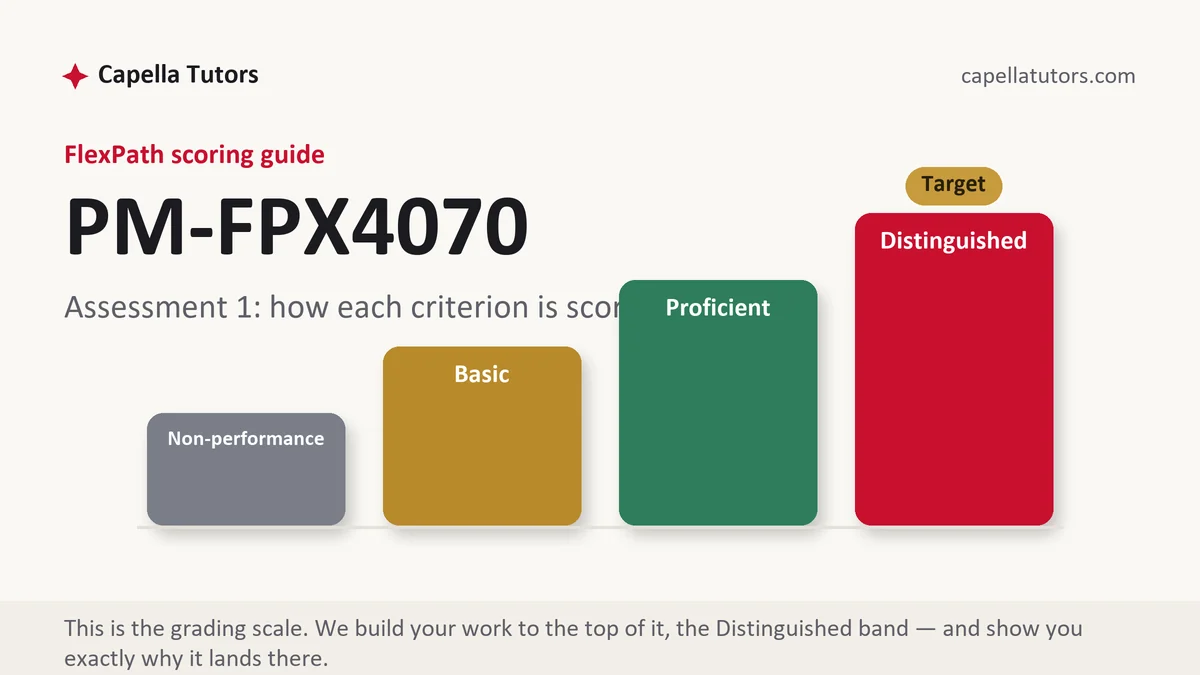
How PM FPX 4070 Assessment 1 is scored
Criteria are scored one at a time, and on a buying decision the four levels turn on whether a volume was computed:
| Level | What it means on a make-or-buy analysis |
|---|---|
| Distinguished | A breakeven volume is computed and compared against a forecast, the factors price cannot express are named separately, the lead time is carried into the schedule, and the recommendation says what would reverse it. |
| Proficient | A correct comparison with a sound recommendation. The arithmetic is right, and nothing outside the spreadsheet is weighed against it. |
| Basic | An assertion that buying is cheaper, supported by two unit prices and no volume, which is the first criterion answered with a preference. |
| Non-performance | A required element is absent, usually the internal cost or the lead time, and a plan showing a component arriving before an award cycle could finish has failed a criterion nobody was watching. |
Lead time is part of the schedule, not a footnote to it. Work out how long solicitation, evaluation and award realistically take, add the supplier's own delivery window, and check that the first activity depending on the item starts after all of that, because the criteria in this course quietly test whether you did.
The PM FPX 4070 Assessment 1 method, step by step
-
Say exactly what you are buying, and in what quantity
The unit matters as much as the item. Trays, tray-washes, hours of service, licences per year: each produces a different comparison. Write the unit down, then write the forecast volume and where the forecast came from, since the whole analysis rests on it.
-
Total the internal cost, capital and running
Internal production has a fixed part and a variable part, and both belong in the comparison. Equipment, installation and any space you have to give up sit in the first; labour, consumables, utilities and maintenance sit in the second. A comparison using only the variable part will recommend building almost every time and will be wrong almost as often.
-
Find the volume where the two lines cross
Divide the internal fixed cost by the difference in cost per unit. If washing in house costs 21,600 dollars in equipment plus 34 cents a tray-wash while a contracted service charges 94 cents with no capital, the 60-cent difference clears the capital at 36,000 tray-washes, and the forecast tells you which side of that line you are on.
-
Name the factors the arithmetic cannot hold
Who owns the result, who carries the liability if something fails, whether the organization wants this capability in eighteen months, what happens if the supplier stops trading, and how much management attention the arrangement will consume. Each of these can overturn a breakeven, and a paper that lists them separately is doing the analysis rather than the spreadsheet.
-
Carry the lead time into the schedule
Take the award cycle plus the supplier's delivery window and put the result on the network as a real duration with a real predecessor. A recommendation that changes the critical path is a finding, and it belongs in the recommendation rather than in an appendix.
-
State what would reverse the decision, then submit
Name the volume, price or condition at which you would choose the other way. That sentence proves the recommendation was reasoned rather than preferred, and it costs a line. Then check every figure against its table, self-score, and submit with room for a second attempt.
A structure that maps to the criteria
Ranges our tutors use for a make-or-buy analysis with a procurement scope section; where the guide asks for a committee recommendation, the qualitative factors take more of the space.
| Section | What it must do | Guide |
|---|---|---|
| Procurement scope | What the project needs from outside, in what unit, at what forecast volume, and where the forecast came from. | ~250 words |
| Internal cost | Capital and running costs of producing it yourself, each figure with a rate or a quotation behind it. | ~250 words |
| External cost | The supplier price, what it includes, what it excludes, and any minimum or escalation terms. | ~200 words |
| Breakeven | The crossover volume computed, compared against the forecast, with the arithmetic shown. | ~250 words |
| Factors beyond price | Ownership, liability, capability retention, supplier continuity and management attention. | ~300 words |
| Lead time, recommendation and references | The award and delivery cycle on the schedule, the recommendation, what would reverse it, current APA. | ~250 words |
Annotated sample excerpt
A breakeven paragraph from an original model our team wrote, printed the way a recommendation should read.
Washing in house needs 21,600 dollars of dishwasher, rack and plumbing work, then 34 cents per tray-wash in labour, water and detergent, while the contracted tray service quotes 94 cents per tray-wash with no capital charge and a 60-tray minimum per delivery.1 The 60-cent difference clears the capital at 36,000 tray-washes, and the district serves about 210,000 a year across eleven schools, so on volume alone the equipment pays for itself inside the first two months of a single year and building is the arithmetic answer.2 Two factors push back and both belong in the recommendation: the district carries the health inspection finding if a wash cycle fails, which the service currently absorbs, and the kitchen at the middle school has no floor space for a second machine, so the recommendation is to build at ten sites, buy at the eleventh, and revisit if the service rate falls below 45 cents.3
- 1Both sides costed with the unit named and the capital separated from the running cost. A reader can compute the crossover from this sentence alone.
- 2The breakeven divided out and compared against a real forecast, with the conclusion stated as the arithmetic answer rather than as the answer.
- 3The factors price cannot hold, applied to produce a split recommendation, plus the price at which the decision reverses. Three moves the Basic version never makes.
The full premium sample for your exact assessment, written fresh to your scoring guide and issue, is free to request. Study it, revise it into your own voice, and submit work you understand.
The five mistakes that cost Distinguished
- A buy decision with no breakeven. Declaring the contracted option cheaper with no volume behind it answers the opening criterion with a preference.
- Internal cost counted as labour only. Leaving out equipment, installation and the space given up makes building look cheaper than it is at every volume.
- A breakeven with no forecast beside it. The crossover volume means nothing until it is compared against how many units the project actually needs.
- Qualitative factors folded into the price. Liability, ownership and capability retention cannot be expressed as a unit cost, so they need their own paragraph.
- Lead time left out of the schedule. A component arriving before a realistic award cycle could finish is a plan that cannot happen, whatever the comparison says.
Pre-submission checklist
- The unit of purchase named, with a forecast volume and its source
- Internal cost split into capital and running, each figure traceable
- Supplier price stated with what it includes, excludes and any minimum
- The breakeven volume computed and compared against the forecast
- Ownership, liability, capability and continuity weighed in their own section
- Award and delivery lead time placed on the schedule, self-scored, submitted early in the week
Make-or-buy analysis due?
Send the quantities, any quotes and the criteria. We total both sides, compute the crossover, weigh what the spreadsheet cannot hold and return a premium original sample inside 24 to 48 hours.