This manual is for PM FPX 4070 Assessment 3, start to submission. Administration and closeout carry the last block of marks in this course and are the sections most frequently left as headings. The assessment usually asks you to set out inspection rights and acceptance criteria, a remedy for the failure most likely to occur, a change order route with a named approver, an invoice approval chain tied to delivered value, and a closure checklist that actually closes something. Your scoring guide decides whether that arrives as an administration plan, a closeout checklist, a claims analysis, or a handover report. The method below is how our team builds it, with a criterion-keyed structure and an annotated excerpt. Prefer to hand it off? A premium original sample reaches you in 24 to 48 hours, revised free of charge until every criterion is answered. Capella's catalog lists the course as PM-FPX4070, and some courserooms print PM4070; both point to this same Assessment 3.
One honesty note before the manual: Capella revises courses and scoring guides over time, so always write to the exact scoring guide attached to your assessment in the courseroom. The course identity above is verified on capella.edu; the method and structure below are our tutors' approach to it, not Capella's official rubric text.
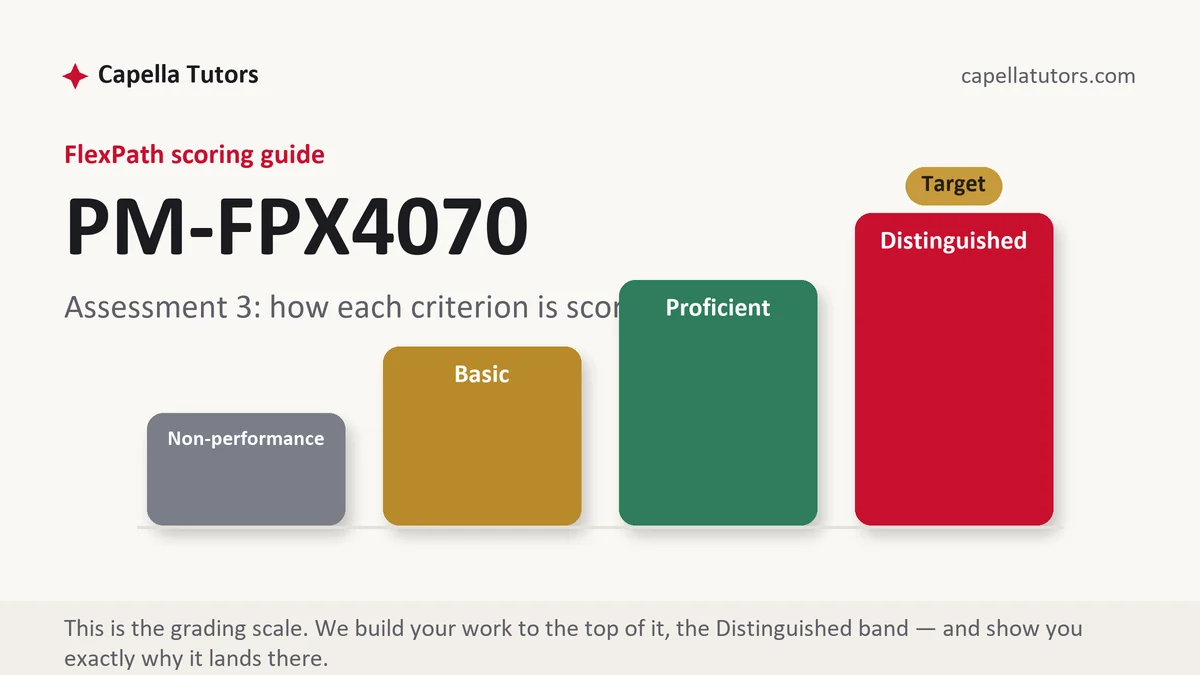
How PM FPX 4070 Assessment 3 is scored
Criteria are graded independently, and on an administration deliverable the four levels turn on whether anything is enforceable:
| Level | What it means on an administration and closeout deliverable |
|---|---|
| Distinguished | Acceptance criteria sit in the contract with inspection rights and a stated remedy, payment is tied to accepted value with the ratio shown, and closure names an owner and a date for retention, claims, warranty start and records. |
| Proficient | A complete administration section with acceptance, change orders and invoicing described correctly. Payment runs on elapsed time rather than on accepted deliverables. |
| Basic | A description of how the supplier will be managed, with acceptance left to the deliverable description and closure summarised as a final payment. |
| Non-performance | A required element is absent, usually the remedy, the retention treatment or the warranty start date, and a project that ends without them leaves real money unclaimed. |
Payment tied to elapsed time pays for a calendar and payment tied to accepted value pays for work, which is why the acceptance log rather than the invoice date should gate the next release. That ratio is worth computing in the paper, because it converts a policy statement into a control.
The PM FPX 4070 Assessment 3 method, step by step
-
Put acceptance criteria in the contract, not in the description
Write what will be inspected, by whom, against what standard, within how many days, and what happens if it fails. Acceptance living only inside a deliverable description gives you an opinion to argue with, while acceptance in the instrument gives you a right to exercise.
-
Write the remedy for the failure most likely to occur
Not every failure, the likely one. Late delivery of the dimmer racks, fixtures supplied to a different specification, an installer without the required certification. Name the remedy for each: replacement at supplier cost, a stated deduction, a right to complete the work and charge it back.
-
Route change orders through one named approver
Every variation gets priced, approved and incorporated, so the final contract value is a figure both parties recognise. A project that reaches closure with three unincorporated change orders has a dispute rather than a contract, and the criterion asking about administration is asking about this route.
-
Gate payment on accepted value and show the ratio
If the supplier has invoiced 68,000 dollars of a 155,000 contract while the acceptance log records 51,000 dollars of deliverables accepted, they are returning 75 cents of accepted work for each dollar billed. That ratio, rather than the date on the invoice, is what should decide whether the next release is approved.
-
Hold retention and start the warranty at acceptance
Retention exists to make the last ten percent of the work happen, so state the percentage, the trigger for release and who authorises it. Then write the warranty start date explicitly, because a warranty that quietly began at delivery rather than at acceptance can expire before anybody uses the equipment in anger.
-
Close with a checklist carrying owners and dates, then submit
Final acceptance against the specification, every change order priced and signed, retention released, claims settled or formally recorded, warranty start captured, a supplier performance note left for the next buyer, and the file archived where an auditor could find it. Then grade each criterion yourself and submit while there is room for one more attempt.
A structure that maps to the criteria
Ranges our tutors use for an administration deliverable with a closeout checklist; where the guide supplies a dispute, the claims section takes the words the payment discussion would have had.
| Section | What it must do | Guide |
|---|---|---|
| Acceptance and inspection | What is inspected, by whom, against what standard, in what window, and the consequence of failure. | ~250 words |
| Remedies | The failures most likely on this contract and the remedy written for each one. | ~250 words |
| Change orders | The route, the pricing method, the named approver, and how variations reach the contract value. | ~250 words |
| Payment control | The approval chain, the tie to accepted value, the ratio computed, and who may release funds. | ~250 words |
| Retention and warranty | The percentage held, the release trigger, the authoriser, and the date the warranty starts. | ~200 words |
| Closeout checklist and references | Every closure act with an owner and a date, the supplier evaluation, the archive, current APA. | ~300 words |
Annotated sample excerpt
A payment control paragraph from an original model our team wrote, printed as it would appear in the administration section.
The supplier has invoiced 68,000 dollars against a 155,000 dollar contract while the acceptance log records 51,000 dollars of deliverables formally accepted, which is 75 cents of accepted work returned for every dollar billed.1 The next release is therefore held until the dimmer rack commissioning certificate is accepted, because the approval chain in this contract ties payment to accepted value rather than to elapsed weeks, and the technical director rather than the finance clerk signs that acceptance.2 Retention stands at five percent, or 7,750 dollars, released 30 days after final acceptance by the board treasurer, and the two-year warranty begins at final acceptance rather than at delivery, which matters here because the rig sat in the loading bay for six weeks before the ceiling work allowed installation.3
- 1The ratio computed from two figures the project already holds, which turns a policy sentence into a decision about the next payment.
- 2The gate named as a specific document and the signature placed with the person competent to judge it rather than with the person holding the cheque book.
- 3Retention, its release trigger, its authoriser and the warranty start date, with the reason the start date matters on this contract. This is the paragraph closeout criteria are written for.
The full premium sample for your exact assessment, written fresh to your scoring guide and issue, is free to request. Study it, revise it into your own voice, and submit work you understand.
The five mistakes that cost Distinguished
- Acceptance left to the deliverable description. With no inspection right and no written remedy, challenging a poor rig install becomes a conversation rather than an entitlement.
- Payment on elapsed time. Releasing money because weeks have passed pays for a calendar, and the acceptance log is the only record of what was actually delivered.
- Unincorporated change orders. Three variations that were approved and never written into the contract leave two parties with different final values.
- Retention held with no release rule. Money withheld and never formally released becomes a dispute, and the criterion expects the trigger and the authoriser.
- A project closed while the contract stays open. Unreleased retention, an unstarted warranty and an open claim are real money left behind, and the criterion asks for the checklist.
Pre-submission checklist
- Acceptance criteria, inspection rights and a failure consequence written into the contract
- A remedy drafted for each failure most likely on this work
- A change order route with one named approver and a path into the contract value
- Payment tied to accepted value, with the ratio computed
- Retention percentage, release trigger and authoriser stated, and the warranty start date named
- A closeout checklist with an owner and a date on every line, self-scored, submitted early in the week
Administration plan or closeout checklist due?
Send the contract, the acceptance position and the criteria. We tie payment to accepted value, draft the remedies and build a closeout checklist with owners, returning a premium original sample inside 24 to 48 hours.