This manual is for PM FPX 4070 Assessment 2, start to submission. This course treats the contract type as the central intellectual move rather than a vocabulary list, because every contract form is a decision about who carries the risk of cost growth. The assessment usually asks you to write a statement of work precise enough that two suppliers would bid on the same thing, choose a contract type and defend it from the maturity of that specification, then evaluate bids against weights you committed to before opening them. Your scoring guide decides whether that arrives as a procurement management plan, a statement of work, a source selection exercise, or an award recommendation. What follows is the method, a structure that answers each criterion, and an excerpt with notes attached. Prefer to hand it off? A premium original sample returns in 24 to 48 hours with the sharing arithmetic checked, revised free until the criteria are met. Capella's catalog lists the course as PM-FPX4070, and some courserooms print PM4070; both point to this same Assessment 2.
One honesty note before the manual: Capella revises courses and scoring guides over time, so always write to the exact scoring guide attached to your assessment in the courseroom. The course identity above is verified on capella.edu; the method and structure below are our tutors' approach to it, not Capella's official rubric text.
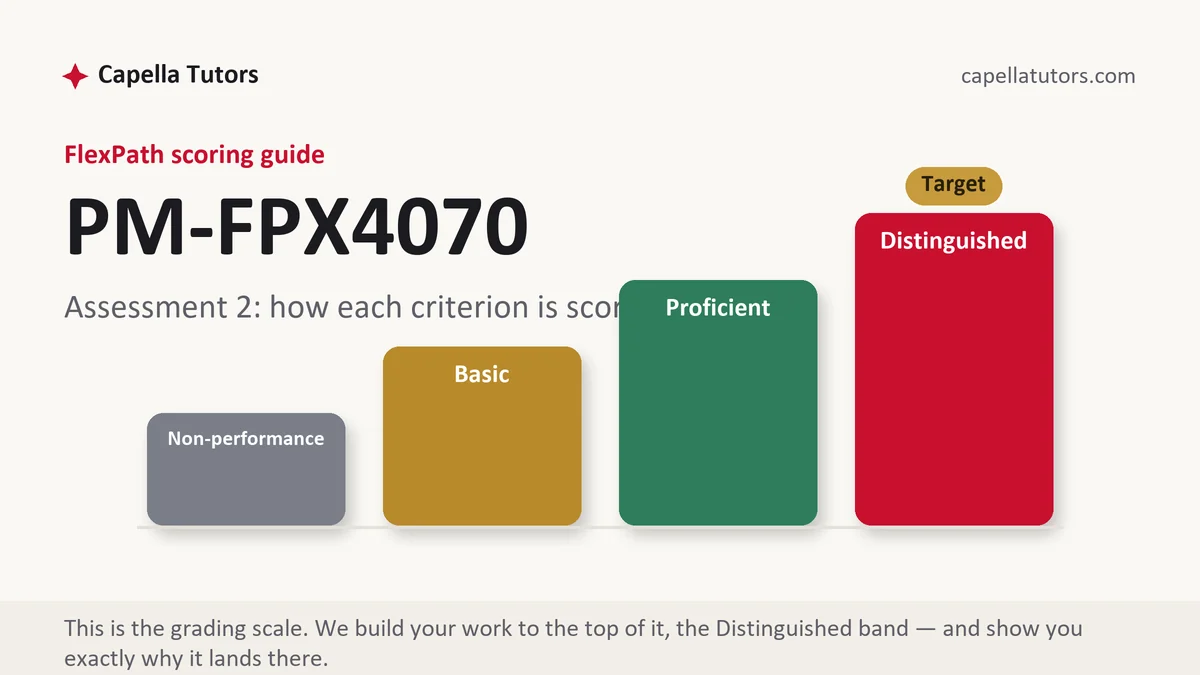
How PM FPX 4070 Assessment 2 is scored
Each criterion sits on one of four levels, and on a selection deliverable the four separate on when the weights were written:
| Level | What it means on a contract strategy and selection deliverable |
|---|---|
| Distinguished | The contract type is argued from specification maturity with the sharing arithmetic worked, the weights are fixed before any bid is opened, price is scored by formula, and the recommendation says what the premium buys. |
| Proficient | A sound contract choice and a complete scored comparison. The weights are stated, and price has been scored by impression rather than by a rule. |
| Basic | A list of contract types with a paragraph each, then a supplier chosen on price, which is the absence of a method rather than a method. |
| Non-performance | A required element is absent, usually the statement of work or the evaluation criteria, and a recommendation with no weights behind it cannot be defended to an unsuccessful bidder. |
One boundary keeps an undergraduate procurement paper out of trouble. Contract law differs by jurisdiction and standard terms are drafted by counsel for a reason, so the right sentence in any recommendation is that the final instrument goes to legal review before signature, and everything before that sentence is analysis.
The PM FPX 4070 Assessment 2 method, step by step
-
Write the statement of work until two bidders would price the same thing
Quantities, standards, interfaces, delivery locations, acceptance criteria and what the supplier is not responsible for. The test is whether two firms reading it would submit comparable bids, and if they would not, the differences in their prices will be differences in what they assumed rather than in what they charge.
-
Choose the contract type from what you know, not from habit
A precise specification with costly late change points to firm fixed price, and the supplier's risk premium is what the certainty costs you. Genuinely exploratory work points to a cost reimbursable form, which obliges you to fund oversight because you now carry the cost risk. State the reason in one sentence tied to the specification and the criterion is satisfied.
-
Work the sharing arithmetic if you choose an incentive form
With a target cost of 600,000 dollars, a target fee of 60,000, a seventy thirty split of overruns and a ceiling price of 744,000, a supplier who spends 640,000 has overrun by 40,000, so the agency absorbs 28,000 and the supplier gives up 12,000 of fee, the fee falls to 48,000 and the price becomes 688,000.
-
Find the point where sharing stops
Under those terms, cost growth stops being shared once the supplier's cost reaches 720,000 dollars, because beyond that the agency pays the 744,000 ceiling whatever happens and the supplier carries every further dollar alone. Showing that figure demonstrates the concept better than any description of contract types.
-
Publish the weights before opening a single bid
Technical approach 35, price 30, past performance 20, implementation schedule 15. Score price by formula so the lowest compliant offer takes the full allocation and the rest scale against it, which prevents the common trick of scoring price by impression once the numbers are known.
-
Say what the premium buys, then submit
If the recommended bidder costs 41,000 dollars more and scores fourteen points higher, translate the points into consequences: a shorter integration window, a firm who has installed this exact system twice, a warranty two years longer. A recommendation naming the premium and what it buys survives a finance review. Then self-score and submit with time for a second attempt.
A structure that maps to the criteria
Ranges our tutors use for a strategy and selection deliverable; where the guide asks only for a statement of work, that section takes the words the matrix would have used.
| Section | What it must do | Guide |
|---|---|---|
| Statement of work | Scope, quantities, standards, interfaces, acceptance criteria and the supplier's exclusions. | ~300 words |
| Contract strategy | The type chosen, the specification maturity behind it, the payment structure and where risk sits. | ~300 words |
| Sharing arithmetic | Target cost, fee, share ratio, ceiling, a worked overrun and the point where sharing stops. | ~250 words |
| Solicitation | The instrument used, who was approached, the timetable, and how questions were handled. | ~200 words |
| Evaluation and scoring | The weights fixed in advance, the price formula, and the scored comparison across bidders. | ~300 words |
| Award, negotiation and references | The recommendation, what the premium buys, the negotiation objectives, current APA both ways. | ~250 words |
Annotated sample excerpt
A scored comparison from an original model our team wrote, printed as the recommendation paragraph would be sent.
Weights were issued with the solicitation and not altered afterwards: technical approach 35, price 30, past performance 20 and implementation schedule 15, with price scored by formula so the lowest compliant bid takes the full 30 and the others scale against it.1 Bidder A is cheapest and takes 30 on price but scores 19 on technical, 11 on past performance and 10 on schedule for a total of 70; bidder B scores 22, 31, 18 and 13 for 84; bidder C lands at 77.2 The recommendation is bidder B at 41,000 dollars above bidder A, and the fourteen-point difference is worth naming in consequences rather than in adjectives: a nine-week integration window instead of fifteen, two completed installations of this exact fare-box on comparable fleets, and a three-year parts warranty against one.3
- 1Weights stated as fixed before bids opened, and price scored by a rule. Both facts protect the award from a challenge and both are usually graded.
- 2Every bidder scored on every dimension with the totals shown, so the reader can check the recommendation rather than accept it.
- 3The premium named in dollars and then translated into three consequences. A finance manager can argue with this paragraph, which is why it survives.
The full premium sample for your exact assessment, written fresh to your scoring guide and issue, is free to request. Study it, revise it into your own voice, and submit work you understand.
The five mistakes that cost Distinguished
- Evaluation criteria written after the bids. Weights invented after the envelopes are open document a preference and cannot be shown to an unsuccessful bidder.
- Cost reimbursable chosen for a defined scope. Paying a supplier's costs for work that could have been specified hands over money and control for nothing in return.
- An incentive form named without its arithmetic. The share ratio and the ceiling are the whole point of the instrument, and a paper that skips them has described a label.
- Price scored by impression. Without a formula the price column drifts toward whichever bidder the writer already preferred, and an unsuccessful bidder can see it.
- A statement of work two firms would read differently. Bids that are not comparable cannot be evaluated, and the differences will be in assumptions rather than in cost.
Pre-submission checklist
- A statement of work precise enough that two firms would bid the same scope
- Contract type argued from specification maturity in one clear sentence
- Sharing arithmetic worked, including the point where cost sharing stops
- Weights published before any bid was opened, and price scored by formula
- Every bidder scored on every dimension with totals shown
- The premium named and translated into consequences, legal review noted, submitted early in the week
Contract strategy or bid evaluation due?
Send the scenario, any quoted prices and the criteria. We write the scope so bids are comparable, work the sharing arithmetic, score the matrix and return a premium original sample inside 24 to 48 hours.