This manual is for PM FPX 4060 Assessment 3, start to submission. A register written once for a grade is the failure this part of the course exists to prevent. The assessment usually asks you to choose a response type for each priority entry, price it, attach a trigger that names an observable event and an owner who is one person, set a review cadence with a route to the sponsor, and close the register formally at the end. Your scoring guide decides whether that arrives as a response plan, a monitoring and control section, a closure report, or a briefing about one serious exposure. The method below is ours, followed by a structure mapped criterion by criterion and an annotated excerpt. Prefer to hand it off? A premium original sample comes back to you in 24 to 48 hours, revised without charge until the descriptors are met. Capella's catalog lists the course as PM-FPX4060, and some courserooms print PM4060; both point to this same Assessment 3.
One honesty note before the manual: Capella revises courses and scoring guides over time, so always write to the exact scoring guide attached to your assessment in the courseroom. The course identity above is verified on capella.edu; the method and structure below are our tutors' approach to it, not Capella's official rubric text.
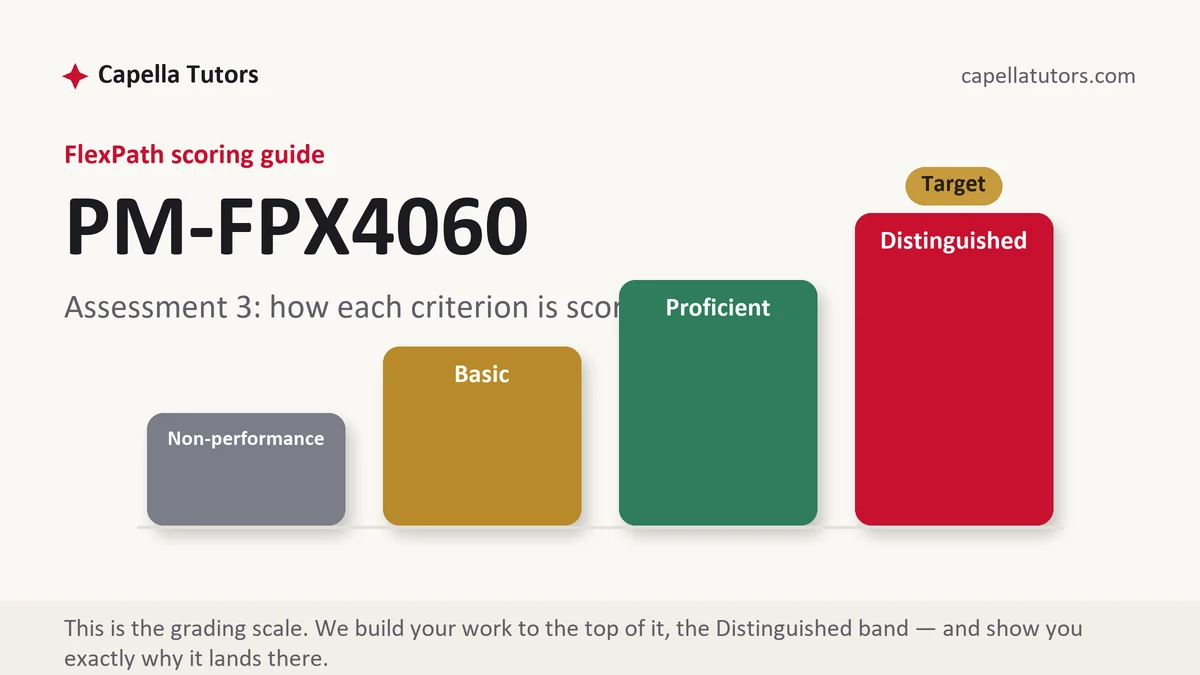
How PM FPX 4060 Assessment 3 is scored
Every criterion carries its own level, and on a response deliverable the four turn on whether anything would actually happen:
| Level | What it means on a response, monitoring and closure deliverable |
|---|---|
| Distinguished | Each response is tested against its own cost, at least one risk is accepted deliberately and explained, every entry has a trigger naming an observable event and one owner, and closure compares estimated impact with what the risks actually cost. |
| Proficient | Sound response choices with owners and a review cadence. The economics are described rather than computed, and reserve consumption is not reported against progress. |
| Basic | Mitigation attached to everything, triggers written as monitor closely, and owners recorded as a department rather than a person. |
| Non-performance | A required element is absent, usually the triggers, the review cadence or the closure step, and a register with no route to the sponsor is a document rather than a control. |
There are four positions available for a threat and acceptance is one of them. It is the right answer whenever the response costs more than the expected loss it removes, and what it still requires is documentation: the entry stays in the register, the reserve carries the money, a trigger says what you are watching, and somebody is named to notice when it fires.
The PM FPX 4060 Assessment 3 method, step by step
-
Choose the response type deliberately, and say why
Avoid by changing the plan, reduce by spending something, transfer the impact to somebody who can carry it, or accept and hold reserve. Name the type for each priority entry rather than describing an action, because the criteria are usually written against the four categories.
-
Price the response against the loss it removes
A response that costs more than the expected loss it retires is a loss, so put both figures beside each other. Transfer needs two tests of its own: whether the premium sits below your expected loss, and whether the counterparty could actually absorb the event if it happened.
-
Write the trigger as something a person could see
Monitor closely is not a trigger. The trigger is the observable event that fires the response: the seed delivery date slipping past a stated day, the ground temperature failing to reach a stated figure by a stated week, a second consecutive failed germination sample. Name the signal and name who watches for it.
-
Give every entry one owner and record the residual
A department cannot notice anything. Name a person, then write down what exposure remains after the response and whether the response created a new risk of its own, since both of those are what the top descriptor means by managing rather than listing.
-
Report reserve consumption against progress
Put the drawdown in the same table as the cost figures. A project that has spent 68 percent of a 21,600 dollar contingency while 40 percent of the work is done is not unlucky, it is under-reserved, and that comparison belongs in front of the sponsor in month two rather than month six.
-
Close the register, comparing estimate with actual, then submit
Say which risks expired without occurring, which occurred and what they actually cost against what you estimated, how much reserve went back, and the two entries you would carry straight into the next project of this type. Then self-score honestly and submit while a second attempt still fits the session.
A structure that maps to the criteria
Ranges our tutors use for a response deliverable with monitoring and closure; where the guide asks about a single serious exposure, the economics section takes most of the words.
| Section | What it must do | Guide |
|---|---|---|
| Priority entries carried forward | The entries the analysis put at the top, with their current probability and impact figures. | ~200 words |
| Response selection | The type chosen for each, the action behind it, and the reason that type fits this entry. | ~300 words |
| Response economics | Cost of each response against the expected loss it removes, with any deliberate acceptance explained. | ~250 words |
| Triggers and owners | The observable signal for each entry, who watches it, and what they do when it fires. | ~250 words |
| Monitoring and reserve | Review cadence, attendees, escalation threshold, and reserve drawdown reported against progress. | ~250 words |
| Closure and references | Risks expired, risks that occurred with estimated against actual cost, reserve returned, current APA. | ~200 words |
Annotated sample excerpt
A response and trigger block from an original model our team wrote, printed as the register rows would read.
Entry 2, cold ground delaying establishment: mitigation by hiring ground-heating covers costs 9,200 dollars and would take the probability from 40 percent to 15 percent, removing 0.25 of a 31,000 dollar impact, which is 7,750 of expected loss for a certain 9,200, so the response is deliberate acceptance funded from reserve rather than mitigation.1 Trigger: soil temperature at 100 millimetres failing to reach 8 degrees by the second Monday in April, read by the head groundsman on the existing daily log, at which point the covers are hired within 48 hours under a pre-agreed rate rather than negotiated in a hurry.2 Owner: the head groundsman personally, not the grounds department; residual exposure after acceptance is the full 31,000 held against a contingency of 21,600, which is reported to the stadium director in the monthly pack alongside the note that 68 percent of that reserve is committed at 40 percent completion.3
- 1Both figures printed side by side, and the decision going against mitigation because the arithmetic says so. A deliberate acceptance with its reasoning is what the response criterion pays for.
- 2A trigger written as a measurement, a threshold, a date and a reader, with the response pre-arranged so firing it is administrative rather than a negotiation.
- 3One named person rather than a department, the residual stated plainly, and reserve drawdown reported against progress in the same breath.
The full premium sample for your exact assessment, written fresh to your scoring guide and issue, is free to request. Study it, revise it into your own voice, and submit work you understand.
The five mistakes that cost Distinguished
- Mitigation attached to everything. Spending more on a response than the expected loss it retires is a loss, and a paper that never accepts a risk has not weighed one.
- Triggers written as intentions. Monitor closely names no event, so nobody knows when the response starts and the register cannot be operated.
- A department recorded as the owner. Departments do not notice signals, and a criterion asking for accountability is asking for one person.
- Transfer treated as disappearance. Insurance or a fixed price clause moves the impact for a premium, and it still fails if the counterparty could not absorb the event.
- A register that is never closed. Comparing estimated impact with actual cost is the cheapest credibility available, and skipping it leaves the closure criterion empty.
Pre-submission checklist
- A named response type for every priority entry, chosen from the four available
- Each response priced against the expected loss it removes
- At least one deliberate acceptance, with the arithmetic that justified it
- A trigger for every entry written as an observable event with a reader
- One named person as owner, with residual exposure and any secondary risk recorded
- Reserve drawdown reported against progress, register closed with estimate against actual, submitted early in the week
Response plan or register closure due?
Send the register, whatever figures you have and the criteria. We price every response against the loss it removes, write triggers somebody could act on, and return a premium original sample inside 24 to 48 hours.