This manual is for PM FPX 4060 Assessment 1, start to submission. The Project Proposal begins the course's risk-focused project work: you propose a project, often for the organization in the courseroom scenario, with its business objectives, the criteria for evaluating success, preliminary requirements, a preliminary cost estimate and schedule, the initial risks, the assumptions, and the approvals needed. The grade turns on a proposal that sets up risk management. Clear objectives and evaluation criteria, with the first risks identified, score above a general project description. Below is the method our tutors use, a structure that maps to the criteria, and an annotated sample excerpt. Prefer to hand it off? A premium original sample for this exact assessment comes back in 24 to 48 hours, revised free until it meets the guide. Capella's catalog lists the course as PM-FPX4060, and some courserooms print PM4060; both point to this same Assessment 1. In current courserooms this assessment typically appears as "Project Proposal".
One honesty note before the manual: Capella revises courses and scoring guides over time, so always write to the exact scoring guide attached to your assessment in the courseroom. The course identity above is verified on capella.edu; the method and structure below are our tutors' approach to it, not Capella's official rubric text.
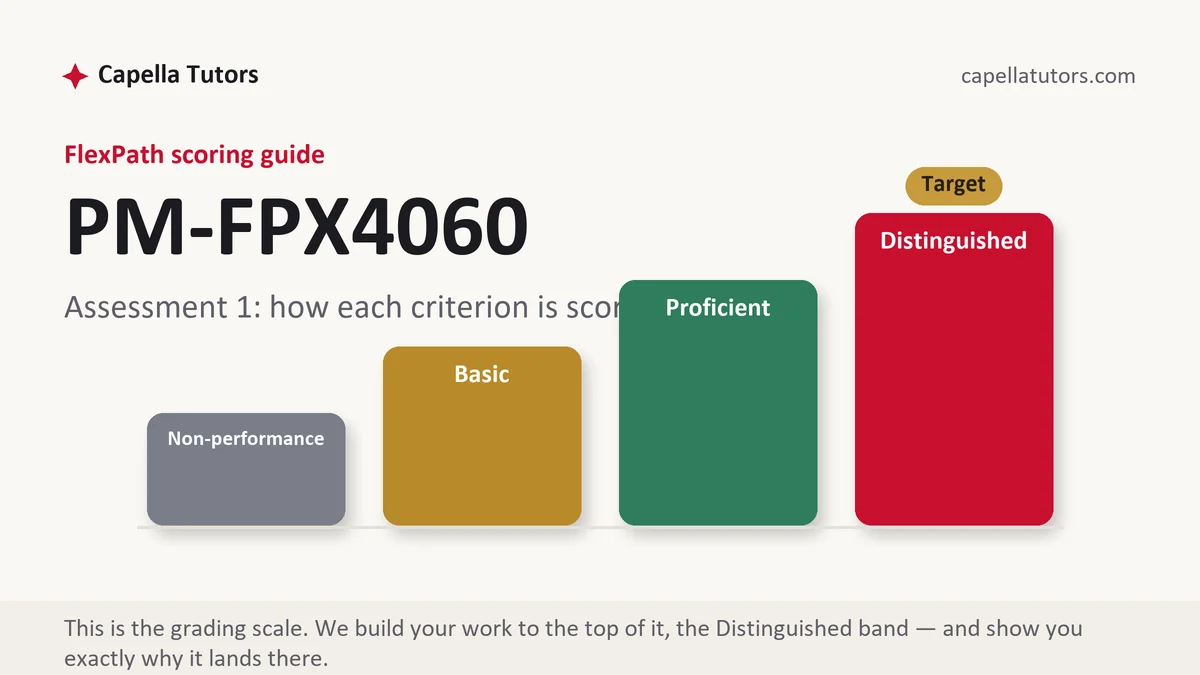
How PM FPX 4060 Assessment 1 is scored
FlexPath does not use letter grades. Each criterion in the scoring guide lands on one of four levels, and the level descriptions are the real writing brief:
| Level | What it means on a project proposal |
|---|---|
| Distinguished | The project proposal is specific to the organization or case, applies course concepts accurately with credible sources, and ends in justified conclusions or recommendations. |
| Proficient | The project proposal is accurate, but the application or recommendations are general. |
| Basic | The project proposal describes concepts with little application. |
| Non-performance | A required part of the project proposal is missing. |
Use the scenario your courseroom provides.
The PM FPX 4060 Assessment 1 method, step by step
-
Introduce the project
Name, manager and need.
-
Set business objectives
Measurable outcomes.
-
Define evaluation criteria
How success will be judged.
-
Outline requirements
Preliminary deliverables.
-
Estimate cost and schedule
Preliminary figures and dates.
-
Identify risks and assumptions
Initial risks and what the plan assumes.
A structure that maps to the criteria
Word counts are planning targets our tutors use, not Capella rules; follow the length and format your scoring guide states.
| Section | What it must do | Guide |
|---|---|---|
| Introduction and business objectives | Context. | ~150 words |
| Evaluation criteria and requirements | Measures and deliverables. | ~150 words |
| Cost estimate and schedule | Preliminary figures. | ~125 words |
| Risks, assumptions and approvals | Initial analysis. | ~150 words |
| References | Sources. | as needed |
Annotated sample excerpt
An original model excerpt from our team, written to show the register that reaches the top of the guide. Learn the moves, then write your own version.
The project will be judged successful if, six months after launch, first-call resolution in the customer service center rises from 62 to 75 percent and average handling time does not increase by more than 10 percent.1 The second criterion guards against a common failure: improving resolution by letting calls run longer, which would raise costs.2 Both measures come from the call center's existing reporting system, so the baseline is already known and progress can be tracked monthly.3
- 1Sets measurable success criteria.
- 2Adds a balancing criterion with its reason.
- 3Confirms data availability.
The full premium sample for your exact assessment, written fresh to your scoring guide and topic, is free to request. Study it, revise it into your own voice, and submit work you understand.
The five mistakes that cost Distinguished
- Definitions without application. Apply each concept to the organization or case.
- No sources. Cite credible business sources.
- Vague recommendations. Make them specific and justified.
- Vague success criteria. Make them measurable.
Pre-submission checklist
- Project introduced
- Business objectives
- Evaluation criteria
- Requirements
- Cost and schedule
- Risks, assumptions and approvals
Want the project proposal written?
Send the scoring guide and any materials from your courseroom. Our team returns a premium original project proposal in 24 to 48 hours, revised free until it meets the guide.