This manual is for PM FPX 4060 Assessment 2, start to submission. Analysis is graded in two layers here and the second one is where most submissions retreat into adjectives. The assessment usually asks you to define probability and impact scales numerically before you apply any matrix, produce a priority order you could defend when questioned, compute expected value on the entries that can be priced, and size a contingency reserve from that arithmetic rather than from a round percentage. Your scoring guide decides whether that arrives as a qualitative analysis, a quantitative exercise, a decision tree, or an analysis section inside a plan. What follows is the working method, the structure that comes out of it, and an excerpt with the moves marked. Prefer to hand it off? A premium original sample returns in 24 to 48 hours with every figure recomputed, revised free until the criteria are met. Capella's catalog lists the course as PM-FPX4060, and some courserooms print PM4060; both point to this same Assessment 2.
One honesty note before the manual: Capella revises courses and scoring guides over time, so always write to the exact scoring guide attached to your assessment in the courseroom. The course identity above is verified on capella.edu; the method and structure below are our tutors' approach to it, not Capella's official rubric text.
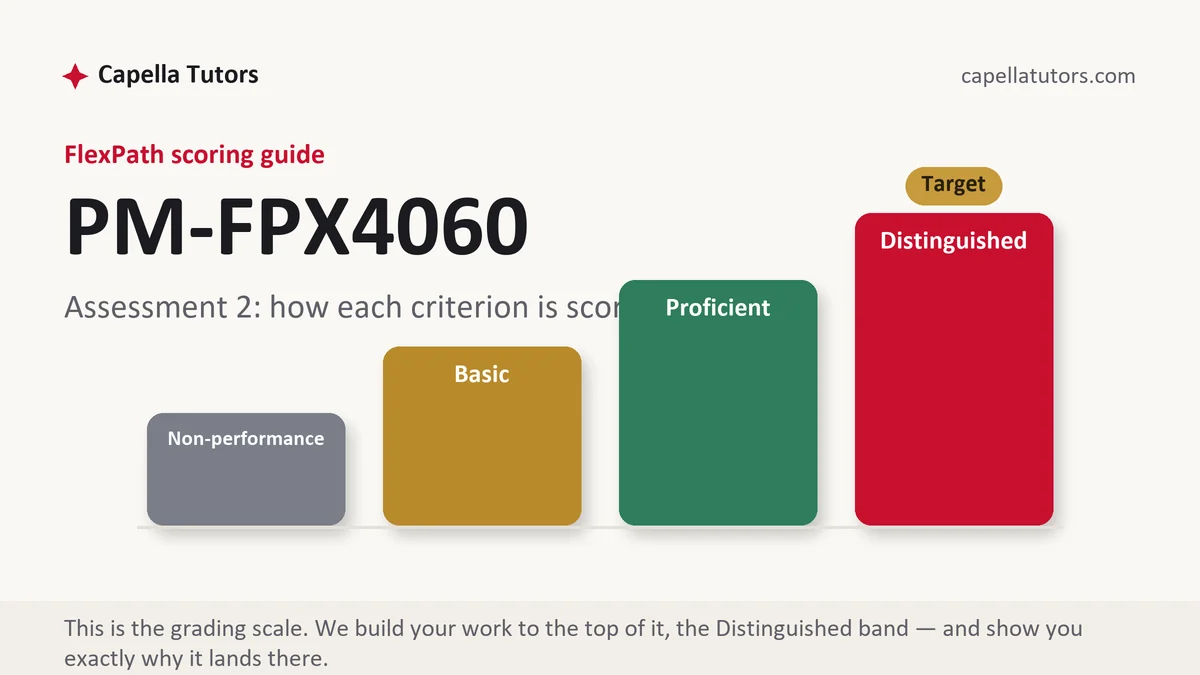
How PM FPX 4060 Assessment 2 is scored
Each criterion is placed on one of four levels, and on an analysis deliverable the four separate on whether the scales came before the matrix:
| Level | What it means on a risk analysis and reserve calculation |
|---|---|
| Distinguished | Probability bands and impact definitions are set out before the matrix is applied, impact is defined separately for cost, schedule and service, expected values are computed and totalled into the reserve, and the weakest estimates are named openly. |
| Proficient | A correct matrix and a correct reserve. The scales are consistent, and nothing in the paper says which of your own numbers you would not defend under pressure. |
| Basic | High, medium and low applied by feeling, then multiplied into a score, so the priority order cannot be defended the moment somebody questions it. |
| Non-performance | A required calculation is absent, usually the expected values or the reserve derivation, and a percentage of budget offered instead answers a different question. |
Expected value is the right instrument for a portfolio of small risks and the wrong one for a single event that would end the project. An expected loss of 17,000 dollars is meaningless comfort if the actual event is an 85,000 dollar penalty the organization cannot absorb, which is why tolerance sits beside the arithmetic rather than in a different section.
The PM FPX 4060 Assessment 2 method, step by step
-
Define the bands before drawing anything
Write the probability ranges you will use, so that likely means a stated interval rather than a mood, and define impact separately for cost, for schedule and for service, because one event can be trivial on one and severe on another. Published critiques of risk matrices land on carelessly drawn boundaries, and defining yours in the document answers them.
-
Apply the matrix consistently and record the reasoning
Put one line of reasoning beside each placement: how often this happened on comparable work, what the plan structure suggests, what the people doing the work said when asked separately. A priority order with reasoning attached survives a question, and one without it collapses at the first challenge.
-
Compute expected value where a price exists
Take a 35 percent chance of a 56,000 dollar emergency remediation sprint, which is 19,600. A 20 percent chance of an 85,000 dollar penalty for missing the attestation date is 17,000. A 45 percent chance of 12,000 dollars in additional consultant days is 5,400. Print each line rather than only the total, so a reader can audit one number without recomputing all of them.
-
Net the opportunities against the threats
A 30 percent chance of saving 24,000 dollars by reusing an authentication component another team has already hardened is 7,200 on the other side of the ledger. Netting gives 34,800 dollars of exposure, and that figure, rather than a percentage of the budget, is what a defensible contingency reserve looks like.
-
Test one response against its own price
Reducing the first risk from 35 percent to 15 percent costs 15,000 dollars and removes 0.20 of a 56,000 impact, which is 11,200 of expected loss for a certain spend of 15,000. That is a loss, so the honest answer is to hold the reserve, write a trigger, and say in the paper why you declined to mitigate.
-
Name your weakest two estimates, then submit
Say which figures you are least sure of and which of them would change your recommendation if it moved. That sensitivity sentence is the one faculty reward and most students skip. Then recompute every product from its inputs, self-score, and submit with room for a second attempt.
A structure that maps to the criteria
Ranges our tutors use for an analysis deliverable with a reserve calculation; where the guide asks for a decision tree, that section takes the words the qualitative discussion would have used.
| Section | What it must do | Guide |
|---|---|---|
| Scales and definitions | Probability bands as intervals, impact defined separately per objective, and the scoring convention used. | ~250 words |
| Qualitative analysis | The matrix applied, each placement carrying one line of reasoning, and the resulting priority order. | ~300 words |
| Quantitative analysis | Expected value per entry with the arithmetic printed, threats and opportunities kept visible. | ~300 words |
| Reserve derivation | The net exposure, the contingency it justifies, and management reserve stated separately outside it. | ~250 words |
| Response economics | At least one response tested against the expected loss it removes, with the decision explained. | ~250 words |
| Limits and references | The weakest estimates named, the technique's limits acknowledged, current APA both ways. | ~200 words |
Annotated sample excerpt
A quantitative extract from an original model our team wrote for an authorised security engagement, printed as the arithmetic would appear.
The engagement is contracted, scheduled and in scope under a signed authorisation letter from the bank's chief operating officer, and the risks below concern the remediation project that follows the report rather than the testing itself.1 A 35 percent chance of a 56,000 dollar emergency remediation sprint is 19,600 dollars of expected loss, a 20 percent chance of an 85,000 dollar penalty for missing the attestation date is 17,000, and a 45 percent chance of 12,000 dollars in additional consultant days is 5,400, against which a 30 percent chance of saving 24,000 by reusing a component another team has already hardened is worth 7,200.2 Net exposure is therefore 34,800 dollars and that is the contingency requested, with the note that the penalty probability is the figure we would least defend under questioning, since it rests on one comparable engagement rather than on a series.3
- 1The authorisation stated in the first sentence, with the scope boundary drawn between the testing and the remediation project. Nothing in the paper reads as unsanctioned work.
- 2Every product printed on its own line, threats and the opportunity both visible, so a reader can audit one figure without redoing the set.
- 3The reserve derived rather than assumed, and the weakest input named. That sentence is the sensitivity move the top descriptor rewards.
The full premium sample for your exact assessment, written fresh to your scoring guide and issue, is free to request. Study it, revise it into your own voice, and submit work you understand.
The five mistakes that cost Distinguished
- A matrix applied to scales nobody defined. Words like high and moderate carry whatever the author meant that morning, so the ranking collapses the first time somebody argues with it.
- One impact definition for every objective. An event can be trivial for cost and severe for service, and collapsing the two hides the risk that actually matters.
- A reserve set as a round percentage. Ten percent of the budget is a habit rather than an analysis, and the quantitative criterion is asking for the arithmetic underneath.
- Expected value used on a single catastrophic event. An average loss is no comfort when the actual event is a penalty the organization could not absorb, which is what tolerance is for.
- No sensitivity anywhere. A page of confident figures with nothing said about which of them are soft reads as arithmetic rather than as judgment.
Pre-submission checklist
- Probability bands written as intervals before any matrix is drawn
- Impact defined separately for cost, schedule and service
- One line of reasoning beside every matrix placement
- Expected value printed per entry, with opportunities netted against threats
- Contingency derived from the net exposure, management reserve stated outside it
- The two weakest estimates named, every product recomputed, submitted early in the week
Quantitative analysis or reserve calculation due?
Send the scenario, whatever figures it supplies and the criteria. We define the scales first, compute every expected value, derive the reserve from it and return a premium original sample inside 24 to 48 hours.