This manual is for PM FPX 4020 Assessment 2, start to submission. This deliverable builds the front half of the scope baseline, and everything later in the course leans on it. The assessment usually asks you to collect requirements from named sources, give each one an identifier and a way of knowing it was met, then write a scope statement with deliverables, acceptance criteria, constraints, assumptions and an explicit list of what the project will not deliver. Your scoring guide decides whether that arrives as a traceability matrix, a scope statement, or both inside a short plan. What follows is the method we use, a structure mapped to the criteria, and a sample excerpt with notes. Prefer to hand it off? A premium original sample returns in 24 to 48 hours, revised free until the criteria are satisfied. Capella's catalog lists the course as PM-FPX4020, and some courserooms print PM4020; both point to this same Assessment 2.
One honesty note before the manual: Capella revises courses and scoring guides over time, so always write to the exact scoring guide attached to your assessment in the courseroom. The course identity above is verified on capella.edu; the method and structure below are our tutors' approach to it, not Capella's official rubric text.
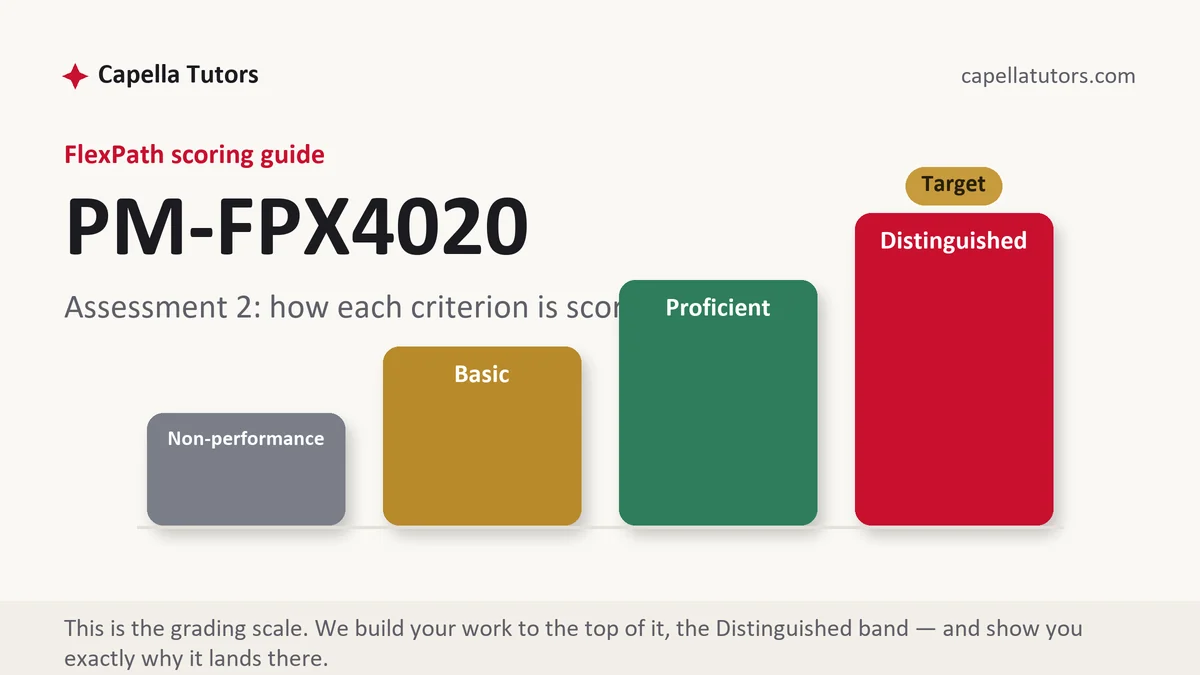
How PM FPX 4020 Assessment 2 is scored
There is no overall mark to average toward. Each criterion lands on one of four levels, and on a requirements deliverable they read like this:
| Level | What it means on a requirements and scope statement package |
|---|---|
| Distinguished | Every requirement carries a source, an objective, a priority and a verification method, the matrix traces in both directions, and the acceptance criteria are written so somebody other than the author could test them. |
| Proficient | A complete and well-formed set of requirements with a sound scope statement. Traceability runs one way, from requirement to work, and nothing catches work with no requirement behind it. |
| Basic | A list of features under a heading called requirements, with acceptance written as adjectives and a scope section that says only what is included. |
| Non-performance | A required element is missing, usually the verification method or the exclusion list, and a scope statement with no exclusions leaves the later validation criterion nothing to work with. |
Product scope and project scope are different objects and the criteria usually test whether you know it. The features the result must have are one thing; the work needed to deliver them, including the testing, the training and the handover nobody thinks to ask for, is another, and a schedule built from the first alone is short before it starts.
The PM FPX 4020 Assessment 2 method, step by step
-
Collect from named people, not from imagination
Every requirement needs somebody who asked for it, so write the role beside it. A requirement with no source is either an assumption or work somebody added because it seemed sensible, and the criteria expect both of those to be labelled as what they are.
-
Number each requirement the moment it is recorded
An identifier is not a formatting decision, it is what lets a later section point at a line without quoting it. Add the objective the requirement serves and its priority in the same row, so the matrix is built while the collecting happens rather than assembled afterwards.
-
Write the verification before the solution
For each requirement, say how anybody would know it was met: a timed test, a count, a sample, a signed check. Requirements you cannot verify are the ones argued about at handover, and the column holding the verification is usually the one the top descriptor is asking for.
-
Turn acceptance criteria into things a stranger could test
Intuitive and user friendly cannot be tested and therefore cannot be validated. An order placed by a grower on a phone reaches the pickup schedule without a second confirmation step can be. Write every acceptance line so a reader who has never met you would reach the same verdict you would.
-
Build the exclusion list until it costs something
Name four or five things a reasonable reader would assume were in and are not, each with the route it takes instead. This paragraph prevents more disputes than any other in the scope statement, and it protects the validation criterion too, since acceptance gets judged against the boundary drawn here.
-
Trace the matrix both ways, then submit
Read down the requirement column and confirm each has work attached, then read up from the work and confirm each piece traces back to a requirement. Anything failing the second test is gold plating with a polite name. Then self-score and submit with room for a second attempt inside the session.
A structure that maps to the criteria
Ranges our tutors use when the deliverable is a requirements matrix with a scope statement behind it; if the guide asks for one artifact only, that one absorbs the words.
| Section | What it must do | Guide |
|---|---|---|
| Elicitation approach | Who was asked, how, and what each source was in a position to know about the work. | ~200 words |
| Requirements matrix | Numbered requirements with source, objective served, priority, and the method that verifies each. | ~350 words |
| Scope statement | The deliverables, the acceptance criteria, the constraints and the assumptions behind them. | ~300 words |
| Exclusions | What the project will not deliver, each item with the route by which it will be handled instead. | ~200 words |
| Traceability check | The two-way test written out, naming anything with no requirement or no work behind it. | ~200 words |
| Assumptions and references | Requirements standards cited by number, elicitation sources credited, current APA both ways. | as needed |
Annotated sample excerpt
Two matrix rows and one acceptance line from an original model our team wrote, printed as they would appear in the document.
R-14, requested by the deputy market manager, serving the objective of cutting counter visits per order from 2.4 to one, priority high, verified by a sample of 30 orders completed end to end with no counter visit recorded.1 R-15, requested by the two grower representatives on the co-op board, serving the same objective, priority medium, verified by a printed pickup list matching the system schedule across a full trading week with no manual correction.2 Acceptance for deliverable 2, pickup scheduling: a grower placing an order in a phone browser reaches a confirmed pickup window without a second confirmation step, tested on both platforms with the market manager present and recorded as accepted or rejected the same day.3
- 1Four columns doing four jobs in one line. The source is a role, the objective is measurable, and the verification is a test somebody could run tomorrow.
- 2A second row on the same objective at a different priority, which is what lets the later ordering decisions be defended rather than asserted.
- 3Acceptance written as an observable outcome with a witness and a same-day verdict, so the validation criterion has something concrete to attach to.
The full premium sample for your exact assessment, written fresh to your scoring guide and issue, is free to request. Study it, revise it into your own voice, and submit work you understand.
The five mistakes that cost Distinguished
- Requirements with no source. A line nobody asked for is an assumption or an addition, and both have to be labelled rather than left looking like requirements.
- Acceptance criteria written as adjectives. Nothing that cannot be tested can be validated, and the handover criterion later in the course inherits the problem.
- A matrix that traces one way. Checking every requirement has work attached misses the opposite fault, which is work in the plan no requirement asked for.
- No exclusion list. Saying what the project will not deliver prevents more arguments than any other sentence in the scope statement, and its absence costs a criterion outright.
- Product scope mistaken for project scope. Listing features without the testing, training and handover that deliver them produces a plan that is short before the work starts.
Pre-submission checklist
- Every requirement numbered, with a named source and the objective it serves
- A verification method written for each requirement, not only for the important ones
- Acceptance criteria a stranger could test and reach your verdict on
- Constraints and assumptions separated, each labelled as what it is
- Four or five real exclusions, each with the route it takes instead
- The matrix traced in both directions, gold plating named, self-scored, submitted early in the week
Requirements matrix or scope statement due?
Send the scenario, the criteria and whatever requirements you have gathered so far. We number them, source them, write a verification method for each, and return a premium original sample inside 24 to 48 hours with the matrix tracing both ways.