This manual is for PM FPX 4020 Assessment 3, start to submission. This is the arithmetic end of the scope course. The assessment usually asks you to decompose the scope statement into a breakdown whose totals reconcile at every level, cost a change request rather than debate it, and say who accepts each deliverable and how. Your scoring guide decides whether that arrives as a breakdown with a dictionary, a change impact analysis, a validation and closure plan, or a memo to a sponsor carrying all three. The method below is what our tutors use, with a criterion-mapped structure and an annotated sample excerpt. Prefer to hand it off? A premium original sample comes back in 24 to 48 hours with every total added again by a second reader, revised free until the criteria clear. Capella's catalog lists the course as PM-FPX4020, and some courserooms print PM4020; both point to this same Assessment 3.
One honesty note before the manual: Capella revises courses and scoring guides over time, so always write to the exact scoring guide attached to your assessment in the courseroom. The course identity above is verified on capella.edu; the method and structure below are our tutors' approach to it, not Capella's official rubric text.
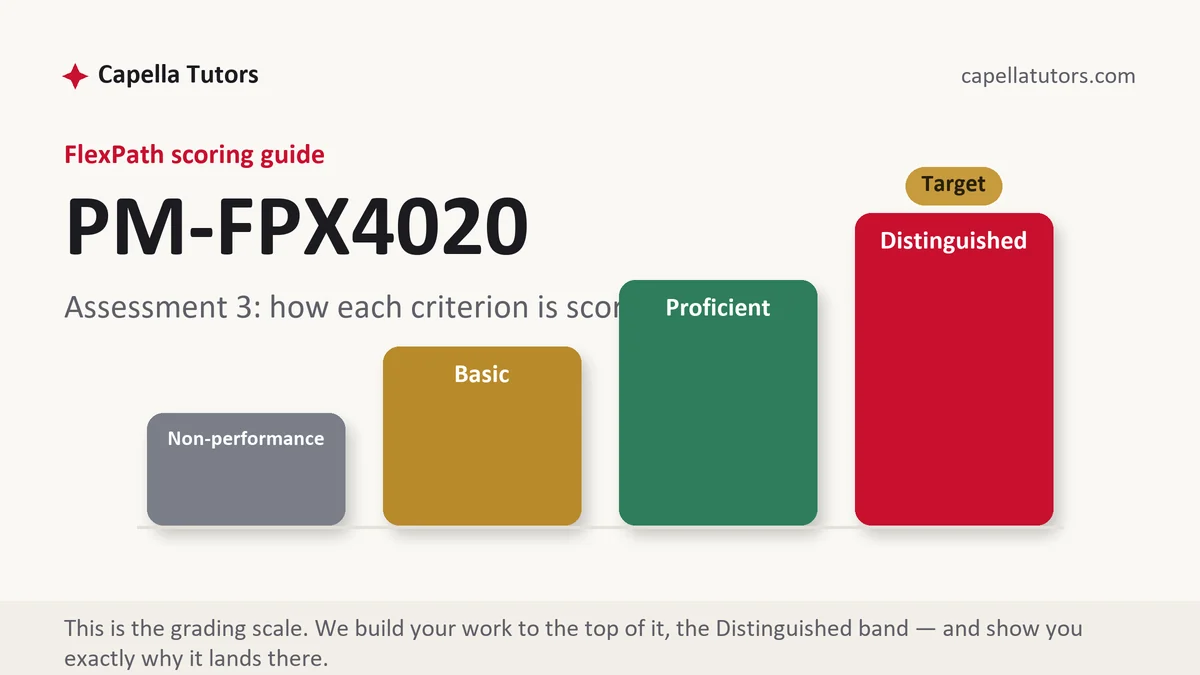
How PM FPX 4020 Assessment 3 is scored
Criteria are scored separately, and on a table-heavy deliverable the four levels turn largely on whether the figures agree:
| Level | What it means on a breakdown and change analysis |
|---|---|
| Distinguished | The totals reconcile at every level, each package carries a dictionary entry rather than a label, the change is costed across schedule and risk as well as money, and the revised baseline appears in the document. |
| Proficient | A correct breakdown and a competent change assessment. The impact is stated in dollars and days, and the baseline that should have changed is not shown changing. |
| Basic | A breakdown that does not quite add up, with a change request discussed in prose and no figure attached to any option offered. |
| Non-performance | A required element is absent, usually the dictionary, the revised baseline or the acceptance route, and an unaccepted deliverable leaves the closure criterion unanswerable. |
One rule governs the whole deliverable: the children of a box account for the whole of that box and nothing more. If the narrative later mentions training that lives in no package, the breakdown is wrong rather than the narrative, and the repair is a new package with an owner rather than a sentence explaining the gap.
The PM FPX 4020 Assessment 3 method, step by step
-
Decompose from the scope statement, in dependency order
The deliverables in the scope statement become the top boxes, and nothing enters the breakdown that the statement never authorized. Build downward rather than sideways, and stop at packages one person could own and estimate.
-
Write a dictionary entry, not a label
Each package needs an owner, a definition of done, an estimate and the basis of that estimate. A breakdown of labels can be drawn in ten minutes and answers no criterion, while a dictionary is the artifact the scope descriptors are actually written about.
-
Add the totals up level by level and print them
Suppose four deliverables hold packages of 7,400, 3,900 and 11,200 dollars, then 14,600 and 5,050, then a single package at 6,750, then 4,300 and 2,800. Those roll up to 22,500, 19,650, 6,750 and 7,100, which reconciles to 56,000 dollars, and 56,000 is the whole project by definition rather than by assertion.
-
Cost the change the same day it arrives
Small describes the request rather than its effect. Estimate the hours, convert them at a stated rate, say which activity absorbs the work and whether it sits on the critical path, then say what happens to the contingency that would pay for it. Answering quickly is part of the answer, since a slow process looks obstructive whatever the arithmetic says.
-
Offer three options and let the sponsor choose
Approve and move the date, approve and remove work of similar size, or defer to a later phase. Each option needs its figure. Deciding belongs to the sponsor and making the consequence visible beforehand belongs to you, which is the sentence a change control criterion is built around.
-
Show the revised baseline, then submit
An approved change with no baseline update makes every later variance report meaningless, so print the new totals and the new date. Then reconcile the prose against every table, self-score against the descriptors, and submit early enough for a second attempt inside the session.
A structure that maps to the criteria
Ranges our tutors use when the deliverable carries a breakdown, a change analysis and a validation section; if the guide asks for only one of the three, it takes the words the others would have had.
| Section | What it must do | Guide |
|---|---|---|
| Scope carried forward | The deliverables and exclusions the breakdown is built from, without restating the whole scope statement. | ~150 words |
| Work breakdown and dictionary | Deliverable decomposition to package level, each package with owner, definition of done and estimate. | ~350 words |
| Reconciliation | Rolled-up totals at every level and a plain statement that each parent equals its children. | ~150 words |
| Change request analysis | Hours, rate, cost, schedule effect, critical path position, risk and quality effects, contingency position. | ~300 words |
| Options and revised baseline | Three costed options, the recommendation, the approval route, and the baseline after the decision. | ~250 words |
| Validation, closure and references | Who accepts each deliverable and how, the handover, the lessons record, current APA both ways. | ~200 words |
Annotated sample excerpt
A costed change assessment from an original model our team wrote, printed the way it would be sent to a sponsor.
Request: two additional driver alert screens, raised in week 7 of an 18-week project, estimated at 84 hours of build and test at a blended 52 dollars an hour, which is 4,368 dollars.1 The work falls inside the routing build, which is on the critical path, so approval adds six working days to the cutover and moves the first live route from the fourth of September to the twelfth; contingency stands at 7,500 dollars, which leaves 3,132 to cover the remaining eleven weeks if this is approved.2 Options: approve and move the cutover, approve and drop the historical mileage report of similar size, or defer both screens to the winter release. On the current contingency position we recommend the third, and whichever is chosen the scope and schedule baselines are reissued before the next status report.3
- 1Hours, rate and total in one line, with the week the request arrived. Nothing here needs a second document to verify.
- 2The schedule effect given as a date change rather than as a duration, plus the contingency left standing afterwards. That figure turns an administrative note into advice.
- 3Three costed options, one recommendation, and the baseline reissue named. The decision stays with the sponsor and the consequence is visible before it is made.
The full premium sample for your exact assessment, written fresh to your scoring guide and issue, is free to request. Study it, revise it into your own voice, and submit work you understand.
The five mistakes that cost Distinguished
- A breakdown that does not reconcile. If the packages under a deliverable do not sum to it, every estimate resting on the breakdown inherits the gap.
- Packages labelled rather than defined. A box with a name and no owner, no estimate and no definition of done cannot be assigned, tracked or accepted.
- A change discussed instead of costed. Weighing a request in prose with no hours, no rate and no date leaves the sponsor to do the arithmetic you were asked for.
- One option offered. Approve or refuse is a corner rather than a choice, and the criterion expects the trade to be visible in figures.
- Change approved with no baseline reissued. The variance reports that follow are measuring against a plan the project has already abandoned.
Pre-submission checklist
- Top boxes taken from the scope statement, with nothing added it never authorized
- A dictionary entry for every package: owner, definition of done, estimate, basis
- Subtotals printed at each level and shown to reconcile with the project total
- The change costed in hours at a stated rate, with the critical path position named
- Three costed options, a recommendation, and the revised baseline printed
- An acceptance route written for each deliverable, self-scored, submitted early in the week
Breakdown rollup or change analysis due?
Send the scope statement, the change request and the criteria. We decompose to package level, add every level up until it agrees, cost the request three ways and return a premium original sample inside 24 to 48 hours.