This manual is for PM FPX 4000 Assessment 1, start to submission. This is the classification deliverable, and it is graded on coordinates rather than on definitions. The assessment usually asks you to take one project and place its activities against both axes of the discipline, the stage of effort where each activity happens and the subject area it belongs to, then show how the output of one area becomes the input of another. Your scoring guide decides whether that arrives as a matrix with commentary, a set of short analyses, or a briefing written for a sponsor. Below sit the six steps, a structure tied criterion to section, and a sample excerpt with our notes on it. Prefer to hand it off? A premium original sample for this exact assessment returns inside 24 to 48 hours, with free revision until every criterion is cleared. Capella's catalog lists the course as PM-FPX4000, and some courserooms print PM4000; both point to this same Assessment 1.
One honesty note before the manual: Capella revises courses and scoring guides over time, so always write to the exact scoring guide attached to your assessment in the courseroom. The course identity above is verified on capella.edu; the method and structure below are our tutors' approach to it, not Capella's official rubric text.
How PM FPX 4000 Assessment 1 is scored
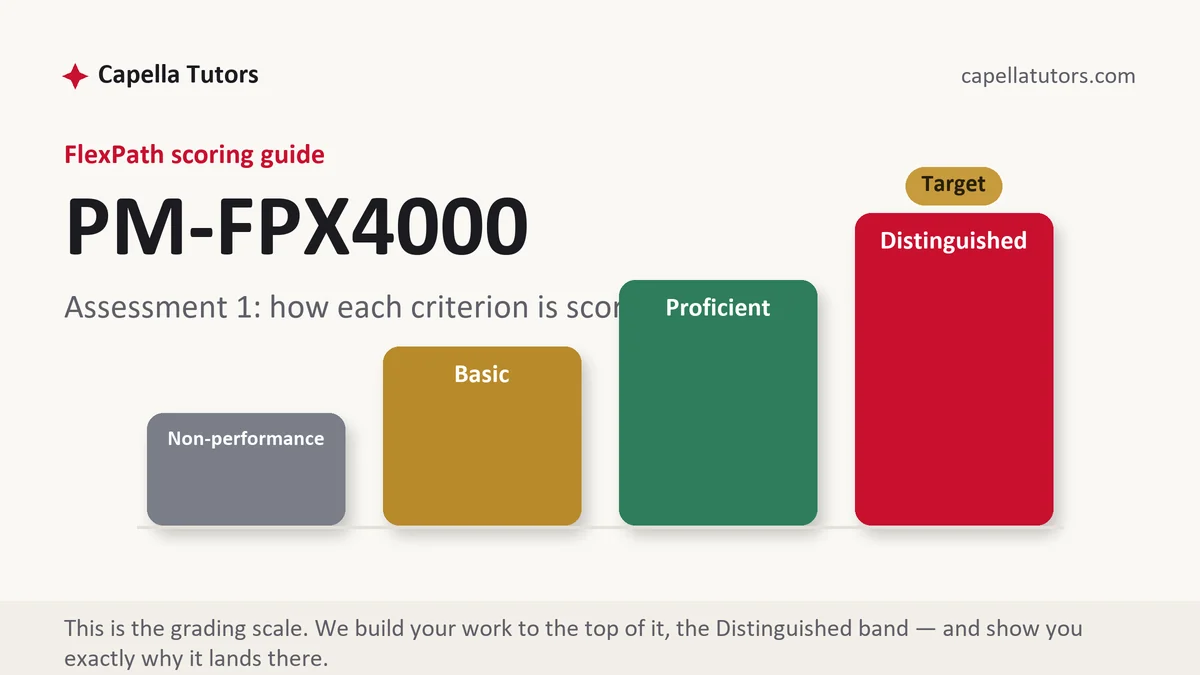
Nothing gets averaged into a grade. Each criterion sits on one of four levels, and on a mapping deliverable the four read like this:
| Level | What it means on a domain mapping analysis |
|---|---|
| Distinguished | Every activity carries both coordinates, a single project runs the length of the document, and the artifact chain is visible, with the output of one area shown arriving as the input of the next. |
| Proficient | Activities placed correctly and areas described accurately. The mapping is right, and the areas still read as separate short essays that happen to share a cover page. |
| Basic | A paragraph of definition for each area. True, general, attached to no particular project, and the commonest shape a first submission takes in this course. |
| Non-performance | An area or a stage is missing from the map, or the classification is given on one axis only, which answers half of what the criterion asked. |
The connective move is what lifts this deliverable. Saying that the scope statement produced the breakdown, that the breakdown produced the estimates, and that the estimates produced the baseline every later variance is measured against demonstrates integration in three clauses, and integration is what a domains criterion is really testing.
The PM FPX 4000 Assessment 1 method, step by step
-
Choose one project and then refuse to change it
Illustrating scope with a software rollout, cost with a building and risk with something from the reading makes integration impossible to show, which is exactly what the criteria are looking for. Pick a project you can describe in detail, write its objective and constraints down once, and carry the same work through every section.
-
Give each activity two coordinates
Write the stage and the area together in the same clause. Approving a supplier is procurement work happening in executing. Rebaselining a budget after an approved change is cost work happening in monitoring and controlling. One coordinate answers half a classification criterion no matter how well the sentence is built around it.
-
Follow the artifacts rather than the vocabulary
Draw the chain of documents your project actually produces and show where each one goes. Requirements become a scope statement, the statement becomes a breakdown, the breakdown carries the estimates, the estimates set the baseline. A map with arrows between areas scores where a map with headings does not.
-
Show the stages overlapping, not queueing
Initiating through closing are kinds of effort rather than weeks in a row, and evaluators notice a paper that treats them as a calendar. Monitoring runs the whole way, planning restarts every time something moves, and an activity that appears in two stages with two different outputs is worth writing down twice on purpose.
-
Put at least one figure inside every area
An area described in adjectives reads as a definition. An area carrying a number reads as a plan: a duration, a rate, a unit cost, a defect count, a lead time in weeks. One figure per area also gives the later sections something to reconcile against, which is where the integration marks live.
-
Test the map against the guide, then submit
Read each criterion and put your finger on the row or paragraph that answers it. Anything with no home in the document is an unanswered criterion, and anything in the document with no criterion behind it is unpaid work. Then submit early enough in the week that the two business days an evaluator has still leave room for a second attempt.
A structure that maps to the criteria
Working ranges our tutors use when the deliverable is a mapping analysis with commentary; where your guide asks for a matrix, the table grows and the prose around it shrinks.
| Section | What it must do | Guide |
|---|---|---|
| Project and context | The one project used throughout, its sponsor, its objective, its constraints and its setting. | ~200 words |
| The two axes explained | What the stages describe, what the areas describe, and why every activity has a position on both. | ~200 words |
| The map itself | Activities placed by stage and by area, each with the output it produces for the next area. | ~350 words |
| Artifact chain | The documents this project produces in order, with the figure each one hands to the next. | ~250 words |
| Integration commentary | Where the areas depend on each other, and what breaks when one of them is written in isolation. | ~250 words |
| Assumptions and references | Declared assumptions, the standard cited with its edition, current APA in both directions. | as needed |
Annotated sample excerpt
Three mapped activities from an original model our team wrote, printed as they would appear under a map rather than as narrative.
Negotiating the filler lead time with the equipment supplier is procurement work happening in executing, and its output is a confirmed delivery week the schedule area consumes as a constraint rather than as an estimate.1 Revising the installation budget after the approved change to the conveyor run is cost work happening in monitoring and controlling, and the figure it produces replaces the baseline that every later variance is measured against.2 Training the two line operators is resource work that begins in planning as an effort estimate of 24 hours and ends in executing as a signed competency record, which is why it appears twice on the map with a different output each time.3
- 1Both coordinates in one clause, then the handoff named. The reader can see which area receives the output, which is the integration the criterion pays for.
- 2A controlling activity written with its effect on the baseline. The paper shows the mechanism instead of defining the cost area.
- 3One activity placed in two stages deliberately, with a different output in each. That sentence proves the stages were not treated as a calendar.
The full premium sample for your exact assessment, written fresh to your scoring guide and issue, is free to request. Study it, revise it into your own voice, and submit work you understand.
The five mistakes that cost Distinguished
- A glossary in place of a map. Explaining what the risk area covers is not the same as showing what it produced for the project in front of you.
- One coordinate only. Calling budget estimation a planning process names the stage and leaves the area unstated, and the criterion is written to catch exactly that.
- A different project in every section. Integration cannot be demonstrated across examples that have nothing to do with each other.
- Stages treated as a calendar. Writing initiating through closing as five consecutive weeks contradicts the overlap the course spends its time establishing.
- Areas with no numbers anywhere. An area with no duration, rate or count inside it has nothing for the later sections to reconcile against.
Pre-submission checklist
- One project named early and carried through every section unchanged
- Every mapped activity carrying both a stage and a subject area
- The artifact chain drawn, with the figure each document hands to the next
- At least one number inside each area rather than description alone
- Monitoring shown running throughout, with any repeated activity mapped twice on purpose
- Each criterion matched to a paragraph or row, self-scored, submitted early in the week
Domain map or classification analysis due?
Send the project, the prompt and the criteria. We map every activity on both axes, draw the artifact chain, and return a premium original sample inside 24 to 48 hours with the integration visible rather than claimed.