This manual is for PM FPX 4000 Assessment 2, start to submission. This deliverable is where the course stops describing the discipline and asks you to choose from it. The assessment usually asks you to decide which processes a specific project needs, defend what you left out, and recommend a delivery approach from the conditions the work actually presents rather than from preference. Your scoring guide decides whether that arrives as a tailoring analysis, an approach comparison, a plan with a rationale section, or a recommendation memo. What follows is the method our tutors use, a criterion-mapped structure and an annotated sample excerpt. Prefer to hand it off? A premium original sample arrives inside 24 to 48 hours, and revision stays free until the guide is satisfied. Capella's catalog lists the course as PM-FPX4000, and some courserooms print PM4000; both point to this same Assessment 2.
One honesty note before the manual: Capella revises courses and scoring guides over time, so always write to the exact scoring guide attached to your assessment in the courseroom. The course identity above is verified on capella.edu; the method and structure below are our tutors' approach to it, not Capella's official rubric text.
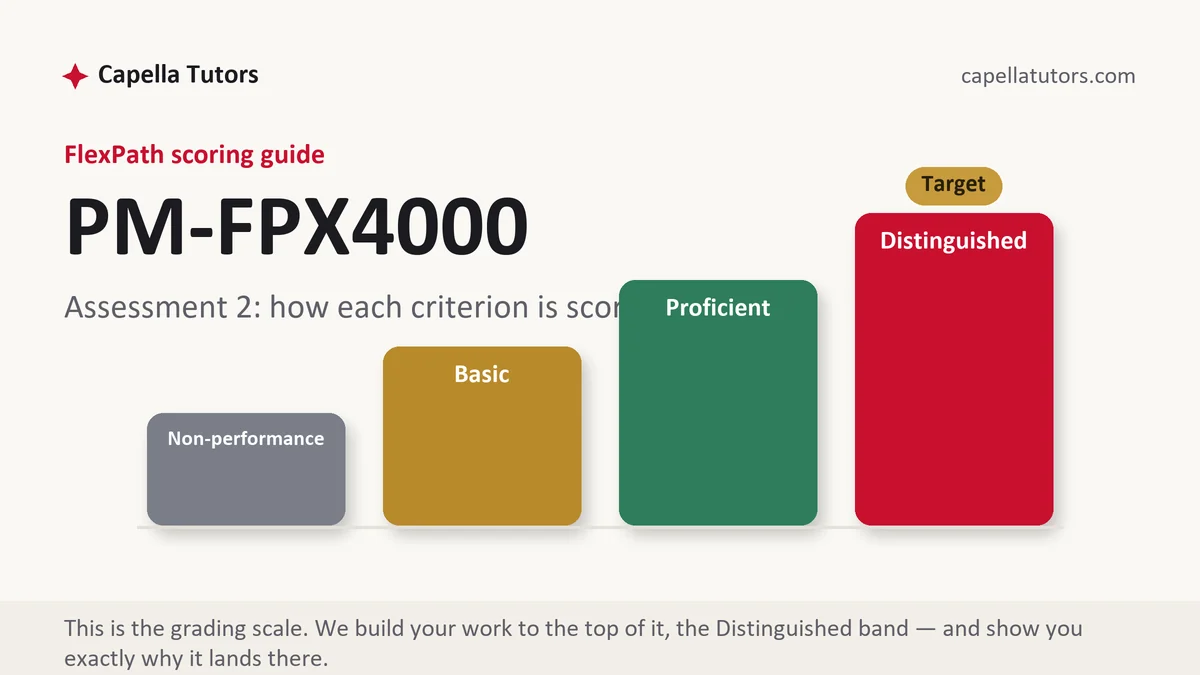
How PM FPX 4000 Assessment 2 is scored
Each criterion is placed on one of four levels independently of the others, and on a tailoring deliverable they read like this:
| Level | What it means on a tailoring and approach recommendation |
|---|---|
| Distinguished | What was kept and what was dropped are both listed, each decision rests on a stated condition of this project, and the paper names the change that would make you add a dropped process back or switch approach. |
| Proficient | A defended set of choices with reasons attached. The reasons describe the project accurately and no threshold is given, so nothing tells a reader when the decision expires. |
| Basic | A survey of every process and every approach with a paragraph each, ending in a preference. Complete, uncontroversial, and no decision has actually been made. |
| Non-performance | The tailoring criterion is answered with a full standard process set applied unchanged, or an approach is named with no comparison at all. |
One sentence separates the top two columns here more often than anything else, and it is the switching sentence. Naming the condition that would reverse your recommendation proves the decision was reasoned rather than convenient, and it costs a line.
The PM FPX 4000 Assessment 2 method, step by step
-
Write down the conditions before the choice
Three questions decide most of this. How well are the requirements known at the start, what does a change cost once the work is under way, and how often can the customer actually look at something and react. Answer all three in writing about your project, then let the answers point, because the criteria are grading the reasoning rather than the verdict.
-
Size the project honestly, then cut to fit
A twelve-week internal upgrade with two part-time contributors and a settled specification does not need a change board, a procurement plan and a forty-entry register. Say so with reasons. Producing all three badly scores below producing the two that matter well and explaining the omission.
-
List the omissions as decisions, not gaps
Print what you dropped in a short table with a reason beside each line, since an unexplained absence reads as an oversight and an explained one reads as judgment. Then add the condition that would bring it back: a second supplier entering scope, a regulator taking an interest, the team doubling.
-
Recommend a hybrid only where you can split it
Most real projects answer the requirement questions differently for different components, so a hybrid is a legitimate answer as long as you say which part runs which way and why. A hybrid named without that division is a way of avoiding the choice, and the criterion reads it as one.
-
Keep the governance you actually need
Tailoring down is not tailoring away. Whatever you drop, something still has to record decisions, approve changes above a threshold and report progress, so name the smallest arrangement that does those three things for this project and say who holds each one.
-
Check every claim against the scenario, then submit
Read the recommendation and ask what fact in the prompt supports each sentence. Anything supported only by the reading is a general truth rather than an analysis of this project. Then self-score against the descriptors and submit with room for one more attempt inside the session.
A structure that maps to the criteria
Ranges our tutors use for a tailoring analysis with an approach recommendation; the comparison section grows where your guide asks you to weigh several approaches formally.
| Section | What it must do | Guide |
|---|---|---|
| Project conditions | Requirement stability, cost of late change, customer availability, size, and regulatory exposure. | ~250 words |
| Tailoring decisions | The processes kept and the processes dropped, each with the condition behind the decision. | ~300 words |
| Approach comparison | What each candidate approach needs to work, and which needs this project actually meets. | ~300 words |
| Recommendation | The approach chosen, the component split if any, and the switching point stated plainly. | ~200 words |
| Governance retained | Decision records, the change threshold, the reporting cadence, and who owns each of them. | ~200 words |
| Assumptions and references | Declared assumptions, standards cited by edition, empirical claims cited to journals, current APA. | as needed |
Annotated sample excerpt
A recommendation paragraph from an original model our team wrote, showing the register a tailoring section should hold.
The deposit capture screens and the limit rules will be built iteratively in two-week increments, because the branch supervisors cannot describe the exception cases in advance and can look at working screens every fortnight without leaving their posts.1 The core integration and the audit trail will run predictively against an approved specification, since the examination timetable requires the control documentation signed before the build starts and a late change there is priced in rework across two systems rather than one.2 If the supervisors stop being available weekly, or if the vendor's release window moves the integration inside the examination period, the iterative half reverts to a fixed increment plan and that decision belongs to the sponsor rather than to the team.3
- 1The iterative choice argued from two named conditions of this project, availability and unknown exceptions, rather than from the merits of iteration in general.
- 2The predictive half justified by a real constraint with a cost attached. Splitting the project by component is what makes a hybrid a decision rather than a hedge.
- 3The switching sentence, with two observable triggers and a named decision owner. This is the clause the Distinguished descriptor is usually describing.
The full premium sample for your exact assessment, written fresh to your scoring guide and issue, is free to request. Study it, revise it into your own voice, and submit work you understand.
The five mistakes that cost Distinguished
- An approach chosen by preference. Naming iterative or predictive delivery without the requirement conditions behind it reads as a habit rather than a decision.
- Tailoring asserted with no condition. Saying a process was not needed earns nothing until you say what would make it needed again.
- A hybrid with no split. Recommending a mixture without naming which component runs which way avoids the choice the criterion asked you to make.
- Governance dropped along with the process. A project with no decision record, no change threshold and no reporting cadence has been tailored into an unmanaged one.
- A practice standard used as evidence. A consensus document records what practitioners agree on, so cite it for vocabulary and cite the journals for whether something worked.
Pre-submission checklist
- Requirement stability, change cost and customer availability each answered in writing
- Processes kept and processes dropped both listed, with a reason on every line
- Approach compared against the conditions it needs rather than its reputation
- Any hybrid split by component, with the reason for each half
- A switching point named, with an observable trigger and a decision owner
- Every claim traced to a fact in the scenario, self-scored, submitted early in the week
Tailoring analysis or approach comparison due?
Send the scenario and the criteria. We answer the requirement conditions in writing, defend what gets dropped, split any hybrid by component, and hand back a premium original sample inside 24 to 48 hours.