This manual is for PM FPX 1000 Assessment 3, start to submission. The closing deliverable is the arithmetic one. The assessment usually asks you to turn an activity list into a network, find the longest route through it, quote the float on everything else, and then say what happens when a sponsor wants the same work done sooner. Your scoring guide decides whether that arrives as a schedule with commentary, a schedule plus a compression analysis, or a short report to a sponsor with the calculations attached. The method below is what our tutors use, followed by a criterion-mapped structure and an annotated sample excerpt. Prefer to hand it off? A premium original sample comes back in 24 to 48 hours with every duration added up again by a second reader, and revision is free until the criteria clear. Capella's catalog lists the course as PM-FPX1000, and some courserooms print PM1000; both point to this same Assessment 3.
One honesty note before the manual: Capella revises courses and scoring guides over time, so always write to the exact scoring guide attached to your assessment in the courseroom. The course identity above is verified on capella.edu; the method and structure below are our tutors' approach to it, not Capella's official rubric text.
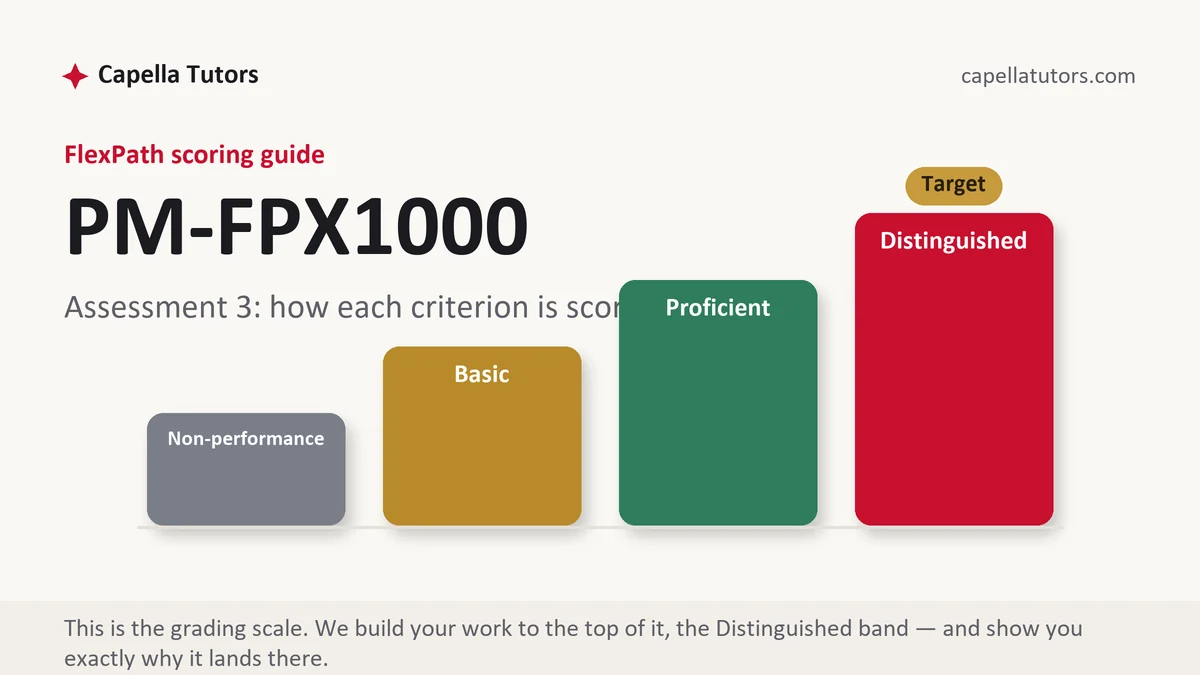
How PM FPX 1000 Assessment 3 is scored
Every criterion lands on one of four levels, and where a criterion has a right answer the levels behave differently from the way they do on an essay:
| Level | What it means on a schedule and compression analysis |
|---|---|
| Distinguished | The finish date falls out of the longest path, float is quoted path by path rather than mentioned, compression is priced only where it can work, and the paper names the point at which the critical path would move. |
| Proficient | The network is correct and the critical path is identified. The float figures are present, and nothing has been done with them beyond reporting them. |
| Basic | Activities listed with dates written beside them, and an end date that came from the assessment deadline rather than from the arithmetic. |
| Non-performance | A required calculation is missing. Usually it is float, and without float the criteria about slack and compression have nothing to grade. |
Arithmetic is unforgiving here in a way that works for you. A criterion asking where the end date came from is answered completely in two sentences when the network is right, and cannot be answered by good writing at all when it is wrong, which is why the calculations get done before any prose.
The PM FPX 1000 Assessment 3 method, step by step
-
Fix the units before anything else
Decide whether durations are working days or calendar days, whether a week means five days or seven, and say so once at the top. Half the schedules that fail an arithmetic check fail because two sections were counting differently, and the sentence that prevents it costs nothing.
-
Lay the network out and total every path
Set the activities down with their predecessors, then list each complete route from start to finish and add its durations up. The longest total is the project duration, and that route is critical. Doing this by hand on a small project is the point of the exercise, since software draws a chart that conceals the very arithmetic the criterion asks you to display.
-
Quote the float where the slack actually sits
Float on a path is the difference between its total and the critical total, and it belongs in the paper as a figure rather than as the word slack. Two conclusions follow and both earn marks. Spending money to finish an activity with float early moves the end date by nothing, and a path that slips beyond its float becomes the critical one.
-
Price the compression before recommending it
When a sponsor wants the work shorter, only activities on the critical path are candidates, and each needs a cost per unit of time beside it. Take the cheapest, then recompute, because shortening one path usually promotes another and the second week of saving costs more than the first. A recommendation carrying two figures reads as a decision rather than an opinion.
-
Say what adding people would really do
More staff is the reflex answer to a late project and the one criteria most enjoy catching. Coordination grows faster than the team, since five people carry ten channels between them and nine carry thirty six, and a newcomer spends the first week being told what everybody else already knows. State that effect, then name what you would do instead.
-
Recompute from the inputs, then submit
Put the draft aside, take the durations and predecessors on their own, and work the paths again without looking at your earlier answer. Figures that disagree get settled by you rather than by an evaluator. Then match every number in the prose to the table it came from, self-score each criterion, and leave room for one more attempt.
A structure that maps to the criteria
Planning ranges for a schedule deliverable with a compression section; where your guide asks for a full report to a sponsor the interpretation grows and the tables do not.
| Section | What it must do | Guide |
|---|---|---|
| Basis of the schedule | The units, the calendar assumptions, the resource assumptions, and where the durations came from. | ~150 words |
| Activity table | Every activity with its duration and its true predecessors, carried across from the work packages. | ~200 words |
| Network and path totals | Each route through the network totalled, the longest named as critical, the rest carrying quoted float. | ~250 words |
| Float interpretation | What the slack means for spending, for sequencing, and for the point at which the critical path moves. | ~200 words |
| Compression analysis | Candidates on the critical path, cost per unit of time, and the network recomputed after each cut. | ~300 words |
| Reporting, closure and references | What is reported to whom and how often, how the project is declared finished, current APA both ways. | as needed |
Annotated sample excerpt
An original worked extract from our team, printed the way a schedule section should read: inputs first, then the answer, then what the answer means.
Filtration plant replacement (F) runs 4 weeks and starts immediately, deck resurfacing (D) runs 3 weeks and also starts immediately, commissioning and water balance (C) runs 2 weeks and cannot begin until F is complete, lifeguard recertification (L) runs 1 week and follows D, and final inspection (I) runs 1 week and needs both C and L finished.1 Path F, C, I totals 7 weeks and path D, L, I totals 5, so reopening is 7 weeks out, F, C, I is the critical route, and the deck branch carries 2 weeks of float.2 Overtime for the deck crew therefore buys nothing, the inspection date moves only if the plant slips, and D slipping beyond 2 weeks would make the deck branch critical instead.3
- 1The inputs printed before the answer, with the unit named once. A reader can check the arithmetic without asking a single question.
- 2Both routes totalled, the longer one named, and the float given as a figure rather than described as some slack.
- 3The interpretation the criterion is written for: what the float means for money, and the condition under which the critical path changes hands.
The full premium sample for your exact assessment, written fresh to your scoring guide and issue, is free to request. Study it, revise it into your own voice, and submit work you understand.
The five mistakes that cost Distinguished
- An end date chosen before the network was drawn. Working backwards from the due date and calling it a schedule fails the criterion that asks where the finish came from.
- Float mentioned and never quoted. Saying a path has slack without the figure leaves nothing to reason with, and the criteria here want the number.
- Compression aimed at the wrong activity. Money spent shortening work that carries float changes the finish date by nothing at all.
- One cut and no recomputation. Shortening the critical path usually creates a second one, and a plan that misses the switch compresses the wrong activity next.
- No dependencies anywhere. If nothing depends on anything then every activity is critical, and the float criterion cannot be answered.
Pre-submission checklist
- Units and calendar assumptions stated once, then used consistently throughout
- Every activity carrying a duration and its real predecessors
- All paths totalled, the longest named critical, float quoted on the others
- The interpretation written under the table rather than left to the reader
- Compression costed per unit of time, with the network recomputed after each cut
- Every figure in the prose traced to its table, self-scored at the top level, submitted early in the week
Network diagram or compression analysis due?
Send the activity table with its rates, plus the criteria. We total every route, quote the float, price the cuts in the order that makes sense, and hand back a premium original sample inside 24 to 48 hours with the arithmetic visible.