This manual is for PM FPX 1000 Assessment 1, start to submission. The opening deliverable asks you to prove the work is a project before you plan it, then write the document that gives it authority. The assessment usually asks you to test the work against the two questions that define a project, whether it ends and whether it leaves something behind that did not exist before, then produce a charter carrying a sponsor, a business reason, objectives, a spending limit and a boundary. Your scoring guide decides whether that arrives as a charter alone, a charter with a stakeholder list attached, or a short analysis with the charter behind it. Below is our tutors' method, a criterion-mapped structure and an annotated sample excerpt. Prefer to hand it off? A premium original sample for this exact assessment lands in 24 to 48 hours, with free revision until every criterion is satisfied. Capella's catalog lists the course as PM-FPX1000, and some courserooms print PM1000; both point to this same Assessment 1.
One honesty note before the manual: Capella revises courses and scoring guides over time, so always write to the exact scoring guide attached to your assessment in the courseroom. The course identity above is verified on capella.edu; the method and structure below are our tutors' approach to it, not Capella's official rubric text.
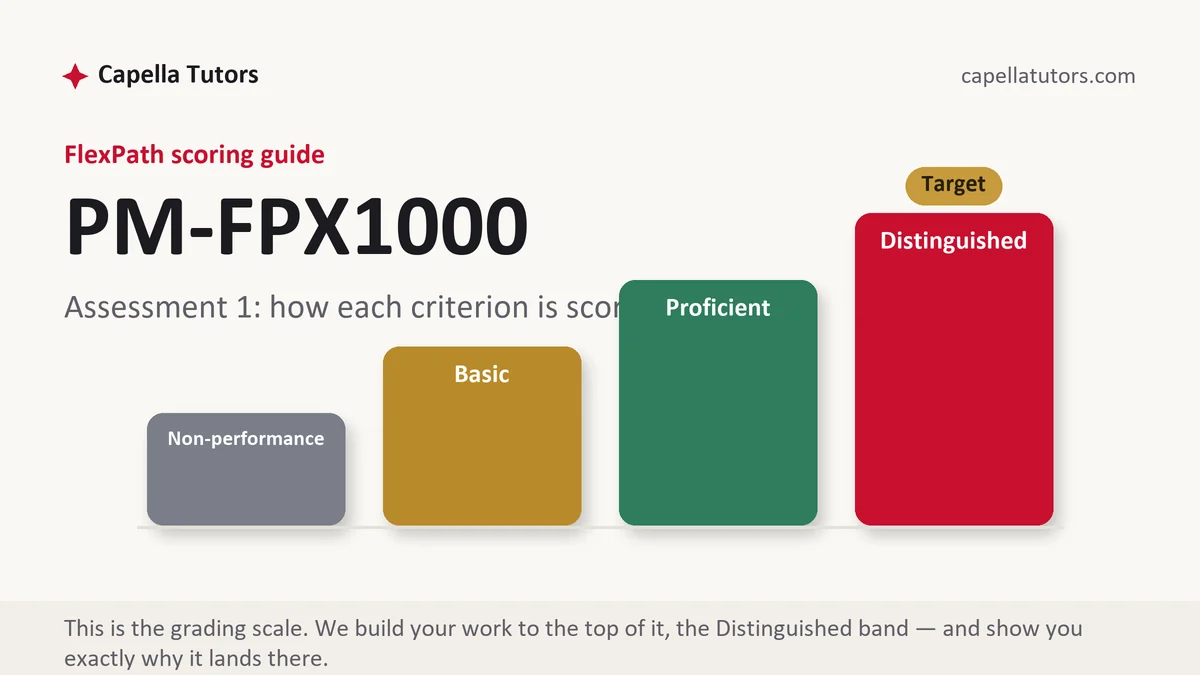
How PM FPX 1000 Assessment 1 is scored
FlexPath scores criteria rather than papers. Each lands on one of four levels, and on a definition and charter deliverable they read like this:
| Level | What it means on a definition and charter deliverable |
|---|---|
| Distinguished | The project test is applied to this specific work rather than recited, the sponsor carries a stated approval limit, every objective names the condition that proves it finished, and the boundary shuts out things a reader would have assumed were included. |
| Proficient | Each required field is present and accurate. The sponsor is named and the objectives are measurable, and nothing here would settle a dispute about scope in month three. |
| Basic | A description of the work laid out under charter headings. The definition comes from the reading rather than the scenario, objectives read as intentions, and scope says only what is in. |
| Non-performance | A required field is simply absent. The spending limit, the assumptions and the exclusions go missing most often, and absent scores below imprecise. |
One habit lifts criteria here faster than any other, which is writing every objective so somebody else could mark it. Attendance will improve is an intention. Weekly evening bookings rise from 11 to 20 within three months of reopening will turn out either true or false, and the criterion pays for the second version.
The PM FPX 1000 Assessment 1 method, step by step
-
Start from the criteria, not the prompt
The prompt says what to hand in and the criteria decide what it is worth, so open the guide first and turn each criterion into a heading in your outline. Beside each one note whether the evidence is a paragraph, a table or a named field, since a criterion using a verb like develop wants the artifact rather than a description of it.
-
Apply the project test to your own work
Two questions settle it. Does the work stop, and does it leave something behind that was not there before. Fitting out a new teaching kitchen at the centre passes both. Running cookery classes in it afterwards passes neither, which makes that operations. Name the question your work satisfies and the one it fails, since a criterion asking you to distinguish wants the line drawn.
-
Put the business reason in numbers
A reason a sponsor could defend at a budget meeting carries a figure and a consequence: hall hours turned away last year, a grant that expires in June, a maintenance bill that arrives whether the work happens or not. Strategic alignment is a category rather than a reason, and the criterion asking why this project wants the arithmetic underneath.
-
Say what the sponsor may decide alone
Name the person, then write the ceiling: the value of change they can approve alone, the decision that has to go higher, and who may commit the staff your plan depends on. Authority written as a figure turns a description of a project into a mandate to run one, and it is the field most first drafts fill with an adjective.
-
Write the boundary from both sides
List what the project delivers, then list four or five things a reader would have assumed were included and are not, each with a note on how it gets handled instead. Exclusions cost nothing to draft and prevent more arguments in month three than any other paragraph here. If yours were painless to write, they are probably not real exclusions.
-
Grade yourself against the descriptors, then submit early
Go through the guide one criterion at a time and give yourself a level on each, using the descriptor wording rather than your sense of how the draft reads. Anything below the top column gets another pass, and anything you cannot grade is a field you never wrote. Evaluations take up to two business days, so submit on a Monday and a second attempt still fits the billing session.
A structure that maps to the criteria
Planning ranges our tutors use for a charter with a short analysis in front of it, not Capella rules; stretch whichever section your guide weights most heavily.
| Section | What it must do | Guide |
|---|---|---|
| Project or operations test | Apply both defining questions to the specific work, state the handover point, and name the unique result. | ~200 words |
| Business justification | The reason in volumes, money or a deadline that cannot move, plus why now rather than next year. | ~200 words |
| Sponsor and authority | The sponsor named, the approval ceiling in figures, control over named staff, and the escalation route. | ~200 words |
| Objectives and success measures | Each objective written so a reader could verify it, with the measure the sponsor will judge it by. | ~250 words |
| Scope boundary | What is included, then an explicit exclusion list with the route each excluded item takes instead. | ~250 words |
| Assumptions, constraints and references | What the plan rests on, what cannot move, early known risks, sources in current APA both ways. | as needed |
Annotated sample excerpt
Three charter fields from an original model our team wrote, printed as they would appear in the document.
Sponsor: the borough director of leisure services, who may approve changes valued up to 15,000 dollars and any date change that does not push reopening past the start of the autumn program, with anything beyond either limit going to the works committee.1 Business reason: the centre turned away 214 hall bookings in the last twelve months for want of a usable gymnasium floor, at an average hire value of 68 dollars, and the renovation is approved on the basis of recovering three quarters of that demand within two terms.2 Out of scope: the car park resurfacing shown on the same condition survey, the roof lantern repair, evening staffing beyond current rotas, and any change to the booking software, each raised as its own authorization rather than absorbed here.3
- 1Authority written as a money ceiling plus a date condition, with the body that hears anything larger named. A reader can tell which decisions will leave the project.
- 2The justification as arithmetic with a target and a window. It commits to a fraction of the lost demand rather than to the word improve, which is what makes it markable at closure.
- 3Exclusions that visibly cost something. The car park sits on the same survey, so it has to be shut out in words or it arrives as an assumption in month two.
The full premium sample for your exact assessment, written fresh to your scoring guide and issue, is free to request. Study it, revise it into your own voice, and submit work you understand.
The five mistakes that cost Distinguished
- Operations chartered as a project. Ongoing service work with no end date wearing charter headings, which loses the first criterion before anything else is read.
- A sponsor with no ceiling. A name in a field, no approval limit, and no statement of who may commit the people the plan depends on.
- Objectives nobody could mark. Improve, strengthen and streamline cannot be shown to have happened, so the success criterion has nothing to attach to.
- A boundary written only as inclusions. With no exclusion list every later request is arguably inside scope, and the document protects nothing.
- Sources that are not sources. Certification cram sites and vendor blogs read as Basic sourcing, and a practice standard cited without its edition reads almost as badly.
Pre-submission checklist
- Every criterion in the guide answered by a section or a named field
- The work shown to be temporary and to leave a unique result, with the handover named
- Business reason stated in volumes, money or a date that cannot move
- Sponsor named with an approval ceiling and a written escalation route
- Objectives written so a reader could verify completion, each with its measure
- Four or five real exclusions listed, every criterion self-scored, submitted early in the week
Charter due and the scope will not sit still?
Send us the prompt, the criteria and whichever project you settled on. Eight people return a premium original sample inside 24 to 48 hours with the project test applied, authority written as figures, and a boundary that would survive an argument.