This manual is for PM FPX 1000 Assessment 2, start to submission. This is the deliverable where the plan stops being prose and becomes structure. The assessment usually asks you to take the outputs your charter promised and decompose them into work packages somebody could own, then turn those packages into an activity list carrying real predecessors and defensible durations. Your scoring guide decides whether that arrives as a breakdown with a dictionary, a breakdown plus an activity table, or a planning memo with both attached behind it. What follows is the method our tutors use, a structure mapped to the criteria, and an annotated sample excerpt. Prefer to hand it off? A premium original sample returns in 24 to 48 hours with the totals and the dependencies rechecked by a second reader, and revisions are free until the criteria clear. Capella's catalog lists the course as PM-FPX1000, and some courserooms print PM1000; both point to this same Assessment 2.
One honesty note before the manual: Capella revises courses and scoring guides over time, so always write to the exact scoring guide attached to your assessment in the courseroom. The course identity above is verified on capella.edu; the method and structure below are our tutors' approach to it, not Capella's official rubric text.
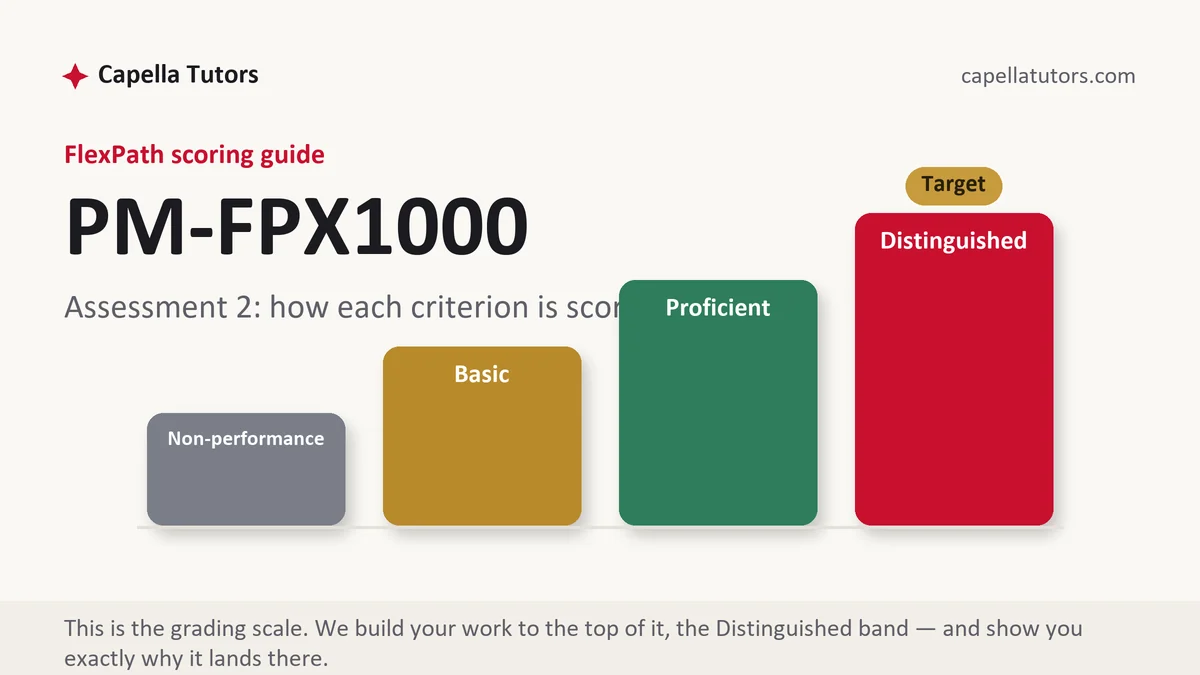
How PM FPX 1000 Assessment 2 is scored
Criteria are graded one at a time against four descriptors, and on a decomposition deliverable the four behave like this:
| Level | What it means on a work breakdown and activity list |
|---|---|
| Distinguished | The breakdown is built from deliverables, the children of every box account for the whole of that box, each package carries one owner and a written definition of done, and every dependency reflects a constraint you could defend out loud. |
| Proficient | A complete and correctly formed breakdown with activities and predecessors attached. Nothing is missing, and no package tells a reader how anybody would know it was finished. |
| Basic | A task list in the order the tasks occurred to the writer, under headings that look like a breakdown, with nothing underneath that a customer could accept. |
| Non-performance | A required element is absent, most often the predecessors, the package owners or the dictionary entries. A breakdown with no dependencies leaves the schedule criterion unanswerable. |
One rule decides more of this grade than the rest combined. The boxes under a parent must account for the whole of that parent and no more, so if five outputs decompose into twenty three packages then those twenty three are the entire project, and work you remember later was needed is evidence the breakdown was wrong rather than a note to add to the narrative.
The PM FPX 1000 Assessment 2 method, step by step
-
Take the top boxes straight from the charter
The outputs the charter authorized become the first level under the project, which is what stops the two documents drifting apart. If a deliverable appears in the breakdown that no charter ever approved, either the charter was short or the project has grown, and the criteria here usually reward saying which of the two happened.
-
Decompose by thing, not by verb
Every box names something that exists once it is done: a migrated content set, a tested enrolment path, a trained editor. Verbs belong in the activity list underneath. A breakdown made of tasks leaves nothing in the plan anybody could accept, and that single fault caps this criterion at Basic more often than any other.
-
Stop at a package one person can own
Size the packages so each runs somewhere between a day and two working weeks, then write a one line definition of done for each. Smaller than that and you have produced a to-do list. Larger and nobody can tell whether it is on track until it is late, and the estimate resting on it will not hold.
-
Number the boxes and total them upward
Code every box so the parent of any package is visible from the number itself, then add the package estimates one level at a time and print the subtotals. If the deliverable totals do not reconcile with the project total, the arithmetic shows you where a package is missing or counted twice before an evaluator finds it.
-
Convert packages into activities with real predecessors
Activities are the work, so list them with a duration and with whatever genuinely has to finish first. Ask why for each dependency. Content cannot be migrated before the template is approved, which is a constraint. Content is not migrated after the photography, because that is only the order the two were typed in.
-
Make the tables and the narrative agree, then submit
Read the prose against the tables deliberately, since the quickest way to lose a criterion here is a sentence saying six weeks sitting above a table that adds to seven. Then mark yourself against each descriptor, repair anything under the top column, and submit early enough that a resubmission still fits inside the session.
A structure that maps to the criteria
Working ranges our tutors use when the deliverable is a breakdown with an activity list behind it; shift the weight toward whichever artifact your guide names first.
| Section | What it must do | Guide |
|---|---|---|
| Scope recap and outputs | The deliverables carried forward from the charter, stated as things rather than as intentions. | ~150 words |
| Work breakdown | Decomposition by deliverable down to package level, numbered, with the levels visible on the page. | ~300 words |
| Package dictionary | For every package: the owner, the definition of done, the estimate, and the basis of that estimate. | ~300 words |
| Activity list and logic | Activities under each package with durations, the unit used, and the predecessors that genuinely bind them. | ~250 words |
| Reconciliation | Rolled-up totals at each level and a plain statement that the children equal the parent. | ~150 words |
| Assumptions and references | Estimating and resource assumptions, plus current APA checked in both directions. | as needed |
Annotated sample excerpt
A single package printed as a dictionary entry, taken from an original model our team wrote for an introductory breakdown.
Package 1.3.2, program pages, sitting under deliverable 1.3 migrated content set: the 84 program pages rewritten to the approved template and published to staging, owned by the communications editor, complete when all 84 render with no validation errors and the department chair for each school has approved the copy in writing.1 Estimated at 96 hours, derived from the 1.1 hours per page the previous relaunch recorded across 61 pages, with an allowance added for the six programs whose curriculum changed in the interim.2 Predecessors: 1.2.4 template approved and 1.1.3 content inventory signed off. Successor: 1.4.1 accessibility audit, which cannot start on a partly populated site.3
- 1A package written as a thing with a testable finish. Two conditions, both observable, so nobody argues in month three about whether it was done.
- 2An estimate with a basis. A rate taken from a comparable finished project beats a number from nowhere, and the adjustment is stated rather than buried.
- 3Dependencies whose reason is visible in the work itself. The successor explains why this order is a constraint and not a preference.
The full premium sample for your exact assessment, written fresh to your scoring guide and issue, is free to request. Study it, revise it into your own voice, and submit work you understand.
The five mistakes that cost Distinguished
- A breakdown made of verbs. Activities standing where deliverables belong leave nothing anybody could accept, and the package criterion has nothing to grade.
- Packages that do not add up. If the children of a box do not equal the box, every estimate built on the breakdown inherits the gap.
- Definitions of done left blank. A package nobody can declare finished cannot be tracked, and the criterion asking for a dictionary is asking for precisely that line.
- Dependencies that are only sequence. Calling the next activity a successor because it was typed second means nothing is really constrained, and float stops meaning anything.
- Durations with no origin. An estimate with no rate, no comparison and no declared assumption collapses the moment a criterion asks you to justify it.
Pre-submission checklist
- Top-level boxes match the deliverables the charter authorized
- Every box names an output and every package has one named owner
- A one line definition of done written for each package
- Package estimates carrying a rate, a comparison or a declared assumption
- Predecessors stated with a real constraint behind each one
- Totals reconciled at every level, prose figures matched to table figures, submitted early in the week
Breakdown due and the boxes will not reconcile?
Send the charter, the prompt and the criteria. We decompose by deliverable, write a dictionary entry for every package, add the levels up until they agree, and return a premium original sample inside 24 to 48 hours.