Send us the prompt and the scoring guide and the work returns inside 24 to 48 hours as an original premium sample, written to the Distinguished language in your own rubric and reviewed by a second reader before it reaches you. It appears on the transcript as PHI FPX 3200, Ethics in Health Care, a 3-point course in the Humanities category of the FlexPath general education menu, where the requirement is 22.5 points at minimum and no fewer than 2 points from each of four categories. Students choose it from the humanities options, and it shows up in health administration, nursing, psychology, business, and information technology plans alike. In Capella's catalog the course code is written PHI-FPX3200.
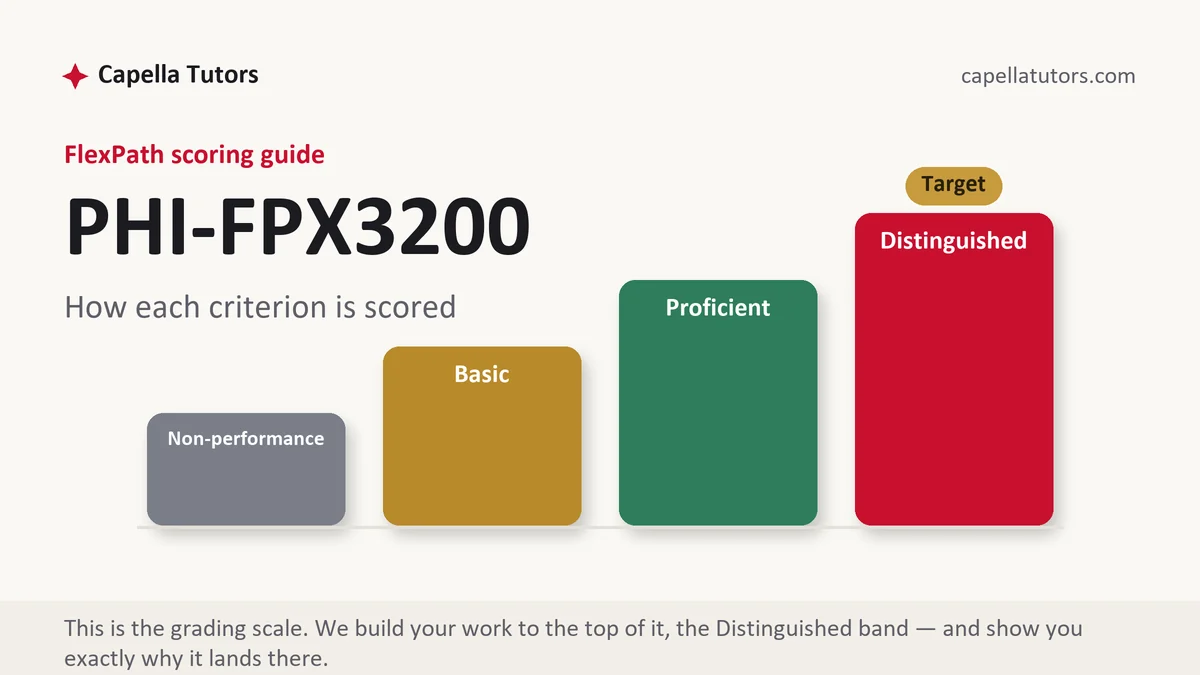
What PHI FPX 3200 actually grades
This course grades applied judgment in a setting where the wrong answer has a patient attached to it. In current courserooms the assessments begin with a matrix of ethical theories and then hand you cases, experimental drug access, withholding life support, organ conscription and professional codes, each with a decision that has to be made by somebody named, and the criteria read for four things: whether you identified the ethical question precisely, whether you applied a recognized framework to it, whether you weighed the considerations that conflict, and whether you reached a defensible resolution. A response that lists the four principles of biomedical ethics and stops there has described the tools. The column above it uses them to settle something.
Respect for autonomy, beneficence, nonmaleficence, and justice come from Beauchamp and Childress, and the framework's own claim is that no principle outranks the others in advance, which is exactly what makes the weighing the graded part. Each one is misused in a predictable way. Autonomy is not a duty to provide whatever is requested; a patient with decision-making capacity may refuse an intervention that would help, and that refusal binds, while a request for something not indicated creates no obligation to give it. Beneficence and nonmaleficence pull against each other in nearly every real case, because effective treatment is rarely harmless, so the analysis has to be about proportion rather than about avoiding harm. Justice at the organizational level means allocation, and a paper invoking it without a scarce resource and a rule for distributing it has used the word without the concept.
The third strand is precision about the machinery, and this is where health care ethics parts company with general ethics. Capacity is decision-specific and can be present for one choice and absent for another, so a blanket statement that a patient lacks capacity is a clinical claim needing support. Surrogate decision making follows an order set by state law and asks the surrogate to apply the patient's known wishes first, a best-interest standard only where those are unknown. Withholding a treatment and withdrawing one are treated as ethically equivalent in the mainstream literature and feel entirely different to families, and a paper that notices the gap between those two facts is doing real work. Confidentiality has its exceptions written into law rather than into conscience, and the difference between what HIPAA permits and what a professional code expects is graded whenever it comes up.
How we help in this course
Our 3200 samples are written by people who work on health care coursework all week. Send the case, the role you are writing from, and the framework your criteria name, and the draft will identify the ethical question in a single sentence, apply the framework to these facts, weigh the principles that conflict, then name the decision maker and the process rather than leaving the resolution floating. Where law and ethics diverge in your case, the sample separates them, because merging the two is the fastest route to a Basic score here.
The rest of the arrangement is what every course here gets. Delivery runs 24 to 48 hours, the target is the Distinguished column, and eight people sit between the prompt and your inbox, among them a reviewer who scores the draft against your own rubric rows and an APA and originality pass that checks the citations in both directions. Revision is free for as long as it takes to clear the guide, and faculty feedback comes back into the queue without a charge.
The assessments, one by one
Assessment 1: Matrix of Ethical Theories
For utilitarianism, Kantian ethics, Ross's ethics and natural law, state the decision criteria, give your own health care example, and evaluate strengths and weaknesses. Read the full Assessment 1 manual.
Assessment 2: A Right to Experimental Drugs?
Analyze whether patients should have access to unapproved experimental drugs using ethical theories and principles, informed consent, costs and benefits. Read the full Assessment 2 manual.
Assessment 3: Should We Withhold Life Support?
Analyze the case in the courseroom, the moral issues in limiting life support, the ethical principles involved, the consequences of ignoring them. Read the full Assessment 3 manual.
How to actually write PHI FPX 3200: where to begin
Start with the scoring guide and write the ethical question as one sentence before anything else. Most weak submissions here are weak because the question was never fixed: the paper discusses a case rather than answering something. A usable question names the decision, the decision maker, and the conflict, for instance whether the care team may proceed with a procedure a patient's daughter is requesting after the patient, while capacitated, declined it. Everything in the paper then either helps answer that question or comes out.
Then establish the facts in the order a clinical ethics consultation would take them: what is medically indicated and with what likelihood, what the patient's goals and previously expressed wishes were, who holds authority to decide and under what standard, and what institutional policy and applicable law say. Ordering it that way prevents the commonest structural mistake, which is arguing about what should be done before establishing who gets to decide. If the patient has capacity, most of the argument dissolves and the paper becomes about how the decision is supported.
Then do the weighing explicitly, because that paragraph is usually where the top column is won or lost. Say which principles conflict, say what each would require here, then give the reason one prevails in this case, tied to a feature of these facts rather than to a general preference. The doctrine of double effect is a worked example worth understanding: an opioid dose sufficient to relieve severe pain at the end of life is accepted when the intent is relief, the harm is foreseen rather than being the means by which relief is achieved, and the dose is proportionate to the symptom, while the same act performed with the intent of hastening death is a different act morally even where it looks identical on the chart. Stating that accurately, and saying what work intention is doing inside it, is the analytical move the course is teaching.
| Section | What goes in it | What Distinguished looks like |
|---|---|---|
| The ethical question | The decision at issue, in one sentence, with the decision maker and the conflict named. | A question specific enough that a yes or a no would resolve it, fixed before the analysis starts. |
| Clinical and contextual facts | What is indicated, what the patient wants or wanted, who holds authority, what policy says. | Facts separated from inferences, with capacity treated as decision-specific rather than global. |
| Framework | The principles or theory applied, attributed, with what each one requires on these facts. | Principles used to generate obligations here, not defined in the abstract and left there. |
| The weighing | Which considerations conflict, and the reason one of them governs in this case. | A stated priority grounded in a feature of these facts, with the cost of the choice acknowledged. |
| Resolution and process | The recommended action, who carries it out, and the process that legitimizes it. | A named decision maker, a consultation or review pathway, and a plan for the family conversation. |
| Sources and format | Bioethics scholarship, professional codes, federal guidance, and law, in current APA. | Codes cited by provision, guidance cited by agency, and the legal point kept separate from the moral one. |
Developing the synthesis
The synthesis a criterion hopes for in this course usually sits between the principles and something that resists them. Principlism is the working framework of American clinical ethics, and its critics have a case: the four principles do not rank themselves, so in a genuine conflict they can supply the vocabulary for a disagreement without resolving it. Casuistry answers by reasoning from settled cases to the new one, the way case law works, which is closer to how ethics committees actually deliberate. Care ethics, developed from Gilligan's work and elaborated by Noddings, objects that the apparatus treats the patient as an isolated chooser and misses the relationships that make the decision meaningful, which lands hardest in exactly the cases families find hardest. No undergraduate paper should try to adjudicate among these. What earns the row is showing you know the principles are a starting structure rather than an algorithm, then using a second perspective to catch something the first one missed in your particular case, and saying plainly what it caught.
Citations that survive faculty review
Four kinds of source carry a health care ethics paper and they are not interchangeable. Bioethics scholarship carries the conceptual claims, meaning Beauchamp and Childress for the principles themselves and peer-reviewed work from journals such as the Hastings Center Report or the American Journal of Bioethics through the Capella library. Professional codes carry role obligations and should be cited to the provision rather than in general: the American Nurses Association code for nursing duties, the American College of Healthcare Executives code for administrative ones, and the relevant board code for whatever role your case is written from. Federal and regulatory material carries the compliance frame, principally the HIPAA privacy rule and Office for Civil Rights guidance for confidentiality, the Belmont Report where research is involved, and the Patient Self-Determination Act for advance directives. State law carries surrogate hierarchy and directive requirements, and it varies enough that you should name the state. Clinical evidence for what a treatment actually does comes from the medical literature and nowhere else.
The mistakes that land Basic instead of Distinguished
- Answering a legal question as though it were the moral one. Lawful and right come apart regularly, and a criterion asking for ethical analysis is not asking what is permitted.
- The four principles listed and never weighed. Naming a conflict is the setup; deciding it is the assessment.
- Capacity treated as a global property of a person. It attaches to a decision, and the case usually turns on which decision.
- No decision maker named. A resolution with nobody responsible for it cannot be implemented and cannot be graded as a recommendation.
- HIPAA used as a general prohibition. The rule permits a great deal of disclosure that students assume it forbids, and the details are checkable.
PHI FPX 3200 questions students actually ask
What is the difference between an ethical problem and a legal one?
A legal question asks what a jurisdiction permits or requires and is answered by looking it up; an ethical question asks what ought to be done and is answered by argument. They overlap constantly and they are not the same, and criteria here are written to see whether you can hold them apart. A disclosure that HIPAA permits to a family member may still be a betrayal the patient would not have wanted, so the two diverge, and the paper saying which one it is analyzing at each point is the one that scores. The practical habit is to write the legal position in its own short paragraph, cite it, then set it aside and argue the ethics on the merits.
How do I resolve a case where two principles genuinely conflict?
Resolve it with a fact from the case rather than with a preference about principles. The framework is deliberately unranked, so the argument has to come from specificity: how severe the harm is, how likely, how reversible, how much the patient's own stated goals bear on it, and whether the burden falls on the person choosing or on somebody else. A refusal of a low-benefit intervention by a patient who has stated the same preference consistently for years is a different case from a refusal made once during an acute delirium, and autonomy carries different weight in each. Write the reason out in a sentence beginning with because, then add what you are giving up by deciding that way, since acknowledging the cost of a resolution marks the top column.
Do I need to work in health care to pass this course?
No. It sits in the general education humanities pool and is chosen by students in business, information technology, psychology, and health administration as well as nursing, and the criteria are written for reasoning rather than for clinical experience. What you do need is accuracy about the setting, and that comes from reading rather than from employment: what an advance directive is and is not, who counts as a surrogate, what a capacity assessment involves, what an ethics committee does. If your plan is a clinical one, our nursing pages cover the courses that build on this material, and if you sit on the administrative side the health administration pages pick it up in policy and compliance terms. Either way, write from the role your prompt gives you and stay inside what that role can decide.
Health care ethics case due?
Send the prompt, the rubric, and the case. The sample fixes the ethical question in one sentence, weighs the principles that conflict, and names who decides. First premium sample free.