This manual is for PHI FPX 3200 Assessment 2, start to submission. A Right to Experimental Drugs? asks you to analyze whether seriously ill patients should have a right to unapproved experimental drugs, often through a case in the courseroom: which ethical theories and principles apply, the role of informed consent, the costs and benefits of access, the assumptions behind each position, whether pre-approval use should be widened, and the gaps in what we know. The grade turns on balanced reasoning. A paper that picks a side without engaging the strongest opposing arguments scores lower than one that weighs both. Below is the method our tutors use, a structure that maps to the criteria, and an annotated sample excerpt. Prefer to hand it off? A premium original sample for this exact assessment comes back in 24 to 48 hours, revised free until it meets the guide. Capella's catalog lists the course as PHI-FPX3200, and some courserooms print PHI3200; both point to this same Assessment 2. In current courserooms this assessment typically appears as "A Right to Experimental Drugs?".
One honesty note before the manual: Capella revises courses and scoring guides over time, so always write to the exact scoring guide attached to your assessment in the courseroom. The course identity above is verified on capella.edu; the method and structure below are our tutors' approach to it, not Capella's official rubric text.
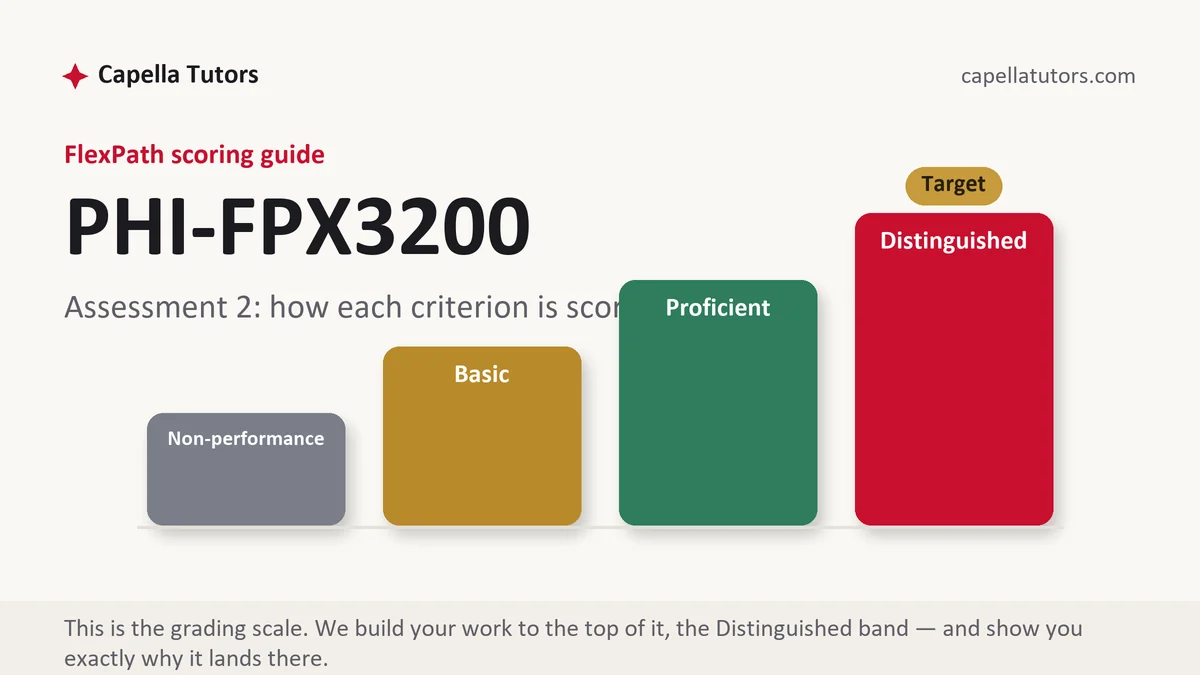
How PHI FPX 3200 Assessment 2 is scored
FlexPath does not use letter grades. Each criterion in the scoring guide lands on one of four levels, and the level descriptions are the real writing brief:
| Level | What it means on an experimental drugs analysis |
|---|---|
| Distinguished | Theories and principles are applied accurately, informed consent is analyzed in depth, costs and benefits are weighed for patients and society, assumptions and knowledge gaps are identified, and the conclusion is reasoned. |
| Proficient | All parts are present, but the opposing view or the knowledge gaps are thin. |
| Basic | The paper argues one side with little ethical analysis. |
| Non-performance | Informed consent, the cost-benefit analysis or the conclusion is missing. |
Ground the discussion in real policy, such as the FDA's expanded access program and the federal Right to Try Act of 2018.
The PHI FPX 3200 Assessment 2 method, step by step
-
Frame the question
Who is asking for access, to what, and why.
-
Apply theories and principles
Autonomy, beneficence, nonmaleficence and justice, with a theory such as utilitarianism.
-
Analyze informed consent
Can consent be truly informed when the risks are unknown and the patient is desperate?
-
Weigh costs and benefits
Hope and possible benefit against harm, false hope, cost and effects on clinical trials.
-
Name assumptions and gaps
What each side assumes and what evidence is missing.
-
Conclude
Your reasoned position and any conditions.
A structure that maps to the criteria
Word counts are planning targets our tutors use, not Capella rules; follow the length and format your scoring guide states.
| Section | What it must do | Guide |
|---|---|---|
| Introduction | The question and its stakes. | ~75 words |
| Ethical theories and moral principles | Applied to the question. | ~150 words |
| Informed consent | Its limits in this context. | ~125 words |
| Costs and benefits | For patients and society. | ~150 words |
| Assumptions, knowledge gaps and conclusion | Then references. | ~150 words |
Annotated sample excerpt
An original model excerpt from our team, written to show the register that reaches the top of the guide. Learn the moves, then write your own version.
Informed consent assumes that a patient understands the likely risks and benefits of a treatment, but for a drug that has not finished testing, no one can state those risks with confidence.1 A terminally ill patient may also feel that any chance is better than none, which makes it hard to know whether consent reflects a weighed choice or the pressure of the situation.2 That does not mean consent is impossible, but it does mean the process must be more careful than usual, with a clear statement of how little is known and an independent person to confirm the patient understands it.3
- 1Identifies the specific problem with consent here.
- 2Adds the pressure of the patient's situation.
- 3Draws a practical, reasoned conclusion.
The full premium sample for your exact assessment, written fresh to your scoring guide and topic, is free to request. Study it, revise it into your own voice, and submit work you understand.
The five mistakes that cost Distinguished
- One-sided argument. Engage the strongest opposing points.
- Principles without application. Apply them to the case.
- Ignoring real policy. Reference expanded access and Right to Try.
- No knowledge gaps. Say what evidence is missing.
- Unconditional conclusion. State any conditions on your position.
Pre-submission checklist
- Question framed
- Theories and principles applied
- Informed consent analyzed
- Costs and benefits weighed
- Assumptions and knowledge gaps
- Reasoned conclusion and sources
Want the experimental drugs analysis written?
Send the scoring guide and any materials from your courseroom. Our team returns a premium original experimental drugs analysis in 24 to 48 hours, revised free until it meets the guide.