This manual is for PHI FPX 3200 Assessment 3, start to submission. Should We Withhold Life Support? asks you to analyze a case, usually that of a patient named Mr. Martinez in the courseroom materials, in which clinicians and family must decide whether to limit life-sustaining treatment: the moral issues it raises, the ethical principles that apply, the real-world consequences of ignoring those principles, and the considerations that should guide the decision. The grade turns on applying principles to the facts of the case. General statements about end-of-life care score lower than an analysis of who decides, on what basis, for this patient. Below is the method our tutors use, a structure that maps to the criteria, and an annotated sample excerpt. Prefer to hand it off? A premium original sample for this exact assessment comes back in 24 to 48 hours, revised free until it meets the guide. Capella's catalog lists the course as PHI-FPX3200, and some courserooms print PHI3200; both point to this same Assessment 3. In current courserooms this assessment typically appears as "Should We Withhold Life Support?".
One honesty note before the manual: Capella revises courses and scoring guides over time, so always write to the exact scoring guide attached to your assessment in the courseroom. The course identity above is verified on capella.edu; the method and structure below are our tutors' approach to it, not Capella's official rubric text.
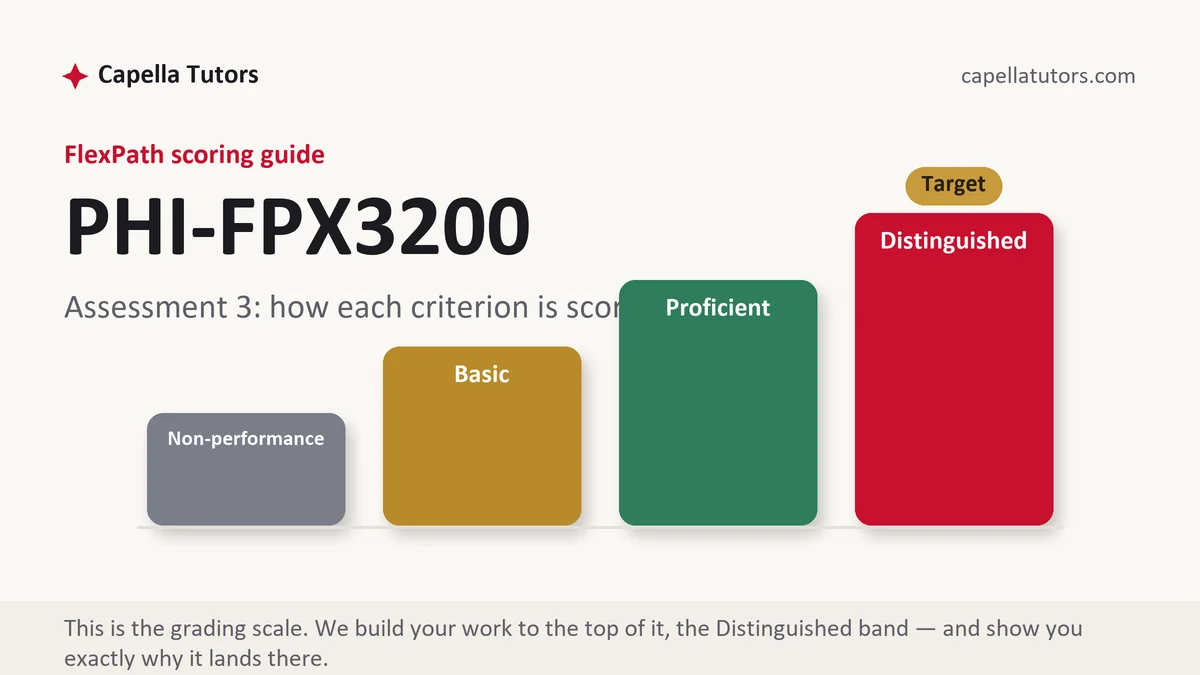
How PHI FPX 3200 Assessment 3 is scored
FlexPath does not use letter grades. Each criterion in the scoring guide lands on one of four levels, and the level descriptions are the real writing brief:
| Level | What it means on a life support case analysis |
|---|---|
| Distinguished | The case facts are summarized accurately, moral issues are identified, autonomy, beneficence, nonmaleficence and justice are applied to the case, consequences of ignoring them are concrete, and the recommended considerations follow. |
| Proficient | All parts are present, but the application to the case is general. |
| Basic | The paper discusses end-of-life ethics with little reference to the case. |
| Non-performance | The principles, the consequences or the considerations are missing. |
Base every claim about the patient on the case materials. Do not add facts the case does not give.
The PHI FPX 3200 Assessment 3 method, step by step
-
Summarize the case
The patient's condition, prognosis, wishes and who is involved in the decision.
-
Identify the moral issues
Who decides, what the patient would want, and whether continuing treatment benefits him.
-
Apply the principles
Autonomy, including advance directives and surrogate judgment, beneficence, nonmaleficence and justice.
-
Show consequences of ignoring them
Prolonged suffering, overriding wishes, family distress, legal risk.
-
Set out the considerations
Prognosis, the patient's known values, surrogate standards and palliative options.
-
Conclude
What should guide the decision in this case.
A structure that maps to the criteria
Word counts are planning targets our tutors use, not Capella rules; follow the length and format your scoring guide states.
| Section | What it must do | Guide |
|---|---|---|
| Introduction and case description | The facts of the case. | ~125 words |
| Moral issues | The questions it raises. | ~100 words |
| Ethical principles | Applied to the case. | ~150 words |
| Consequences of ignoring the principles | Real-world effects. | ~75 words |
| Considerations and conclusion | What should guide the decision, then references. | ~100 words |
Annotated sample excerpt
An original model excerpt from our team, written to show the register that reaches the top of the guide. Learn the moves, then write your own version.
Autonomy is the starting point, but Mr. Martinez cannot speak for himself, so the question becomes what he would have chosen, which is the substituted judgment standard surrogates are asked to use.1 If his earlier statements about not wanting to be kept alive on machines are documented or credibly reported by his family, they carry weight even against a relative who now wants everything done.2 Beneficence and nonmaleficence point the same way when continued treatment offers little chance of recovery and prolongs suffering, which is why the analysis turns on his prognosis and his own values rather than on what anyone else would want for him.3
- 1Applies autonomy through the correct surrogate standard.
- 2Weighs the patient's prior wishes against a family member's view.
- 3Combines principles with the case facts to reach the deciding considerations.
The full premium sample for your exact assessment, written fresh to your scoring guide and topic, is free to request. Study it, revise it into your own voice, and submit work you understand.
The five mistakes that cost Distinguished
- Ignoring the case facts. Apply principles to this patient.
- Adding facts. Use only what the case provides.
- Confusing surrogate standards. Explain substituted judgment and best interests correctly.
- No consequences. Show what goes wrong when principles are ignored.
- A vague conclusion. State what should guide the decision.
Pre-submission checklist
- Case summarized accurately
- Moral issues identified
- Principles applied to the case
- Consequences of ignoring them
- Guiding considerations
- Current APA references
Want the life support case analysis written?
Send the scoring guide and any materials from your courseroom. Our team returns a premium original life support case analysis in 24 to 48 hours, revised free until it meets the guide.