This manual is for PHI FPX 3200 Assessment 1, start to submission. The Matrix of Ethical Theories asks you to complete a matrix that compares major ethical theories used in health care, usually utilitarianism, Kantian ethics, Ross's ethics of prima facie duties and natural law: for each theory you state its decision criteria, give your own example from health care, and evaluate its strengths and weaknesses. The grade turns on accuracy and original examples. Correct decision criteria with an example you wrote yourself score above textbook definitions. Below is the method our tutors use, a structure that maps to the criteria, and an annotated sample excerpt. Prefer to hand it off? A premium original sample for this exact assessment comes back in 24 to 48 hours, revised free until it meets the guide. Capella's catalog lists the course as PHI-FPX3200, and some courserooms print PHI3200; both point to this same Assessment 1. In current courserooms this assessment typically appears as "Matrix of Ethical Theories".
One honesty note before the manual: Capella revises courses and scoring guides over time, so always write to the exact scoring guide attached to your assessment in the courseroom. The course identity above is verified on capella.edu; the method and structure below are our tutors' approach to it, not Capella's official rubric text.
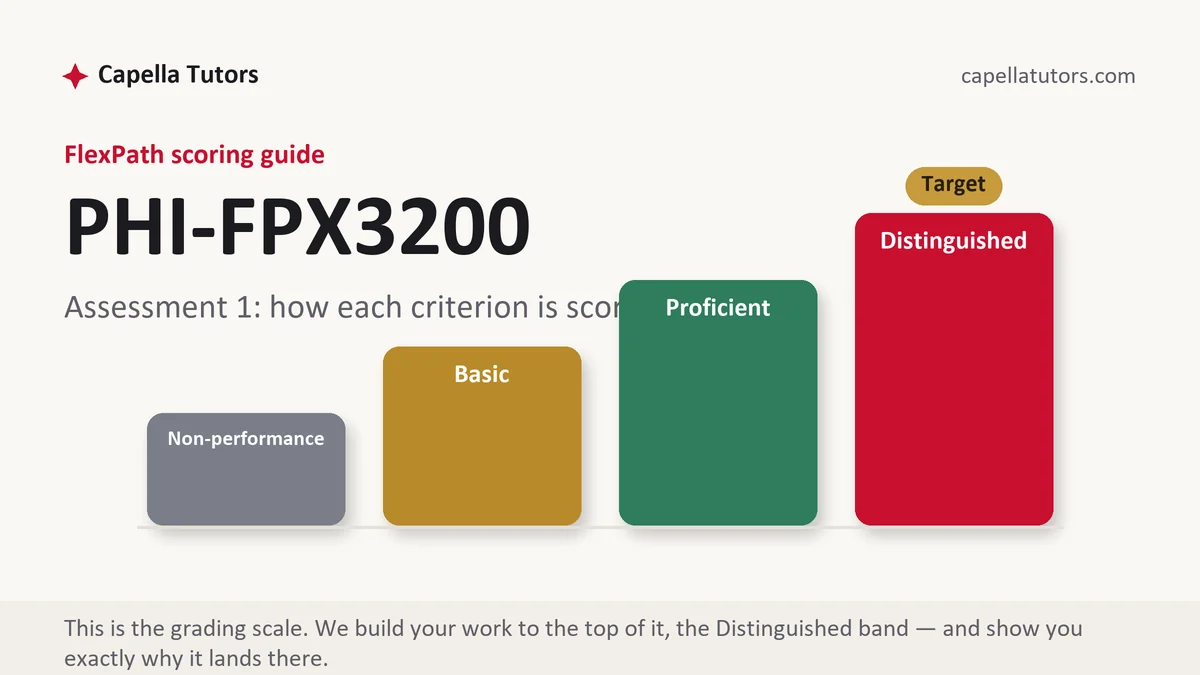
How PHI FPX 3200 Assessment 1 is scored
FlexPath does not use letter grades. Each criterion in the scoring guide lands on one of four levels, and the level descriptions are the real writing brief:
| Level | What it means on an ethical theories matrix |
|---|---|
| Distinguished | Each theory's decision criteria are stated accurately, each example is original and fits the theory, strengths and weaknesses are specific, and sources are cited. |
| Proficient | The matrix is accurate, but examples are generic or strengths and weaknesses are brief. |
| Basic | Some decision criteria are inaccurate or examples do not fit. |
| Non-performance | A theory or a column of the matrix is missing. |
Use the matrix template in your courseroom and keep each cell concise but complete.
The PHI FPX 3200 Assessment 1 method, step by step
-
Utilitarianism
Right actions maximize overall good; example such as allocating a scarce vaccine.
-
Kantian ethics
Act only on maxims you could will as universal law and treat persons as ends; example such as honest disclosure.
-
Ross's ethics
Prima facie duties such as fidelity, nonmaleficence and beneficence, weighed in conflict.
-
Natural law
Actions that accord with human nature and basic goods, including the principle of double effect.
-
Evaluate each
A strength and a weakness for health care decisions.
-
Cite sources
Course text or reputable encyclopedias.
A structure that maps to the criteria
The matrix template in your courseroom sets the format; the rows below are what evaluators check.
| Section | What it must do | Guide |
|---|---|---|
| Utilitarianism row | Criteria, example, strengths, weaknesses. | matrix cells |
| Kantian ethics row | Criteria, example, strengths, weaknesses. | matrix cells |
| Ross's ethics row | Criteria, example, strengths, weaknesses. | matrix cells |
| Natural law row | Criteria, example, strengths, weaknesses. | matrix cells |
| References | Current APA. | as needed |
Annotated sample excerpt
An original model excerpt from our team, written to show the register that reaches the top of the guide. Learn the moves, then write your own version.
Decision criteria: we have several prima facie duties, including fidelity, reparation, gratitude, justice, beneficence, self-improvement and nonmaleficence, and when they conflict we must judge which is weightier in the situation.1 Example: a nurse has promised a patient confidentiality, but the patient discloses a plan to harm a family member; the duty of fidelity conflicts with nonmaleficence toward others, and nonmaleficence takes priority.2 Strength: it reflects how clinicians actually reason through competing obligations. Weakness: it offers no fixed method for ranking duties, so two careful people can reach different answers.3
- 1States the criteria accurately.
- 2Gives an original example that shows the duties in conflict.
- 3Names a specific strength and weakness.
The full premium sample for your exact assessment, written fresh to your scoring guide and topic, is free to request. Study it, revise it into your own voice, and submit work you understand.
The five mistakes that cost Distinguished
- Inaccurate criteria. Check each theory against your sources.
- Copied examples. Write your own health care examples.
- Generic strengths. Say why it helps or hinders health care decisions.
- Missing a theory. Complete every row.
- No citations. Cite your sources.
Pre-submission checklist
- All theories in the matrix
- Accurate decision criteria
- Original health care examples
- Specific strengths and weaknesses
- Template completed
- Current APA references
Want the ethical theories matrix written?
Send the scoring guide and any materials from your courseroom. Our team returns a premium original ethical theories matrix in 24 to 48 hours, revised free until it meets the guide.