Help for every NURS FPX 4025 deliverable lives on this page — a premium original sample with a walkthrough, back in 24 to 48 hours. The course itself: Research and Evidence-Based Decision Making, listed at 3 pts / 6 quarter credits in Capella’s RN-to-BSN catalog, offered in both FlexPath and GuidedPath. In Capella's catalog the course code is written NURS-FPX4025.
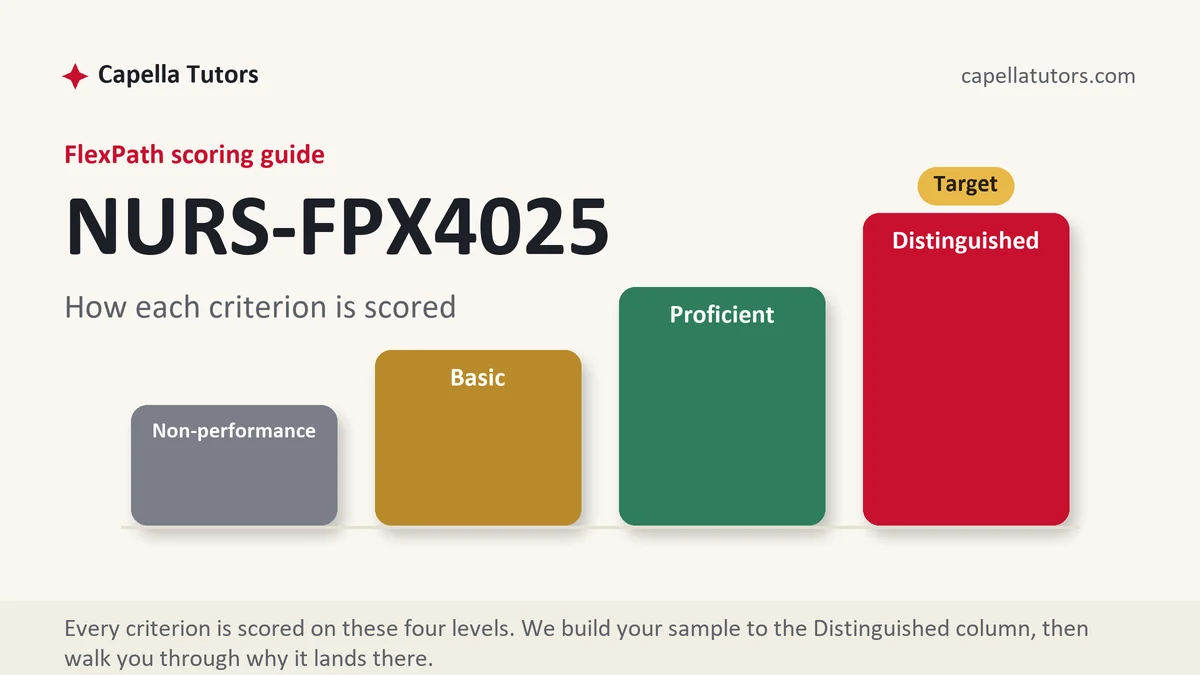
What NURS FPX 4025 actually grades
The EBP course: frame a clinical question, appraise current research, and argue a practice decision from the evidence. Its criteria are the purest test of analysis-over-summary in the program, listing what five studies said is Basic, weighing them against each other for strength and fit is Distinguished. Evidence currency rules bite here more than anywhere, and so does the requirement to name what the evidence cannot tell you.
How we help in this course
This is the course our annotated public manual was written for, and orders get the full treatment: a PICOT-framed question from your practice area, appraisal that grades the evidence rather than reciting it, and a limitation section that reads like a researcher wrote it. See the assessment manual for exactly what that looks like.
Every deliverable in the course follows our standard promise: a premium original draft in 24 to 48 hours, written to the Distinguished column on FlexPath or the A rubric row on GuidedPath, through the eight-person pipeline with both QA passes, revised free until it meets target.
Assessment manuals for this course
Every assessment in NURS FPX 4025 has its own manual now: the walkthrough, the structure that maps to the criteria, an annotated sample excerpt, and the done-for-you door. Open Assessment 1, Assessment 2, Assessment 3, Assessment 4, or start from the list in the sidebar.
In NURS FPX 4025 right now?
Send the assessment number and the scoring guide from your courseroom. First premium sample free, back in 24 to 48 hours.
Evidence currency, graded as its own criterion
Appraisal writing in 4025 lives or dies on source discipline, and the scoring guides make it explicit: current peer-reviewed evidence, usually from the last five years, each source doing named work for a specific criterion. A reference list of older or unassigned sources drags otherwise strong analysis toward Basic, because listing what studies said is precisely what the Distinguished column is written to rise above. Our research analyst builds the evidence table before drafting starts, design, finding, and criterion assignment noted per source, which is why the appraisal reads like judgment instead of inventory.
Where this course sits in the FlexPath economics
As a 3-point course on the submit-next-on-grade loop, 4025 rewards momentum: each assessment written to the Distinguished column, evaluated, and immediately followed keeps the course closing inside the flat-rate billing session it shares with the rest of your plan. The desk's 24 to 48 hour turnaround exists to keep that loop turning, and GuidedPath students get the same drafts planned against their Thursday and Sunday Central deadlines instead.
A scope request that gets answered in hours
Send the assessment number, the scoring guide, and your practice area. The reply frames the PICOT direction, lists the criteria that decide the grade, and quotes the delivery window. The annotated public manual for this course shows the full method in the open if you want to read before you write to us. Either door reaches the same desk, and the manual's method is what the paid drafts execute.
The assessments, one by one
Assessment 1: Analyzing a Research Paper
One peer-reviewed study linked to a course patient case, summarized and judged for credibility. Read the full Assessment 1 manual.
Assessment 2: Applying an EBP Model
An evidence-based practice model applied to a clinical problem, full annotated sample available. Read the full Assessment 2 manual.
Assessment 3: Applying the PICO(T) Process
A PICO(T) question, the evidence that answers it, and the practice decision. Read the full Assessment 3 manual.
Assessment 4: Presenting Your PICO(T) Process Findings to Your Professional Peers
The PICO(T) findings presented to colleagues with essential care steps. Read the full Assessment 4 manual.
How to actually write NURS FPX 4025: where to begin
Begin with the scoring guide, not the topic. Turn the criterion list into the outline itself, one heading per criterion with its Distinguished description underneath, and treat that outline as the paper's skeleton. In 4025 the criteria typically ask you to define a clinical problem, frame an answerable question, locate and appraise current research, and argue a practice decision from what the appraisal found. The assessments in this course build on each other, so the problem you choose first is usually the one you finish the course with. Choose it like it has to last.
Choose from your own practice and from the well-studied list: falls, CAUTI, pressure injuries, medication errors, handoff failures. The research base for these is deep and current, and a question the literature has not studied leaves you appraising nothing. Then build the PICOT question before you search: population, intervention, comparison, outcome, timeframe. "In adult medical-surgical patients, does a nurse-driven catheter removal protocol, compared with physician-initiated removal, reduce catheter days over six months" is answerable; "does good communication improve safety" is not.
Search with the question, not the topic: set the databases to peer-reviewed, roughly the last five years, and keep a working table as you go: author, year, design, sample, finding, and which criterion the source will serve. That table is the appraisal section in embryo, and it stops you discovering at midnight that your sources all say the same thing and none addresses the comparison arm.
| Section | What goes in it | What Distinguished looks like |
|---|---|---|
| The problem | The clinical problem with local and published data showing it is real and current. | A measurable local gap, not a national statistic standing in for one. |
| The PICOT question | All five elements stated in one sentence, then unpacked briefly. | A question narrow enough that a single study could answer it. |
| Search strategy | Databases, terms, filters, and the count that survived screening. | Inclusion choices defended, one plausible exclusion explained. |
| Appraisal of the evidence | Each source graded: design, sample, findings, strength, and fit to the question. | Sources ranked against each other by evidence level, disagreements adjudicated. |
| The practice decision | What the evidence supports doing in your setting, with barriers named. | A decision the evidence actually licenses, sized to its strength, no further. |
| Conclusion and references | The question answered directly, one limitation, current APA. | The limitation is specific: a population gap or design ceiling, not "more research is needed". |
Developing the synthesis
Appraisal is where 4025 grades hardest, and the move it wants is judgment, not inventory. Rank what you found by design strength, systematic reviews and meta-analyses above randomized trials, trials above cohorts, cohorts above cross-sectional surveys, and let the ranking do work in your prose. When two sources disagree, a trial showing a protocol cut catheter days and an observational study showing no change, adjudicate in the same paragraph: which design is stronger, which population is closer to yours, which is newer. Strength and fit can point in different directions, and saying which one governs your case is the analysis the Distinguished column describes. Finish by naming what the evidence cannot settle, because an appraisal that admits its limits reads like a researcher wrote it.
Citations that survive faculty review
Evidence currency bites harder in 4025 than anywhere else in the program; a source list is the first thing an EBP evaluator scans. Hold the line at peer-reviewed and roughly five years, sourced through the Capella library, CINAHL and PubMed first, Cochrane for systematic reviews. Assign every source a named job for a criterion: this one establishes the problem's scope, these four are the appraisal set, this one supports the implementation barrier. Integrate the citation into the argument sentence, "Okafor et al. (2023) randomized 14 units and found a 31 percent reduction" is appraisal in motion; the same claim with the citation tacked on at the period is summary. Keep the reference list honest both ways: everything cited appears there, nothing appears there uncited, formatted to current APA.
The mistakes that land Basic instead of Distinguished
- The unanswerable question. A vague PICOT poisons every later criterion; no search can serve it.
- Annotated bibliography syndrome. Six paragraphs, each summarizing one source, with no sentence relating any two of them.
- Design blindness. Treating a cross-sectional survey and a randomized trial as equal votes ignores the hierarchy the course exists to teach.
- The overreaching decision. Recommending a housewide rollout from two small studies claims more than the evidence licenses.
- No named limitation. The Distinguished column in appraisal work almost always pays for what the evidence cannot say.
NURS FPX 4025 questions students actually ask
How do I pick a PICOT topic that will hold up?
Pick the intersection of what you have seen on your unit and what the literature has studied heavily: falls, CAUTI, pressure injuries, medication errors, handoffs. Run a quick scoping search before you commit; if a five-year, peer-reviewed filter returns fewer than a handful of usable studies, change the question now rather than in the appraisal section. The topic serves the whole course, so a boring well-studied problem beats an interesting unstudied one.
What counts as current evidence?
The working rule is peer-reviewed work from roughly the last five years, and in 4025 it is enforced, because evidence currency is part of what the criteria measure. An older landmark study can appear as background, but the appraisal set itself should sit inside the window. If the best study on your question is eight years old, say so explicitly and weigh it accordingly; naming the currency problem is analysis, quietly including the old study is a Basic trigger.
What do I do when my studies disagree?
Use the disagreement; it is the highest-value material in the paper. Put the conflicting findings in one paragraph and adjudicate on design strength, sample size, setting fit, and recency, then state which finding you weight more and what that means for your practice decision. Two studies that disagree, adjudicated, score higher than four studies that agree, listed, because only the first one demonstrates appraisal.