This manual is for NURS FPX 4025 Assessment 1, start to submission. Analyzing a Research Paper asks you to choose one peer-reviewed research article that relates to a patient case from the course, summarize what the study did and found, and judge how credible and how useful it is for that patient's care. It is the first step of the course's evidence cycle, and it is graded on judgment: a summary alone sits in the middle of the guide, while a reasoned verdict on the study's design, sample and relevance reaches the top. Below is the method our tutors use, a structure that maps to the criteria, and an annotated sample excerpt. Prefer to hand it off? A premium original sample for this exact assessment comes back in 24 to 48 hours, revised free until it meets the guide. Capella's catalog lists the course as NURS-FPX4025, and some courserooms print NURS4025; both point to this same Assessment 1. In current courserooms this assessment typically appears as "Analyzing a Research Paper".
One honesty note before the manual: Capella revises courses and scoring guides over time, so always write to the exact scoring guide attached to your assessment in the courseroom. The course identity above is verified on capella.edu; the method and structure below are our tutors' approach to it, not Capella's official rubric text.
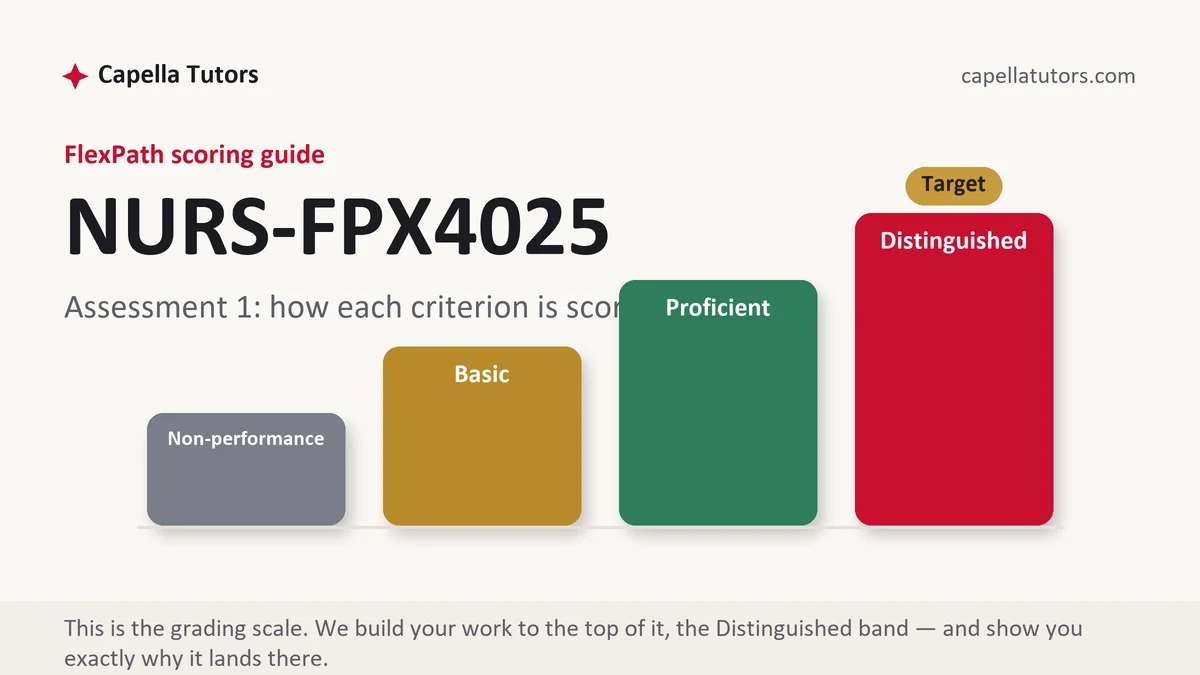
How NURS FPX 4025 Assessment 1 is scored
FlexPath does not use letter grades. Each criterion in the scoring guide lands on one of four levels, and the level descriptions are the real writing brief:
| Level | What it means on a research paper analysis |
|---|---|
| Distinguished | The article is clearly relevant to the patient case, its purpose, design, sample and findings are summarized accurately, credibility is judged with named criteria, and its usefulness for this patient is argued with its limits stated. |
| Proficient | The summary is accurate and the article is relevant, but credibility is asserted from the journal name rather than examined. |
| Basic | The paper retells the abstract and says the article is useful without explaining why. |
| Non-performance | The article is not a research study, or the credibility or usefulness discussion is missing. |
Choose a primary research study, not a review or an opinion piece, unless your guide allows otherwise. A clear design and sample make the credibility criterion easier to answer well.
The NURS FPX 4025 Assessment 1 method, step by step
-
Start from the patient case
Read the course case and write down the clinical question it raises, for example fall risk, wound healing or medication adherence. That question decides which article fits.
-
Find one peer-reviewed study
Search the Capella library databases such as CINAHL or PubMed with the question's key terms, filter to peer-reviewed research from roughly the last five years, and choose a study you can explain.
-
Summarize the study precisely
Purpose, design, setting, sample size, intervention or measures, and main findings, in your own words. One tight paragraph is better than a long retelling.
-
Judge credibility with named criteria
Use a recognized tool such as the CRAAP test or an evidence hierarchy: currency, authority of the authors, design strength, sample size, and whether the conclusions follow from the results.
-
Argue usefulness for this patient
Explain what the findings suggest for the case and where they do not apply, for example a different age group or setting.
-
Include the link and reference
Give the article's permalink or DOI if your guide asks for it, and a full reference in current APA.
A structure that maps to the criteria
This is a short analysis. Word counts are planning targets our tutors use, not Capella rules; follow the length your scoring guide states.
| Section | What it must do | Guide |
|---|---|---|
| Introduction and patient case | The case, the clinical question and the article chosen. | ~100 words |
| Summary of the study | Purpose, design, sample and findings. | ~175 words |
| Credibility | Named criteria applied to this study. | ~150 words |
| Usefulness for the case | What the findings mean for this patient and where they stop. | ~125 words |
| Link and reference | Permalink or DOI and current APA reference. | as required |
Annotated sample excerpt
An original model excerpt from our team, written to show the register that reaches the top of the guide. Learn the moves, then write your own version.
The study is a randomized controlled trial of 312 adults on two medical units, published in 2023 in a peer-reviewed nursing journal, and its authors are nurse researchers affiliated with an academic medical center.1 Randomization and a sample of that size strengthen confidence that the drop in falls came from the intervention rather than from differences between patients, which places it high on the evidence hierarchy.2 Its main limit for this case is that participants were younger on average than the patient in the scenario and few had cognitive impairment, so the protocol's effect on a confused 84-year-old is an inference, not a finding.3
- 1Gives the facts a reader needs to judge credibility: design, size, date, venue and authority.
- 2Explains why the design strengthens the conclusion, which is analysis rather than assertion.
- 3Names the limit that matters for this patient, which is the extra move the top column asks for.
The full premium sample for your exact assessment, written fresh to your scoring guide and topic, is free to request. Study it, revise it into your own voice, and submit work you understand.
The five mistakes that cost Distinguished
- Choosing a review or a news article. The task asks for a research paper; pick a study.
- Retelling the abstract. Summarize in your own words and move on to judgment.
- Credibility from the journal name. Name the criteria and apply them.
- Usefulness without limits. Say where the study does not fit the patient.
- Missing link or reference. If the guide asks for a permalink, include it.
Pre-submission checklist
- Clinical question drawn from the course patient case
- One peer-reviewed research study, recent
- Purpose, design, sample and findings summarized
- Credibility judged with named criteria
- Usefulness argued with limits
- Link if required and current APA reference
Want the article analysis done fast?
Send the scoring guide and the patient case. Our team finds a fitting study and returns a premium original analysis in 24 to 48 hours, revised free until it meets the guide.