This manual is for NURS FPX 4025 Assessment 4, start to submission. Presenting Your PICO(T) Process Findings to Your Professional Peers turns the PICO(T) work from Assessment 3 into a presentation for colleagues: the patient's diagnosis with its prognosis and risks, the PICO(T) question, a summary of the peer-reviewed evidence, the evidence-based answer to the question, and the essential care steps that follow from it. It is delivered as a presentation, usually slides with speaker notes or a recorded talk; check what your courseroom asks for. The grade turns on whether the evidence actually answers the question and changes the care steps. Below is the method our tutors use, a structure that maps to the criteria, and an annotated sample excerpt. Prefer to hand it off? A premium original sample for this exact assessment comes back in 24 to 48 hours, revised free until it meets the guide. Capella's catalog lists the course as NURS-FPX4025, and some courserooms print NURS4025; both point to this same Assessment 4. In current courserooms this assessment typically appears as "Presenting Your PICO(T) Process Findings to Your Professional Peers".
One honesty note before the manual: Capella revises courses and scoring guides over time, so always write to the exact scoring guide attached to your assessment in the courseroom. The course identity above is verified on capella.edu; the method and structure below are our tutors' approach to it, not Capella's official rubric text.
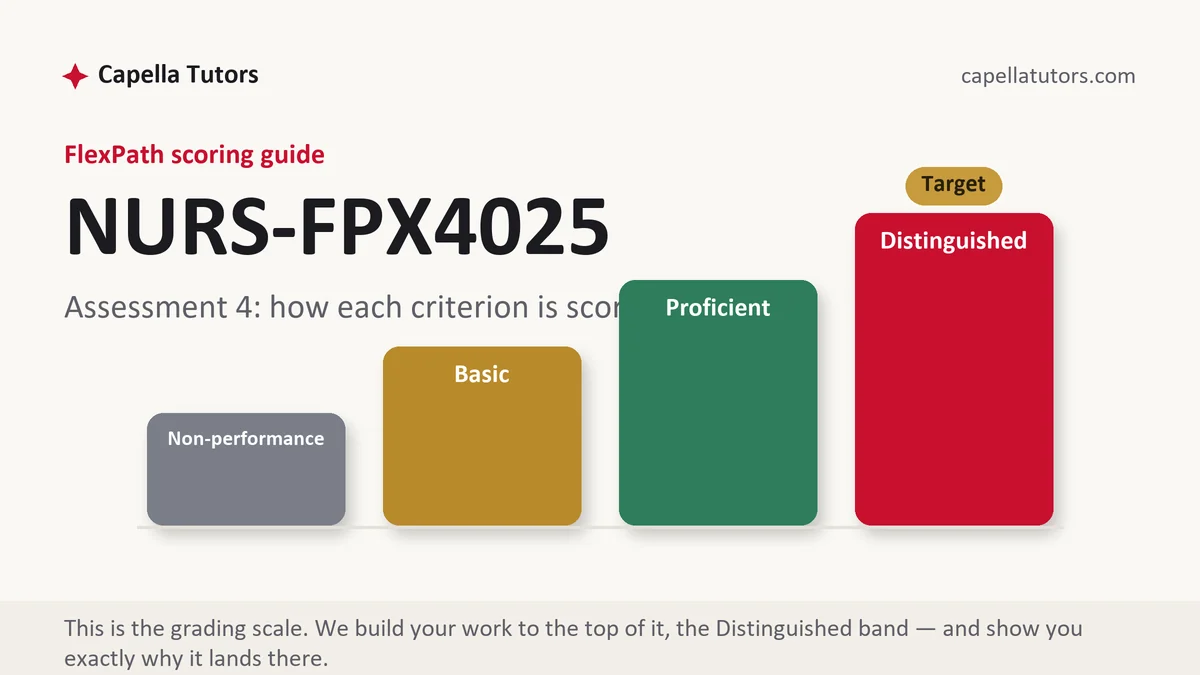
How NURS FPX 4025 Assessment 4 is scored
FlexPath does not use letter grades. Each criterion in the scoring guide lands on one of four levels, and the level descriptions are the real writing brief:
| Level | What it means on a PICO(T) findings presentation |
|---|---|
| Distinguished | The diagnosis and risks are explained clearly, the PICO(T) question is complete, the evidence is summarized with its strength, the answer follows from the evidence, the care steps are specific and cited, and the delivery suits an audience of peers. |
| Proficient | All parts are present and accurate, but the link from evidence to care steps is general. |
| Basic | The presentation repeats the earlier paper without adapting it, and the evidence is listed rather than summarized. |
| Non-performance | The PICO(T) question, the evidence summary or the care steps are missing. |
Speak to nurses who will use the steps on their next shift. Peers want to know what to do differently and why the evidence supports it.
The NURS FPX 4025 Assessment 4 method, step by step
-
Open with the patient and the diagnosis
State the diagnosis, the likely course and the main risks and complications in plain clinical language, with a source.
-
Present the PICO(T) question
Population, intervention, comparison, outcome and time, each named, then the full question in one sentence.
-
Summarize the evidence
Three or four peer-reviewed sources: what each found and how strong it is. Group them by finding rather than listing them one by one.
-
Answer the question
Say what the evidence supports and how confident you are, including any conflicting results.
-
Turn the answer into care steps
Three to five essential steps a nurse would take, each linked to the evidence behind it.
-
Close for peers
Summarize the change, invite questions, and include a references slide in current APA.
A structure that maps to the criteria
Slide counts and timing vary by version; follow your scoring guide. The note lengths below are planning targets our tutors use.
| Section | What the slide and notes must do | Guide |
|---|---|---|
| Title and purpose | Who is presenting and what the audience will learn. | 1 slide |
| Diagnosis, prognosis and risks | The clinical picture with a source. | 1 to 2 slides, ~175 words of notes |
| The PICO(T) question | Each element named and the full question. | 1 slide, ~100 words |
| Summary of evidence | Sources grouped by finding with strength noted. | 2 slides, ~250 words |
| Evidence-based answer | What the evidence supports and with what confidence. | 1 slide, ~150 words |
| Essential care steps and close | Specific steps tied to evidence, then references. | 2 to 3 slides, ~200 words |
Annotated sample excerpt
An original model excerpt from our team, written to show the register that reaches the top of the guide. Learn the moves, then write your own version.
So what does this mean for our patients with heart failure on the unit tomorrow morning?1 The strongest studies we reviewed agree that structured discharge teaching using teach-back, combined with a follow-up call within 72 hours, lowers thirty-day readmissions compared with standard written instructions, so the first two steps are to use teach-back for every medication change and to schedule that call before the patient leaves.2 The third step, daily weights recorded by the patient at home, has weaker evidence on its own, but it supports both of the others, so we recommend it as part of the teaching rather than as a separate intervention.3
- 1Frames the slide for peers who will act on it, which is the audience the assessment names.
- 2Turns the evidence into specific steps and says where they come from.
- 3Qualifies a step by the strength of its evidence, which is the judgment the top column rewards.
The full premium sample for your exact assessment, written fresh to your scoring guide and topic, is free to request. Study it, revise it into your own voice, and submit work you understand.
The five mistakes that cost Distinguished
- Copying the Assessment 3 paper onto slides. Adapt it for a spoken presentation to peers.
- An incomplete PICO(T). Name every element, including the comparison and time frame.
- Evidence listed source by source. Group findings so the answer is visible.
- Care steps with no citations. Each step should point to its evidence.
- No notes or script. The notes carry the evidence the evaluator scores.
Pre-submission checklist
- Diagnosis, prognosis and risks explained with a source
- Complete PICO(T) question
- Evidence summarized and graded for strength
- Answer follows from the evidence
- Essential care steps specific and cited
- Notes or script for every content slide, current APA references
Want the PICO(T) presentation built?
Send the scoring guide and your Assessment 3 work. Our team returns a premium original slide deck with full speaker notes in 24 to 48 hours, revised free until it meets the guide.