This manual is for NURS FPX 4025 Assessment 2, start to submission. Prefer to hand it off? We deliver a premium original sample for this exact assessment in 24 to 48 hours, with revisions until it meets the guide. NURS FPX 4025 is Capella's RN-to-BSN research course, Research and Evidence-Based Decision Making. You pass its assessments by applying an evidence-based practice framework to a real clinical problem and writing to the scoring guide, criterion by criterion, at the Distinguished level. Below is the method our tutors use, the structure that maps cleanly to EBP criteria, and an annotated sample excerpt. Capella's catalog lists the course as NURS-FPX4025, and some courserooms print NURS4025; both point to this same Assessment 2. In current courserooms this assessment typically appears as "Applying an EBP Model".
One honesty note before the manual: Capella revises courses and scoring guides over time, so always write to the exact scoring guide attached to your assessment in the courseroom. The course identity above is verified on capella.edu; the method and structure below are our tutors' approach to it, not Capella's official rubric text.
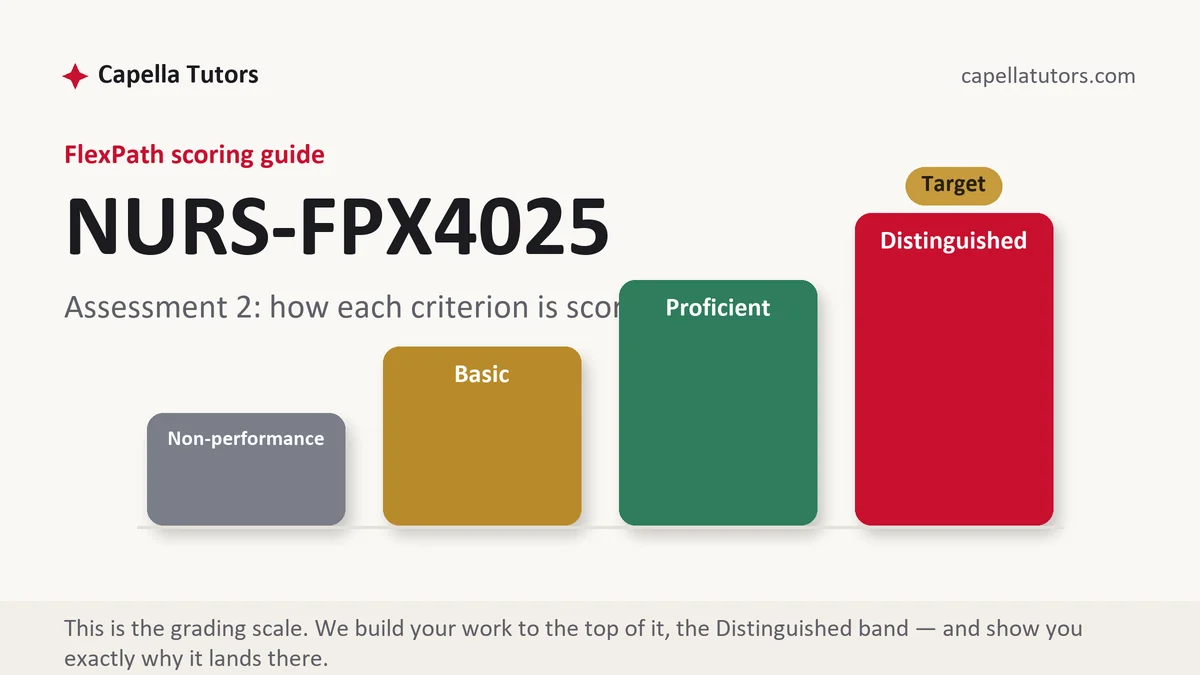
How NURS FPX 4025 Assessment 2 is scored
FlexPath does not use letter grades. Every criterion in the scoring guide is rated on four performance levels, and the level descriptions are the actual writing brief:
| Level | What it means in practice |
|---|---|
| Distinguished | You did everything Proficient asks, plus the extra move the criterion names: a deeper analysis, an acknowledged limitation, an impact statement, or a comparison. This is the target on every criterion. |
| Proficient | You answered the criterion completely and correctly. Safe, but it leaves the top of the transcript unused. |
| Basic | Partial or shallow coverage. Usually caused by summarizing sources instead of analyzing them. |
| Non-performance | The criterion is missing. Often an entire required section skipped, not bad writing. |
The practical consequence: you do not write an essay and hope. You write to the criteria, in order, and you check each one against the Distinguished column before you submit.
The NURS FPX 4025 Assessment 2 method, step by step
-
Pull the scoring guide apart first
Open the scoring guide before you read anything else. Copy every criterion into your outline as a heading, with its Distinguished description underneath. This is your writing contract; nothing else gets graded.
-
Pick a clinical problem you can defend with evidence
Choose a problem from your own practice that current research actually covers: falls, CAUTI, pressure injuries, medication errors, handoff communication. A problem you have seen makes the application sections concrete instead of generic.
-
Frame one answerable question
Turn the problem into a single focused question about population, intervention, and outcome. Every source you cite must help answer that question; anything else is padding the grader will skip.
-
Hunt evidence with a currency rule
Use peer-reviewed sources from roughly the last five years, found through the library databases, and appraise them: study design, sample, findings, and how strong the evidence actually is. Distinguished-level work names the strength of the evidence, not just its existence.
-
Draft criterion by criterion
Write each outline section to fully satisfy its criterion, then add the Distinguished move: a limitation, an implication for practice, or a conflict between sources and how you resolved it. Keep paragraphs analytical, never source summaries in a row.
-
Self-score before you submit
Read your draft against the scoring guide one criterion at a time and mark each D, P, B, or N yourself. Anything below D gets one more pass. FlexPath allows revision cycles, but a submission that lands Distinguished the first time is what keeps the expedite pace.
A structure that maps to the criteria
Word counts are planning targets our tutors use for a typical 4025 written assessment, not Capella rules; expand where your scoring guide asks for more.
| Section | What it must do | Guide |
|---|---|---|
| Introduction | Name the clinical problem, why it matters now, and preview your question in the last sentence. | ~150 words |
| The problem and question | Describe the practice problem with data or context, then state the focused question you will answer. | ~250 words |
| Evidence review | Appraise 4 to 6 current peer-reviewed sources: design, findings, strength, and relevance to the question. | ~450 words |
| Application to practice | Translate the evidence into a concrete decision or change for your setting, including barriers. | ~350 words |
| Conclusion | Answer the question directly, state the practice implication, and name one limitation. | ~150 words |
| References | Current APA style, every in-text citation matched, nothing cited that is not used. | as needed |
Annotated sample excerpt
This is an original model excerpt written by our team to show the register that scores at the top of the guide. It is study material: learn the moves, then write your own version.
Catheter-associated urinary tract infections remain one of the most preventable harms in adult inpatient care, yet they persist on units where indwelling catheter use is routine rather than justified.1 On the medical-surgical unit where I practice, catheter days per patient remain above the unit's own benchmark, which makes the problem local, measurable, and actionable rather than theoretical.2 This assessment asks whether a nurse-driven removal protocol, compared with physician-initiated removal alone, reduces catheter days and infection rates in adult medical-surgical patients, and it appraises the current evidence for adopting one.3
- 1Opens on the clinical problem and its stakes in one sentence, no throat-clearing. Graders find the criterion answered immediately.
- 2Grounds the problem in the writer's own practice with a measurable gap. This is the specificity that separates Distinguished from Proficient.
- 3Ends the introduction by previewing the exact question and the plan, so every later section is expected before it arrives.
The full premium sample for your exact assessment, written fresh to your scoring guide and topic, is free to request. Study it, revise it into your own voice, and submit work you understand.
The five mistakes that cost Distinguished
- Writing an essay instead of answering criteria. Beautiful prose that ignores a criterion still scores Non-performance on it.
- Source summaries in a row. Listing what five studies said is Basic; weighing them against each other is Distinguished.
- Old or weak evidence. A textbook and a ten-year-old study will cap you at Proficient in an evidence course.
- No limitation, no barrier. The Distinguished column usually rewards acknowledging what the evidence cannot say or what will resist the change.
- APA drift. Mismatched citations and references are the most common revision request we see on 4025 work.
Pre-submission checklist
- Every scoring-guide criterion has its own clearly labeled section
- Each section read against the Distinguished column and self-scored D
- 4 to 6 current peer-reviewed sources, each appraised, not just cited
- One limitation and one practice barrier named explicitly
- Every in-text citation appears in the reference list, current APA style
- Read once aloud for flow; no paragraph is a single long sentence
Want this assessment done with backup?
Send the scoring guide and your topic. A team of eight, including a research analyst and two QA reviewers, returns a premium original sample written to the Distinguished column in 24 to 48 hours, with revisions until it gets there. On the expedite plan, this course pairs with your next one and both close in about a week.