This manual is for NURS FPX 4025 Assessment 3, start to submission. Assessment 3 of NURS FPX 4025 is where the evidence has to buy something. The searching is behind you and the appraisal is behind you; this paper is graded on the practice decision the evidence produces, framed in PICOT so that the decision has edges. The failure mode here is not weak research, it is a paper that argues beautifully and then never says what should change on Tuesday morning. Written well, this deliverable reads like a proposal a nurse manager could act on, with a measure attached that would prove it worked. The method our tutors use follows, with a mapped structure and an annotated excerpt. Rather hand it off? A premium original sample for this exact assessment comes back in 24 to 48 hours, revised free until it meets the guide. Capella's catalog lists the course as NURS-FPX4025, and some courserooms print NURS4025; both point to this same Assessment 3. In current courserooms this assessment typically appears as "Applying the PICO(T) Process".
One honesty note before the manual: Capella revises courses and scoring guides over time, so always write to the exact scoring guide attached to your assessment in the courseroom. The course identity above is verified on capella.edu; the method and structure below are our tutors' approach to it, not Capella's official rubric text.
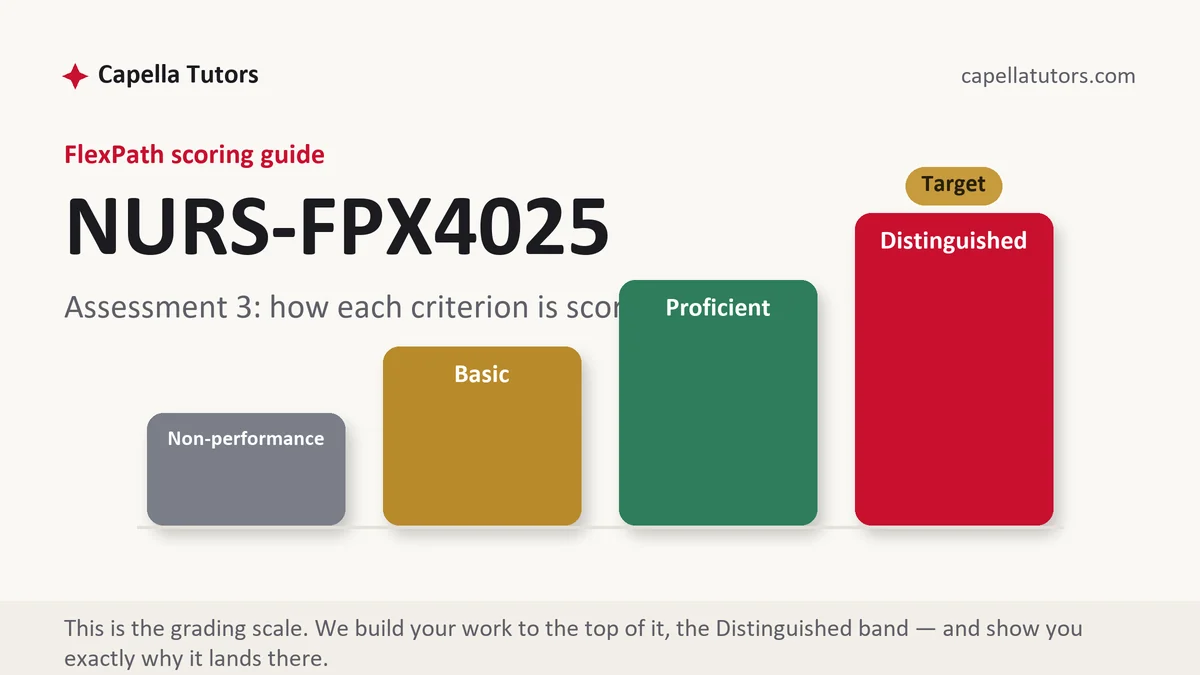
How NURS FPX 4025 Assessment 3 is scored
Each criterion sits at one of four levels, and on a practice-decision paper they separate by how actionable the writing is:
| Level | What it means on a practice decision paper |
|---|---|
| Distinguished | A decision stated plainly, traced to the evidence that supports it, defended against the evidence that complicates it, written out as steps a unit could begin next week, with the number that would settle whether it worked. Your scoring guide holds the exact extra move; write at that wording. |
| Proficient | A supported decision described in general terms. Correct and well cited, but nobody could run it from the page as written. |
| Basic | Evidence restated and a recommendation implied. The reader is left to work out what the writer actually decided. |
| Non-performance | A required piece absent, most often the outcome measure or the implementation detail, because the paper stopped when the argument felt finished. |
The PICOT frame is doing more here than it did earlier in the course. In the opening assessment it organized a search; in this one it is the skeleton of a decision, since the population tells you who the change touches, the comparison tells you what you are replacing, and the outcome and timeframe together become your evaluation plan. Write the frame carelessly and three later criteria go soft.
The NURS FPX 4025 Assessment 3 method, step by step
-
Rewrite the PICOT until the decision is visible inside it
Open the scoring guide, build the outline from its criteria, then rebuild your question so that a reader could guess the recommendation from it. If the comparison is still "usual care" with nothing named, you do not yet know what you are replacing, and the implementation section will show it.
-
Commit to the decision in the first hundred words
Say what should change, for whom, and starting when, before any evidence is presented. Suspense is a literary device, not a rubric strategy. Evaluators reading for a decision criterion should find it satisfied on page one and then spend the rest of the paper watching it get defended.
-
Argue with the study that disagrees with you
Find the evidence that cuts against your decision and handle it in the open: a null result, a different population, a trial where the effect vanished at six months. Explaining why it does not overturn your recommendation is stronger writing than pretending it does not exist, and it is usually the analysis the top level is describing.
-
Translate the decision into who does what, and when
Name the roles, the timing, and the documentation that changes. Which order set is edited, which shift owns the new step, where it gets charted, who is told during orientation. Specificity is not padding in this section; it is the criterion.
-
Name the barriers and answer each one
List the real obstacles, habit, workload, cost, skepticism from an experienced colleague, and pair every one with a response. Barriers without answers read as pessimism; barriers with answers read as planning, and only the second scores. Keep the supporting evidence current and peer reviewed through the Capella library, CINAHL, or PubMed.
-
Attach the number that will settle it, then self-score
Define one outcome measure and one process measure, say who collects them and how often, and state what result would mean the change failed. Then grade each criterion D, P, B, or N against the guide and rework anything below D. Upload it on a Monday rather than a Friday, because an evaluation can sit for two business days and a weekend is not one of them.
A structure that maps to the criteria
The word targets below are our tutors' working outline for a typical 4025 practice-decision paper, not Capella's figures; your scoring guide decides the real scope, so grow the section it weights hardest.
| Section | What it must do | Guide |
|---|---|---|
| Introduction | Set the practice problem in your own setting and state the decision the paper defends in the final sentence. | ~150 words |
| PICOT and the decision | The question with every component named, then the recommended change stated as a decision rather than as a possibility. | ~250 words |
| Evidence behind the decision | The strongest supporting studies argued together, with design and effect size doing the persuading rather than volume of citation. | ~350 words |
| Evidence that complicates it | The contrary or limited findings named honestly, with a reasoned explanation of why the decision still stands. | ~200 words |
| Implementation in the setting | Roles, timing, documentation, education, and the barriers with an answer attached to each. | ~300 words |
| Measurement and conclusion | The outcome and process measures, who collects them and when, plus the result that would count as failure. | ~200 words |
| References | Current APA, every cited study used in the argument, nothing listed that the paper never touched. | as needed |
Annotated sample excerpt
An original model excerpt from our team for this deliverable, showing a decision written so a unit could start it. Take the moves, write your own sentences.
The decision this paper defends is scheduled multimodal analgesia after open abdominal surgery, acetaminophen and an NSAID given around the clock through the first forty-eight hours, with opioids held for breakthrough pain.1 On our surgical unit that changes three visible things: the post-op order set carries the non-opioids as scheduled rather than as needed, reassessment is charted at sixty minutes instead of at the next medication pass, and overnight breakthrough doses are read aloud at the morning huddle.2 The barrier is habit rather than pharmacology, since as-needed dosing lets a stretched night shift defer a decision, so the measure that will tell us whether the change survived contact with the unit is the proportion of scheduled doses given on time, pulled weekly for the first month.3
- 1The decision arrives as a decision, with the population, the agents, and the window inside one sentence. Nothing has to be inferred.
- 2Implementation written as three observable changes to real documents and real routines. That concreteness is what lifts the criterion past Proficient.
- 3Names the honest barrier and converts it straight into a process measure, so the plan arrives already testable rather than merely argued.
The full premium sample for your exact assessment, written fresh to your scoring guide and issue, is free to request. Study it, revise it into your own voice, and submit work you understand.
The five mistakes that cost Distinguished
- The recommendation that never lands. A paper that concludes more research is needed has declined to make the decision the criteria are scoring.
- A change nobody could start. No roles, no timing, no document named, and the implementation criterion has nothing concrete to reward.
- Only friendly evidence. A literature that agrees with you completely usually means the contrary studies went unread, and evaluators in this course notice.
- Barriers listed and abandoned. Naming resistance without answering it converts a plan into a worry.
- No number at the end. If nothing measurable would prove the change worked, the evaluation criterion stays empty no matter how strong the argument was.
Pre-submission checklist
- Every scoring-guide criterion has its own labeled section in the draft
- The decision is stated in the introduction, not saved for the conclusion
- The PICOT names a real comparison instead of unspecified usual care
- At least one contrary or limited finding addressed with reasoning
- Roles, timing, and documentation changes written out explicitly
- One outcome measure, one process measure, APA matched, self-scored D
Want the practice decision written with backup?
Send the scoring guide, your PICOT, and the sources you have collected so far. An eight-person pod, research analyst and two QA reviewers included, returns a premium original sample with the decision defended and the implementation costed out in 24 to 48 hours, revised free until it holds the Distinguished column. This is the assessment that proves you can turn reading into practice; make it look like it.