In Capella's RN-to-BSN sequence, NURS FPX 4015, pathophysiology, Pharmacology, and Physical Assessment, carries 3 pts / 6 qcr and runs in both FlexPath and GuidedPath. In Capella's catalog the course code is written NURS-FPX4015.
What NURS FPX 4015 actually grades
The three Ps in one course, delivered as written case work rather than exams: assessment write-ups where disease mechanism, drug rationale, and physical findings must connect in prose. The scoring guides prize the chain of reasoning, this finding, because this mechanism, therefore this monitoring, and penalize the symptom-list style most of us chart in. It is the most content-dense writing in the program and the course our nursing clients rate hardest.
How we help in this course
Our MSN-credentialed writers draft these cases with the reasoning chain visible in every section, sourced to current clinical literature, so the science is airtight and the writing carries it. The walkthrough doubles as a patho refresher aimed exactly at what the criteria examine.
Orders here get the standard machinery: your scoring guide decoded by the research analyst, a subject-matched writer, scoring-guide QA then APA and originality QA, delivery inside 24 to 48 hours, and the revise-until-target guarantee.
Assessment manuals for this course
Every assessment in NURS FPX 4015 has its own manual now: the walkthrough, the structure that maps to the criteria, an annotated sample excerpt, and the done-for-you door. Open Assessment 1, Assessment 2, Assessment 3, Assessment 4, or start from the list in the sidebar.
In NURS FPX 4015 right now?
Send the assessment number and the scoring guide from your courseroom. First premium sample free, back in 24 to 48 hours.
Four columns applied to a clinical case write-up
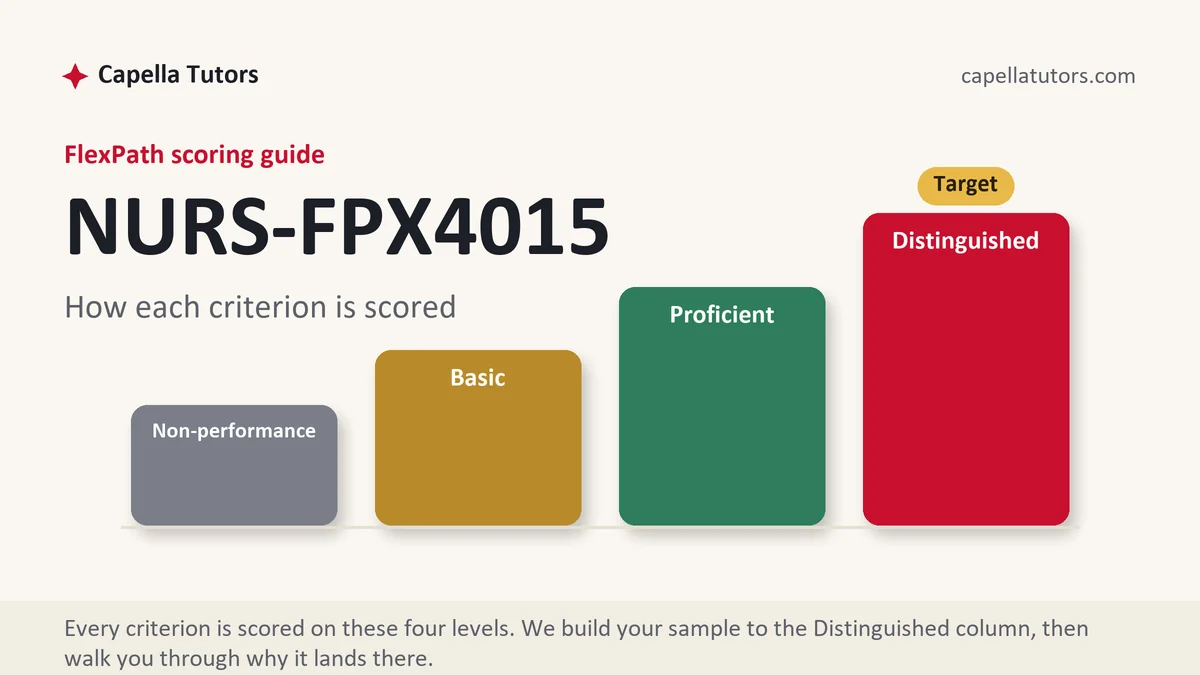
The three Ps course grades its cases against the same performance ladder as everything else at Capella, and the mapping is stark. Non-performance is the skipped section, usually a monitoring or rationale piece the outline forgot. Basic is the symptom list, accurate content arranged as description. Proficient is the complete case: finding connected to mechanism connected to intervention. Distinguished adds what each column names, often the limitation of a finding or the implication for ongoing care. Our drafts are outlined from the criteria first, so the reasoning chain the guide rewards is the structure of the paper, not a decoration on it.
The 24 to 48 hour rhythm against content this dense
Density is why this course leads our nursing queue, and the desk's clock holds anyway: each assessment returns within 24 to 48 hours through the eight-person pod, an MSN-credentialed writer drafting, scoring-guide QA and the separate APA and originality pass behind it, revisions free until Distinguished, or the A row on GuidedPath, posts. The walkthrough that rides along is a targeted patho refresher aimed at exactly the criteria your evaluator reads.
Can you handle the pharmacology and assessment portions in one draft?
Yes; the scoring guide treats them as connected criteria, and the draft connects them the same way, drug rationale tied to the mechanism and findings that justify it.
Which assessment should the free sample cover?
The one in front of you. It arrives full-length with the criterion map, so you can audit our chain-of-reasoning method against your own guide before spending anything.
The assessments, one by one
Assessment 1
Choose an adult volunteer and complete the waiver for the recorded head-to-toe assessment. Read the full Assessment 1 manual.
Assessment 2: Enhancing Holistic Nursing Care with the 3Ps
Holistic care and how pathophysiology, pharmacology and physical assessment support it. Read the full Assessment 2 manual.
Assessment 3
A concept map for a mental health diagnosis in a course patient scenario, with a written explanation. Read the full Assessment 3 manual.
Assessment 4: Caring for Special Populations Teaching Presentation
Teach nurses about one special population and culturally competent care. Read the full Assessment 4 manual.
Assessment 5: Comprehensive Head-to-Toe Assessment
The recorded head-to-toe exam with your volunteer and its SOAP note. No manual page for this one yet; ask in chat.
How to actually write NURS FPX 4015: where to begin
Start with the scoring guide, always. Copy each criterion into a blank document as a heading with its Distinguished description underneath, and only then read the instructions for the case details. In 4015 the criteria typically ask you to explain the pathophysiology of a condition, justify the pharmacologic management, connect physical assessment findings to both, and support the whole chain with current clinical evidence. In current courserooms the assessments include "Enhancing Holistic Nursing Care with the 3Ps", "Caring for Special Populations Teaching Presentation" and "Comprehensive Head-to-Toe Assessment" among others, and your scoring guide decides the exact format of each.
Choose a condition you have actually nursed and that has a clean mechanism-to-drug-to-finding chain: heart failure, COPD, type 2 diabetes, hypertension. The reasoning must travel in both directions, crackles and edema back to preload, the loop diuretic forward to the potassium check. A rare condition you researched for the assignment produces recitation; a condition you have assessed at 0300 produces reasoning, and reasoning is the graded commodity here.
Then write the chain before you write the paper. One page, three columns of your own: what the disease does, what the drugs do about it, what the body shows for it. Every section of the draft is that page expanded with citations. A drug with no mechanism line, or a finding with no disease line, will surface as a Basic score, so find the gaps at the outline stage where they cost nothing.
| Section | What goes in it | What Distinguished looks like |
|---|---|---|
| The case or concept overview | The patient or concept in brief: history, presentation, and why this case teaches this condition. | A de-identified composite from real practice, specific enough to constrain every later section. |
| Pathophysiology | The mechanism of the condition, from cause to compensation to the failures that produce symptoms. | Mechanism explained at the depth that predicts the findings and the drugs, not a textbook chapter in miniature. |
| Pharmacology | Each drug tied to the mechanism it interrupts, with dosing logic, key interactions, and monitoring. | Rationale plus the trade-off: what the drug fixes, what it risks, what you watch for it. |
| Physical assessment | The findings this condition produces and what each one means against the mechanism. | Findings interpreted, this because that, including the finding whose absence matters. |
| Education and monitoring | What the patient needs to understand and what gets followed over time. | Teaching matched to the actual regimen and one named barrier to adherence. |
| References | Current guidelines and peer-reviewed sources, APA matched both ways. | Guideline-anchored, nothing stale, no care-plan websites. |
Developing the synthesis
Synthesis in 4015 is the visible chain of reasoning, and the scoring guides reward it sentence by sentence: this finding, because this mechanism, therefore this drug, monitored by this value. Guidelines and newer trials diverge on things like target blood pressure in older adults or beta-blocker choice across heart failure phenotypes; put the guideline and the trial in one paragraph, weigh recency against design strength and population fit, and say which governs your case. Listing a drug's side effects is Basic, explaining why this patient's kidney function makes one of them the finding you would reassess first is Distinguished. Close by naming what the evidence cannot settle for your case, an unstudied population or a monitoring interval set by convention rather than trial, because that admission is usually the Distinguished column's named extra.
Citations that survive faculty review
Clinical claims need clinical-grade sources, and faculty in this course check. Anchor each condition in its current national guideline, then support the finer points with peer-reviewed studies from roughly the last five years, found through the Capella library, CINAHL, and PubMed. Drug facts come from the guideline or a pharmacology reference, never from a consumer site, and never from a nursing care-plan website. Give every citation a named job for a criterion and write it into the sentence doing the work: "the 2022 guideline moved SGLT2 inhibitors into first-line heart failure therapy" carries the argument in a way a bare parenthetical cannot. Then run the two-way check, every citation referenced, every reference cited, current APA throughout.
The mistakes that land Basic instead of Distinguished
- The symptom list. Accurate findings arranged as description, with no mechanism connecting them, is charting, not analysis.
- Drugs without rationale. Naming the medication and its class without tying it to the pathway it interrupts leaves the pharmacology criterion at partial.
- The textbook transplant. A general disease chapter rewritten in your words, unconnected to the case, misses the application the criteria ask for.
- Stale guidelines. Citing a superseded guideline in a condition that has a current one reads as weak evidence in the program's most clinical course.
- The orphan section. Patho, pharm, and assessment written as three separate essays; the guide grades the connections between them.
NURS FPX 4015 questions students actually ask
Can I invent the patient for the case?
Build a composite, not a fiction. Take a patient pattern you have actually nursed, strip every identifier, and adjust details so no real person is traceable. A composite keeps the clinical logic honest, invented cases drift into presentations that no disease actually produces, and evaluators with clinical backgrounds notice when the vitals, findings, and history do not cohere.
How deep into the mechanism do I need to go?
To the depth that explains the findings and the drugs, and no deeper. If preload, afterload, and neurohormonal compensation are what make the edema and the ACE inhibitor make sense, that is the required depth; receptor-level biochemistry beyond what the therapy touches is space the criteria will not pay for. The test for every mechanism sentence: does something later in the paper depend on it.
Do care-plan or nursing-study websites count as sources?
No. They are unreviewed summaries of the sources you should be citing, and evidence criteria in this course are scored on peer-reviewed currency. Spend the same time in CINAHL or PubMed, or start from the condition's current clinical guideline and follow its citations backward. Same effort, and the evidence criterion moves from liability to strength.